
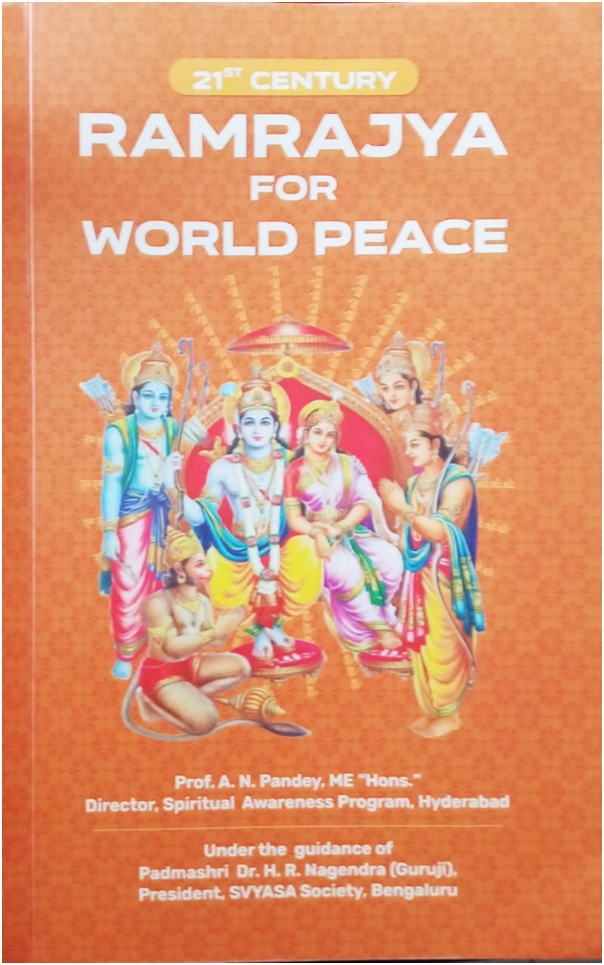
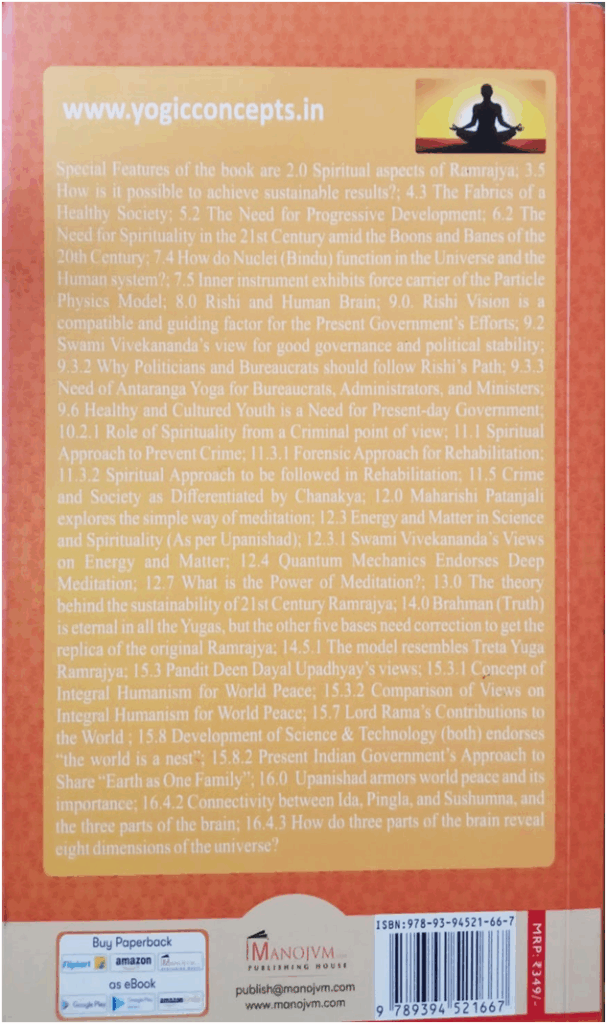
21st Century Ramrajya
For
World Peace
Prof. A. N. Pandey,ME “Hons”,
Director, Spiritual Awareness Program (SAP),
Hyderabad
Under The Inspirational Guidance Of
Padmashri Dr. H. R. Nagendra (Guru Ji),
President, SVYASA Society, Bengaluru
Published by: Manojvm Publishing House, India
Website: www.manojvm.com
Email Address: manojvmind@gmail.com
ISBN:
Price: ₹
Author: Prof. A. N. Pandey
Publication Year: – April 2025
© All Rights including Copyrights reserved with the Author.
Acknowledgement: All the Information and Images taken from internet are duly acknowledged with thanks.
All rights reserved. No part of this book may be reproduced or utilised in any form or by any electronic, mechanical or means, now known or hereafter invented, including photocopying and recording, or in any information storage and retrieval system without permission in writing from the publisher or author.
From the Author’s Desk
21st Century Ramrajya is needed to overcome the preset day crises of the People & Environment and for World Peace. This is no longer an idea that simply lingers in my mind. It has been thought out and elaborated in sixteen chapters, and by God’s grace, the dream to have a book on “21st Century Ramrajya for World Peace” has been fulfilled by the help of friends and well-wishers.
What gave me the idea to write the book? What made me feel that this was the time for it to come out for others to pore on? Do I strongly feel that Ramrajya could see the light of the day? These were some of the posers put before me by my well-wishers who had their reasons for addressing such but it gave the confidence that when a Ram temple at Ayodhya saw the light of the day, a follow-up on the theme of Ramrajya could not be discarded, and using my views on the subject a few years earlier I decided it was a necessity if not for realization, at least to be put forth as a strong possibility that might later be taken up by a well-meaning individual or entity.
When Mananiya PM Modiji, in the birthday wishes for the past two to three years, casually inquired about me in his email, I took the courage to mention that I believed that if there was a time when Ramrajya had a chance to be realized, it should be now. This is because the present-day Government is working in tune with certain factors of the then (Treta Yuga) Ramrajya for the welfare and upliftment of the society.
The Government’s progressive views on Governance since 2014 when it first came to power and two successive mandates thereon, made it easier for me to expound my views on the subject in the form of this book which explores the possible views and solutions to the basis of inputs from various quarters of the general populace, such as the Government, Social reformers, the scientific community, traditional thought and spiritual wisdom. Further, it is my opinion, which may have other takers as well, that Spirituality has not been explored sufficiently by Society, and based on what it has to offer, it certainly could provide the solution to very many problems that occur in day-to-day life which if given thought could transform Society itself to a better state of living. Having this view in mind, the upanishadic principles have been added in this book to minimize or eliminate the War among countries based on the stipulated 21st Century Ramrajya.
Modern Science has come up with solutions to many problems in Society but has, over time found to be very limited in nature and extent. India has for centuries been the home to spiritual wisdom that the world is now looking up to, and this includes those in echelons of power within the country. In this connection, Swami Vivekananda had once suggested that it would be a good idea if the Best of Science and the Best of Spirituality could come together on a common platform, seeking solutions to complex problems that face the world. There is nothing that needs to be found wanting for lack of a solution. Swamij’s Visions have also been included.
21st Century Ramrajya embarks on this theme and while highlighting the ills in Society also offers solutions, which if given that extra push in the corridors of power, and lent the able support of agencies that matter at different strata of Society; could bring about this theme as a reality, maybe a little diluted, but achievable in a form that could augur well for World Peace.
About the Author
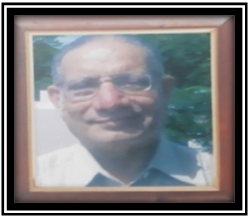
| Prof. A. N. Pandey, ME, “Hons” Director, Spiritual Awareness Program (SAP), Hyderabad, www.yogicconcepts.in |
Professor A N Pandey received a Master of Engineering Degree and a Diploma in Business Administration before joining the Bhabha Atomic Research Centre (BARC) in India. Despite his busy schedule, he managed to learn several meditation techniques (namely Simplified Kundalini Yoga, Vipassana, Omkar meditation, and Yogadha meditation) from competent Spiritual Masters during his service. After his tenure in the Management Cadre in BARC, he established the “Spiritual Awareness Program (SAP)” at Hyderabad, where he researched Yoga and its applications along with the revelation of the “Root” explained in Veda and Upanishads before “Bigbang” Concept of modern science. Professor Pandey has published numerous articles and 28 books, which can be found at www.yogicconcepts.in. His Hindi book “Hanuman Chalisa for Sab Keliye”, which is approximately 218 pages, is available for free download. He has also created many videos, including 16 playlists on his YouTube channel, which cover topics such as Meditation, Management, NuclearScience, Modern Science &Spirituality, Science &Religion, and Yoga. These videos can be found on the “Yogi Amrendra” YouTube channel. (https://www.youtube.com/@yogiamrendra3848).
About Dr. H R Nagendra (Guruji)
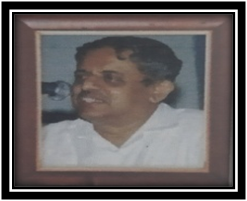
| Dr. H RNagendra, PhD President, SVYASASociety, Bengaluru, http://www.hrnagendra.in/ |
Dr. H.R. Nagendra received his Bachelor of Mechanical Engineering from Banglore University with a Ph.D. in Mechanical Engineering from the Indian Institute of Science (IISc), Banglore in 1968. Later, he served as a faculty of IISC in the Department of Mechanical Engineering. Served as a post-doctoral Research Fellow at the University of British Columbia, Canada in 1969. In 1970 he moved to NASA Marshall Space Flight Center, USA as a Post-doctoral Research Associate. In 1972 he moved to the Engineering Science Laboratory, Harvard University, USA as a Consultant and also a Visiting Staff at the Imperial College of Science and Technology, London.
He has published 30 research papers in engineering, 135 papers on yoga, and published 28 books on yoga. Dr. H.R. Nagendra has guided 32 PhD students. He is the recipient of many honors and awards including Padmashri from various national & international institutes and organizations. He is a mentor for many educational and other organizations.
Why One should Read this Book
By fulfilling the highest desire, people do not get satisfied unless they get peace of mind and bliss (Ananda) in the mental and intellectual domain. This indicates that Human Beings are in search of peace and bliss (Ananda). In day-to-day life, the scenario of peace can be explored by the ruling pattern of a society and country at large, and bliss can be obtained in the management scenario employed by the policy maker and ruler of the country.To obtain that, there should be a pattern of ruling; which could be like Ramrajya and the same is defined as “Ramrajya is the land of Dharma, poetically described as a realm of peace, harmony, and happiness for young and old, high and low, all creatures, and the earth itself, in recognition of a shared universal consciousness”.
The domain of bliss (Ananda) exists in the brain, where no cruelty exists. It is found by the Indian Rishis that the root of War exists in the middle petal of the Right Lobe. There, cruelty is the dominant factor in an individual. For this, the ruler of the country to be free from a cruel segment of the mind that exists in the middle petal of the right lobe. Cruelty of the right lobe can only be eliminated with the help of Yoga and meditation. When the ruler of the country and his associates are free from impurities of the right lobe, then the domain of bliss fulfills no conflict or war between people to people, and also among the societies & countries. For this, the Yoga Tattva Upanishad has been discussed for maintaining the long-term effect of “No War” in the World.
Spirituality is the backbone for any Government to obtain peace and bliss among the common citizens, including policymakers and bureaucrats. For this, the present-day Day Government uses “Reform, Perform and Transform concepts connected with Right Lobe, Middle Lobe and Left Lobe of Yogic Brain” for planning and organizing the welfare of the citizen. In addition, government policy matches with four segments of Evolved Brain (theme of Rishipath) to fulfill the aim and objective of the Government, which is “Sabka Saath, Sabka Vikas, Sabka Prayaas and Sabka Vishwas”. In this way, the Government is trying to evolve to have peace and bliss together among the citizens.
Lord Rama was known as Purushottama or “the Ideal One”, and his reign or “Ramrajya” symbolized the ultimate in governance; where the subjects of the kingdom experienced peace and prosperity in all quarters of Life. The King looked after their needs and necessities like a parent and the rule was akin to a “welfare state”. Ramrajya is the concept that was also a favorite theme of Mahatma Gandhi Ji, who envisaged such a rule after India gained Independence, but which never got a chance to materialize since.
The Present-day Government led by Honorable Prime Minister Narendra Modi Ji has set an example in this twenty-first century of Governance, in which the Progress of the Nation has been defined by the coinage “Sab ka Saath, Sab ka Vikas, Sab ka Vishwas, Sab ka Prayas”. This also echoes what Gandhiji harbored. The Government’s efforts since 2014 have been nothing short of trying to realize this. A Government can only do that much that is within its scope and ambit, and the PM and his dedicated Team have spared no effort, nor left any stone unturned, towards the realization of a 21st-century Ramrajya.
2047 is when India shall complete its 100 years of Independence. If the country is to realize its import, the environment of Ramrajya has to be well-advanced in its existence much before that. Progressive policies of the Government have gained the confidence of the people regarding its intent and the three successive mandates have given it momentum. It only needs the continual blessings of the people to give it sustained support to see its successful culmination.
Acknowledgment
I humbly offer my Pranam to all the Gurus, especially Dr. H R Nagendra Ji of SVYASA, Bengaluru for his blessings in completing this book. I am extremely grateful to my wife (Mrs. Sudha Pandey), sons, daughters-in-law, and grandsons who constantly encouraged and cooperated with me throughout the writing process of this book.
The book contains various expressions and anecdotes I collected from the internet and Satsang. I express my gratitude for their contributions. Shri Amit Kumar Choudhary Ji, Co-Founder, and Chief Technology Officer, of PRAGYATMIKA, the Power of Intelligence, helped me regularly to overcome complex problems on the Internet,& I am very thankful to him. Shri Tallapragada Madhusudhana Rao, a Research Associate of the Spiritual Awareness Program, Hyderabad, and a writer of articles related to spirituality, has edited this book spared some time for proofreading this book, and given helpful suggestions. I am deeply grateful to him for his valuable advice and contribution.
I am also thankful to Dr. Yogendra Pathak Viyogi; who happens to be my friend, philosopher, and guide. I am grateful to Shri. Lakshmi narayan Ji, mentor and author of many books on social reforms, has given valuable suggestions and he has shown his readiness to edit this book in its final form.
I express my gratitude to Mr. Akhil, who holds a B. Tech degree in Computer Science and Engineering, for his invaluable assistance in typing and editing the manuscript. I am also thankful to Shri. Pratap K.V. and Shri. Ravi Teja who have shown a keen interest in making this book in final form.
S. N. Subject or Chapter Page No.
a. From the Author’s Desk 3- 4
b. About the Author 5
c. About Dr. H. R. Nagendra (Guruji) 6
d Why One should Read this Book 7
e. Dedication to the Nation. 8
f. Acknowledgement 9
CHAP 1. INTRODUCTION 12-16
CHAP 2. RAMRAJYA IN TRETA YUGA 17-27
CHAP 3. MAJOR BOONS AND BANES THAT
EXIST BETWEEN TRETA YUGA
AND THE 20TH CENTURY 28-40
CHAP 4. VISION OF GANDHI JI
AFTER INDEPENDENT INDIA 41-52
CHAP 5. MAJOR DIFFICULTIES DURING
INDUSTRIAL DEVELOPMENT 53-63
CHAP 6. SPIRITUAL PRACTICE TO CREATE THE BEST POSSIBLE POLITICS FOR ENHANCING RAMRAJYA CONCEPT 64-77
CHAP 7. A COMMON PLATFORM NEEDED AS A JOINT VENTURE TO SOLVE THE WIZARD OF SCIENCE AND TO HAVE BETTER CLARITY IN THE SPIRITUAL FIELD 78-90
CHAP 8. RISHI PATANJALI’S VISION OF BRAIN (CHITTA) FOR POLITICIANS
AND BUREAUCRATS 91-106
CHAP 9. PRESENT-DAY GOVERNMENT’S EFFORTS BASED ON RISHI’S VISION 107-124
CHAP 10. APPROACH TO MANAGE CRIME BY DIFFERENT SEGMENTS OF SOCIETY 125-135
CHAP 11. REHABILITATION APPROACH FOR CRIMINALS 136-148
CHAP 12. RISHI PATANJALI EMPOWERS THE BRAIN FOR SCIENTISTS AND SPIRITUAL SEEKERS 149-165
CHAP 13. UTILITY OF YOGIC SCIENCE FOR 21ST-CENTURY RAMRAJYA TO SUSTAIN 166-174
CHAP 14 HOW CAN WE ACHIEVE RAMRAJYA IN THE 21ST CENTURY 175-189
CHAP 15. 21ST CENTURY RAMRAJYA IS NEEDED FOR WORLD PEACE 190-209
CHAP 16. WHAT UPANISHADS SAY ABOUT WORLD PEACE? 210- 223
BIBLIOGRAPHY 224
1. INTRODUCTION
The book “21st Century Ramrajya for World Peace” consists of 16 chapters, and it deals with many topics connected to relevant chapters sequentially.
The Ramrajya in Treta Yuga is followed by Major Boons and Banes which exists between Treta Yuga and the 20th century, visualizing the existing situation as of today. After Independence, Gandhiji dreamed of obtaining the Ramrajya scenario in the country. Still, there were many hurdles to be faced and the same could be handled with spiritual practice and also by utilizing the common platform. To overcome the hurdles, Rishi Patanjali’s Vision of Brain (Chitta) for Politicians and Bureaucrats has to be introduced in the present-day Government’s Efforts carried out in the country. Corruption &Crime are the main obstacle for any progressive country and the Government has to review how to manage crimes.
For the 21st-century establishment of Ramrajya, the spiritual seeker rather than the believer of religion is needed. For this, the method by which Rishi Patanjali empowers the Brain for Scientists and Spiritual Seekers has to be practiced; so that, the concepts expressed by Veda and Yoga can be adopted. The process to obtain Ramrajya in the 21st century is essential to establish Peace in the Country as well as in the World. The Chapter-wise details are as follows:-
Chapter 2 “Ramrajya in TretaYuga” describes topics like i) spiritual aspects of Ramrajya ii) the Basic foundation of Ram Rajya by Bhagavan Parashuram iii) How he had established the Dharma iv) The structure of the Treta Yuga Ramrajya and v) scenario of Ramrajya described in Ramayan. This chapter highlights the emergence of divine personalities like the four brothers (Lord Rama, Bharata, Lakshmana, and Shatrugna), Mother Janaki, and Shri Hanumanji from the six syllables of Omkara.
Topics connected with the Advantage of Gurukul education till its existence, the Effects of Modern Education on Society and on Human Personality, the emergence of Purusha (Soul) and Prakriti (Primordial Matter) from Akshar Padarth (Truth), the Buddha period (Golden Period) to establish connectivity between Veda, Upanishad and Bhagwad Geeta, the emergence of Modern Science, Boons & Banes of 20th century, and the effect of Banes associated with Boons of 20th century. How does Society become restless? How is it possible to achieve sustainable results with quality? As described in the 3rd chapter “Major Boons and Banes” existed between Treta Yuga and the 20th century. The comparison between Gurukul education and Modern Education has also been explored.
Descriptions of a) Vision of Mahatma Gandhi about Ramrajya b) What is Ramrajya? c) The Fabrics of a Healthy Society d) Society deterioration causing World problems e) Concept of developed countries in the 20th Century f) Practical approach by the Chinese g) Practical approach in the Japanese model h) Vibrant individual and Vibrant society i) Search for the new Holistic Model with Yogic Science (Maharishi Patanjali’s vision) j) Importance of Cultured Society for a Holistic Model &k) Why to integrate Ramrajya model with Yogic approach? have been explained in the 4th chapter “Vision of Gandhi Ji for Ramrajya after Independent India”& Dream India 2047 needs Ramrajya as the point of attraction in this Chapter.
Chapter 5 “Major Difficulties during Industrial Development” deals with Self–centered individuals with a possessive attitude as a cause of unhappiness, Mental Vishaad (Anguish) conditions of the Individual, Society, and Country, the Root of War in the Inner mind, and misuse of “fight or flight” mechanism by the Western world.
In connection with Chapter 6 “Spiritual practice to create the best possible Humanism”, topics such as i) Spirituality in politics ii) using a “Higher common ground” process for resolving conflicts and making policy iii) working to transform Consciousness is the main factor iv) Tattva Gyana is not a must for the Ramrajya model but essential for Spiritual Masters including v) synthesizing the spiritual aspects of both Hierarchy and Democracy have been dealt with.
Explanation of topics like a) Science and Spirituality b) the Need for Viveka Tattva (Third Eye) for Scientific Discovery c) Description of SETU (Sequential Entanglement between Truth and Universe) d) “Mundako Upanishad” exhibits the similarity between the Human System (Microcosm) and the Universe (Macrocosm) e) Similarity between Cosmic Neuronal Network along with Galaxy and Internal Neuronal Network of the Brain f) The emerging scenario of Truth (Effulgent Light) connecting different domains explores the Universality from its Individuality &g) The importance of the Mind or Manas (Right Lobe) in Student Life have all been covered in Chapter 7 “Common Platform needed as a joint venture between Science and Spirituality”.
In the context of Chapter 8 “Rishi Patanjali’s Vision of Brain (Chitta) for Politicians and Bureaucrats”, topics like i) Rishi and the Human Brain ii) Patanjali Yoga Sutra views Chitta (Mind Stuff) as Brain iii) How Chitta is formed iv) Role of Purusha and Prakriti in Chitta v) Different states of Chitta after Karma Phala along with vi) How Mind Modification (Vritti) Comes in Chitta (Brain) and vii) The Chitta is the major part of the brain as the storage house for Action (Karma) has been described.
Rishi’s Vision as a compatible and guiding factor for the Present-day Government’s Efforts, Swami Vivekananda’s views on Good Governance and Political Stability, Healthy and Cultured Youth; which is a need for the present-day Government, Yogic Test (On the three Lobes) for the involved Ministry and Bureaucrats along with Domain of Political justice with Spiritual Approach has been explained in 9th chapter “Present-day Government’s Efforts Based on Rishi’s Vision”.
Chapter 10 “Approach to Manage Crime by Different Segments of Society” deals with a) Criminality in Society b) Anti-Social elements and Criminals c) how the Young become Criminals, d) how Spiritually evolved people should tackle criminal situations e)Social Disparity Leads To Criminal Growth &f) Types of criminals as per spiritual approach for the Government in connection with smooth functioning.
The points such as i) Spiritual Approach for Preventing Crime and ii) How does Spiritual Culture help to change Duty Consciousness? iii) Importance of Rehabilitation iv) Forensic approach for Rehabilitation v) Spiritual approach to be followed in Rehabilitation vi) Crime and Society as differentiated by Chanakya vii) Vedantic approach for Rehabilitation of Criminals and viii) Government & NGO approaches for Rehabilitation have been described in Chapter 11 “Rehabilitation Approach for Criminals”.
Chapter 12 “Rishi Patanjali Empowers the Brain for Scientists and Spiritual Seekers”; describes points like the Utility of Breath with the Help of Left and Right Nostrils,Maharishi Patanjali explores the simple way of Meditation, Cultural Environment enhances the result in the field of Neurology and Meditation,& What is the Power of Meditation? In addition, it talks about how Energy and Matter in Science and Spirituality (As per Upanishad and Quantum Mechanics) endorse Deep Meditation.
In context, Topics like i) Spiritual Culture in Sustainable Development ii) Integration of Ramrajya with Yogic Model &iii) Touchstone for a Healthy and Cultured Society are dealt with in chapter 13 “Utility of Yogic Science for 21st-Century Ramrajya to Sustain”
Regarding Chapter 14 “How to achieve Ramrajya in the 21st century?” the subject matter such as a) Possibility of achieving Ramrajya in the 21st century b) AIW (Ancient Indian Wisdom) in respect of Civilization & Cultural Wisdom c)Why is Integration necessary? d) Economic Development with Special Reference to hosHumanism e) How Yogic approach strengthen the base of Holistic Economic Development? f) Search for a New Holistic Model g) The Model resembles Treta Yuga Ramrajya and h) Why integrate the Ramrajya Model with the Yogic approach? have been explained.
Topics such as i) What is the Call of the World? ii) What is the scenario existing in the present period? iii) Present-day Status in India iv) Pandit Deen Dayal Upadhyay’s views v) Comparison of views on Integral Humanism for World Peace vi) Basic Foundation of Ram Rajya by Lord Rama vii) Modern Concept of Ramrajya viii) The basic elements of Ramrajya ix) Healthy society fulfills the vision of the Vedic Mantra x)Lord Rama’s Contributions to the World xi) A vision like “Earth is One Family” could not be achieved and xii) Present-day Indian Government’s Approach to share “Earth as One Family” have been described in the chapter 15 “21st Century Ramrajya is needed for World Peace”.Next Chapter, Indian Rishi’s Vision expressed in the Upanishads is explored to maintain the world peace for longer time.
2. RAMRAJYA IN TRETA YUGA
Most Indians are familiar with Ramrajya from Ramayana; where Life was perfect in all ways possible and evoked the feeling all around that they could not wish for anything better than this. Prince Rama, the son of King Dashrath, ruled the kingdom of Ayodhya after his 14-year exile. His benevolent reign of many years brought such peace and prosperity to the kingdom that it idealized the concept of a “welfare state” where the King was seen as a guardian, the state’s citizens across all walks of life lived peacefully, and ‘want’ was unheard of. This is because the just ruler saw to it that people’s basic needs were sufficiently provided to meet their requirements of justice or whatever else contributed to a life of peace and harmony.
Ramrajya was ruled by Sri Rama but the actual foundation of the same was paved by Bhagwan Parashurama who is the sixth Avatar (Incarnation) of Sanatan Dharma. He established Dharma (Righteousness) which in turn, was the favorable condition for the establishment of a popular kingdom, later known as Ramrajya. The prevailing condition of Ramrajya got lost due to many hidden factors. Present day, there is a dilemma whether Ramrajya could be re-established. To understand the favorable conditions of Ramrajya, the present-day scenario has to be reviewed.
2.0 Spiritual aspects of Ramrajya
“Ram Uttar Tapanya Upanishad” provides the structure of Ramrajya. “Ram Uttara Tapanya Upanishad” is the “Vishnu” Upanishad; which is a part of Atharva Veda. Upanishad explains “Om” as Brahm; by realizing the same (Om), one can get Salvation. In the list of 108 Upanishads, “Ram Uttar Tapanya Upanishad” and “Ram Purva Tapanya Upanishad” have been clubbed and called “Ram TapanyaUpanishad”; which occupies the 55th serial number in the list of 108 Upanishads. In this Upanishad, there is a conversation between Brihaspati and Yagyavalkya (a Spiritual Master). The Upanishad states that the sound of “Om” should be chanted; this is because the “Om” sound symbolizes Brahm (Truth). The same (Om) is “a combination of “Sat, Chit, and Anand” and the sound of Om should be remembered as Brahm. This Upanishad also illustrates the relation of the six syllables of Om with the six Devas of the Ramrajya scenario.
In connection with Akshar Om, there was a conversation between Rishi Bharadwaj and Rishi Yagyavalkya. Rishi Yagyavalkya explained that Akshar Om should be taken as Brahm (a combination of “Sat, Chitt, and Anand”).
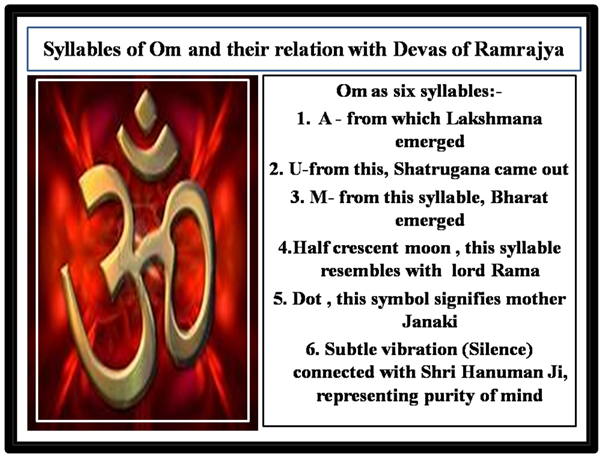
In this, A (अ) is the first syllable, Au is the second syllable, and M is the third syllable, the crescent moon is the fourth syllable, the dot on the crescent moon is the fifth syllable and silence above dot (resonance) is the sixth syllable. Yagyavalkya further explained what is the relation between the Six syllables of Om with Lord Rama, Bharata, Lakshmana, Shatrughana, Mother Janaki, and Shri Hanumanji; who (a combination of all six) represented the Divine Identity in the rule of Ramrajya in Treta Yuga.
Om is Brahman and its 6 syllables are also referred to as the Base (Foundation) for the Universe; these are explored in the eighth chapter of Bhagwad Gita (in the beginning verses) and they are i) what is Brahm ii) what is Karma iii) what is Adhyatam iv) about Physical Domain (Bhoutik Loka) v) about Subtle Domain (Daivik Loka) and vi) what is Aadi Yagna. Lord Krishna answers the queries of Arjuna to indicate that the Lord Himself is Brahm and the Foundation (Base) of the Universe; and on which, the whole Universe exists. Similar is the case with the Human Body and Brain as human beings are the replica of the universe. This indicates that the foundation of the Universe and the foundation of the Ramrajya both emerged from Brahm (Om). Because of this, the age of the universe is supposed to be many hundred billion years.
“Ram Uttar Tapanya Upanishad” clarifies the divine personalities functioning in Ramrajya, are the emergence of the Brahm (Om). Based on the divine personalities, the life of Ramrajya lasted many hundred thousand years.
This indicates that if the government of any country has ministers and bureaucrats who satisfy the divine qualities to some extent; then, the government will produce a result connected with the overall development of the country on par with the Ramrajya model. It is worthwhile to note that the Lawmakers (Ministers) and Law executors (Bureaucrats) are evolved persons; they will be surely very truthful to the poorest of the poor and richest of the rich living in the country. That is why, Spirituality the knowledge of the inculcation of the same (Spirituality) should be an added virtue for Politicians and Bureaucrats.
2.1 Basic Footing of Ramrajya by Bhagwan Parashurama
Bhagwan Parashurama being the sixth incarnation of Vishnu, did the spade work for Ramarajya by cleansing the Adharma (Unrighteousness) of all wicked kings, who did injustice to the people of the kingdom, especially to the general people. He (Bhagwan Parashurama) is generally presented as the fifth son of Renuka and Rishi (seer) Jamdagni. Like other incarnations of Vishnu, he was foretold to appear at a time when overwhelming evil prevailed on Earth.
The legends of Parashurama appear in many Hindu texts, in different versions: In Chapter 3.33 of the Mahabharata, in Chapter 6 of the Devi Bhagavata Purana, Chapter 4 of the Vishnu Purana, Chapter 2 of the Vayu Purana, Ramrajya has been defined in every Ramayana and the most prominent are Valmiki Ramayan, &Tulsikrit Ramayan. According to the definition given in Ramayana, King Rama’s reign is known as the Ramrajya which lasted for about 11,000 years or more.
During this period, people were happy, healthy, holy, satisfied, and lived in complete peace and harmony. There was no evil, no wars, no natural calamity, and no diseases. Lord Rama ruled the whole earth without using military force as all kings submitted themselves to him. Rama acquired a rare gem from Rishi Agastya which entombed the powers of the Gods, Indra, Varuna, Yama, and Kubera, which helped the king to rule efficiently.
2.1.1 How did he establish the Dharma?
He (Bhagwan Parashurama) incarnated to establish the balance (Dharma) between Ahimsa (Non-violence) and Violence (Himsa), Asura and Sura, and the growth of Purushartha (Kama, Artha, Dharma, Moksha are assets) among the common people. Being the son of a Brahmin Rishi, he possessed the true nature of a Brahmin endorsing the complete sense of forgiveness (Kshma) but at the same time, he saw the Adharma (Unrighteous Action) of the kings around the world. This forced him to change his nature from forgiveness (Kshma) to becoming aggressive for the establishment of Dharma in the world. Because of this, Parashurama carries to a mythic extreme an enduring Brahmin conflict; on the one hand, restraint, purity, non-violence, and detachment; on the other hand, along with inherent power and the recurring temptation to use it in the violent pursuit of an uncompromising vision.
Brahmrishi Samaj of present-day India worships Him (Bhagwan Parashurama) for establishing the true Dharma in individuals, in Society, and also in the country for exploring the richness of Life and World Peace.
2.2 The Structure of Original Ram Rajya
Original Ramrajya was based on the Cultural, Educational, Economic & Environmental development of Kishkindha (Environment and Culture for Heritage) and Lanka (Economy and Education). The Kishkindha kingdom was rich in Environment and Culture or Heritage. Likewise, Lanka was prospering in Economy and Education.
These factors (Environment, Economy, Education, and Culture or Heritage) are the Basic Fabrics of a Healthy Society. Lord Rama has strengthened these factors taking the model of Kishkindha and Lanka.
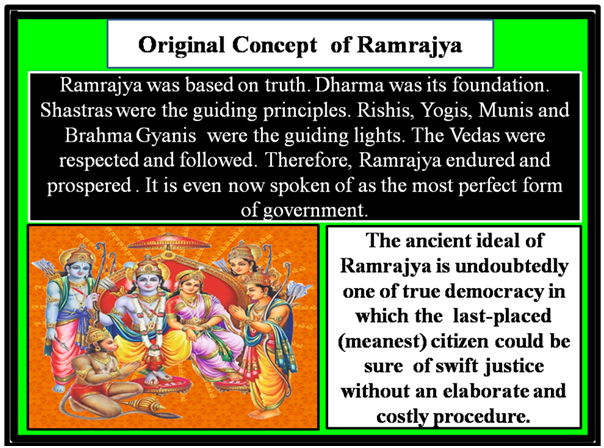
The Healthy Fabrics of Society consisting of factors like Environment and Culture or Heritage were taken from the Kishkindha kingdom. Likewise, the Economy and Education (High Technology) were taken from the Lanka kingdom. Keeping these factors in proper development, Ramrajya in Ayodhya (capital of Rama) was established. The image describes the original concept of Ramrajya in brief.
Original Ramrajya was based on truth. Dharma was its foundation. Shastras were the guiding principles. Rishi, Yogi, Muni, and Brahma Gyani were the guiding lights. The Vedas were respected and followed. Therefore, Ramrajya endured and prospered. It (Ramrajya) is even now spoken of as the most perfect form of government. The ancient ideal of Ramrajya is undoubtedly one of true democracy in which the last-placed (meanest) citizen could be sure of rapid justice without an elaborate and costly procedure.
Ramrajya was ruled by Sri Rama but the actual foundation of the same was paved by Bhagavan Parashurama who is the sixth Avatar (Incarnation) of Sanatan Dharma. He established Dharma (righteousness) which in turn, was the favorable condition for the establishment of a popular kingdom, later known as a Ramrajya. The prevailing condition of Ramrajya got lost due to many hidden factors. Present day there is a dilemma whether Ramrajya could be re-established. To understand the favorable conditions of Ramrajya, the present-day scenario has to be reviewed.
The call of the world needs “Sustainable peace” in all rounds, especially in the scenario of “Networking” & “Trafficking”. These (Networking & Trafficking) are the parts of Energy & Space. This means that the Energy & Space of Individuals, Society, Country & the World are to be well balanced to meet the smooth function of the computed universe including worldwide human transactions.
To achieve the best possible result of Ramrajya in the Modern Era, the Axe & Love (used by Bhagwan Parashurama) are the two means to establish Dharma (Righteousness) among bad & good, cruel & peace-loving, and anti-social & law-abiding elements. This principle will minimize the discrepancy among environment, economy, education & heritage factors prevailing in different parts of the world.
Does the structure discuss the subject like a) What is the scenario existing in the Present Moment b) Basic Foundation of Ramrajya by Bhagwan Parashurama c) What is Ramrajya? d) The Structure of Original Ramrajya e) Concept & Relevance of Ramrajya in Independent India f) Vision of Mahatma Gandhi about Ramrajya g) The basic elements of Ramrajya h) Vibrant Individual and Vibrant Society i) The Fabrics of Healthy Society j) Present day Status k) Dream India 2047 needs Ramrajya l) Modern Concept of Ramrajya m) Least disparity in society encourages achieving Ramrajya model & n) Why to integrate Ramrajya model with Yogic approach?
The probable structure consists of i) the Basic Foundation of Ramrajya by Bhagwan Parashurama ii) the Original Concept of Ramrajya iii) the Key Features of Ramrajya iv) Fabrics of a Healthy Society v) What is the need for Ramrajya vi) Balanced Society vii) Improvement of Quotient against Corruption and Unrighteousness images; which explain the contents in brief.
2.3 Scenario of Ramrajya described in Ramayana
Sri Tulsidasji has written Ramayan in the Avadhi Language; which can easily be followed by Hindi-speaking people. There is Valmiki Ramayan in Sanskrit and there too the scenario of Ramrajya is described in Sanskrit. In Uttar Kaand of Tulsikrit Ramayan, a scenario of Ramrajya is described and the brief of the same is shown below.
The verse described in poetic language clarifies that no one was suffering from physical illness (DaihikTaap), there was no agony of global warming or harsh changing environment (Daivik Taap) and no one was having anguish from flood and drought (Bhoutik Taap). The language describes that the people living in Ramrajya were free from all kinds of Taap (Pain, Agony, and Anguish). The men and women in Ramrajya have unconditional love (Preeti) among themselves and they follow the Swadharma by listening to the scriptures connected with true living patterns based on Nature’s law and followed them.
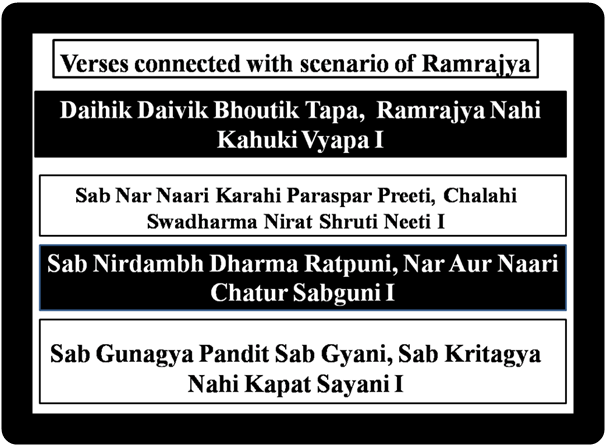
The Swadharma is not based on any cult following; but to follow whatever dimension, one possesses. This indicates that people have three main Nadis i) Ida (connected with Right lobe) ii) Pingla (connected with Left lobe) and iii) Sushumna Nadi (connected with spinal cord). They are responsible for generating Energy, Space, and Consciousness; by proper combination of them, Nature’s law can be truly followed. This clarifies the meaning of Swadharma.
During the rule of Lord Rama, all were egoless (Nirdambh) or had the bare minimum ego in day-to-day dealing with people, objects, places, and situations. In that way, they were following true Dharma and yielding Punya Karma. In this connection, it is to be noted that the followers of True Dharma will be ego-less, otherwise, they will indulge in Adharma Karma (Unrighteous Action). The sufficient doer of Adharma Karma will yield the fruits (Karma Phala); which will be the measure for deciding the species (categories) for the next birth. But followers of Dharma Karma (Righteous Action) will enjoy a great deal of Karma Phala in terms of a prosperous life (Bhoga for enjoyment). This indicates that in the Ramrajya scenario, the people were more prosperous as they were true Dharmik (egoless) or carrying the bare minimum ego. In that process (doing Dharmik), the men and women of the Ramrajya period were good decision-makers (Chatur) and processors of wisdom and knowledge. Here Chatur does not mean clever people or having cut-throat competition among each other.
During the same (Ramrajya) scenario, everyone had scientific as well as spiritual knowledge (Sarv Gunagya), and they were scholars in their respective fields to exchange knowledge among themselves. That indicates that they were following the concept of the Yajur Veda verse.
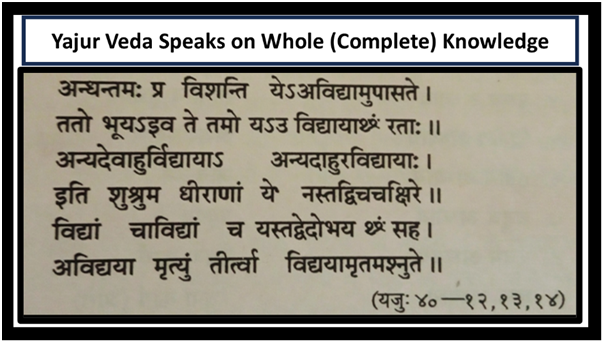
Here Yajur Veda states that people having only Vigyana (Spiritual Knowledge) but not having Gyana (Worldly Knowledge) including Scientific Knowledge, are supposed to be the possessors of half the knowledge. The vice versa is also true. In other words, if someone has only worldly expertise and scientific knowledge; but does not have spiritual knowledge; they are also the possessor of half the knowledge.
But in the scenario of Ramrajya, it seems that the people had both kinds of knowledge (Spiritual Knowledge as well as Scientific and Worldly Knowledge); hence they were called Sab Gunagya Pandit. In the same reign (Ramrajya), the people had a sense of gratitude for each other (Kritagya) and they were not clever enough to cheat others. This indicates that they were very simple and lawful behavior; so that, they were processors of IQ (Intelligence Quotient), EQ (Emotional Quotient), and SQ (Spiritual Quotient).
The above analysis indicates that it is difficult to achieve all the positive facts described above during the Ramrajya period of Treta Yuga. However, the background of the development of Modern Science and Technology can be clubbed with spiritual and yogic concepts to evolve the modern kind of Ramrajya scenario; so that, World Peace can be achieved among the followers of Ramrajya.
In conclusion, Treta Yuga Ramrajya blossomed because of the emergence from “Omkar” with Six Syllables; which is the base for Truth or Parambrahm. King Rama & his three brothers with Janaki (As Avyakta Prakriti) along with Shri Hanuman Ji; were all divine personalities who could effectively manage the Ramrajya; where pleasant atmosphere and situations among the people of the Kingdom existed. The kingdom had total knowledge of Veda comprising eternal knowledge (Spiritual Knowledge) and Changeable knowledge (biological knowledge); fulfilling the slogan of Yajurveda.
3. MAJOR BOONS AND BANES THAT EXIST BETWEEN TRETA YUGA AND THE 20th CENTURY
This chapter takes us to the present-day situation that starts with the comparison of the traditional Gurukul system with that of the Modern Education System which is considered as the beginning of the 20th Century but had its roots in the 17th century itself. It is a simple commentary on how education changed from what existed just beyond the Treta Yuga to when Education with Science as its base underwent a drastic change both in terms of what was imparted in the classroom as well as what changed in the Systems &values of Society came about.
3.0 Comparison between Modern Education and Gurukul Education
In the olden days, Gurukul Education was the most important education before going to the professional kind of education. In Gurukul Education, skills like horse riding, archery, wrestling, hunting, spiritual education, and ayurveda used to be taught. Because of the Gurukul education as a base, the life journey in any profession was enjoyable. In the present day, professional education of ancient times took the shape of modern education except for the spiritual education of Gurukul time. Because of this (absence of spirituality), Modern Education is in a fragile condition. It is observed that Society in Modern Education has shrunk to a nuclear family and selfishness-oriented development without caring for their fellow beings of society.
The core of Gurukul education is completely absent in modern education. This creates a weak base for modern education during its sustenance for a long time. The effect of not having Gurukul Education is visible among people in the society as they exhibit unhealthy signals like i) fear of losing health, wealth, position, name, and fame ii) having anxiety for no valid situation iii) frequently losing temper for least possible reasons and iv) slowly getting in the grief of depression because of loneliness in the society. Depression or isolation is especially observed among affluent people; however, other levels of people in society are also likely to become the prey of depression. Nowadays, Professional Education like Engineering, Medicine, Management, IT (Information Technology), Computer, Journalism, Commerce, Accounting, Architecture, Aviation, etc are the aims of the youth without having the benefits of Gurukul Education.
Because of this; the youth and the politicians are deprived of a strong base of honesty, integrity, transparency, and accountability. They become desirous of petty things and also inculcate a deep sense of greed in their personality. The thinkers of the 19th Century used to feel that as soon as modern Education had a good grip on society, illness (bad physical health), poverty, and mismatch in education would be minimized or eliminated. The thinkers were also confident in getting rid of anti-social elements and criminal activity from society. The experience shows that Modern Education has a good grip on the Western world, but still, they are facing all kinds of problems related to the downfall of society. In addition, the people are more restless and they are in the grip of a rat race.
3.1 Advantage of Gurukul Education till its existence
In the older period, Gurukul education was the platform to reinforce the youth’s allround personality with the wisdom of needed dharma for life as well as the methodology to clean the “Klesh Vikar” (Deep Conflicting duality) for smooth sailing in family life. That way Gurukul Education is used to provide the essential factors needed for a healthy youth hood round personality keeping celibacy (Brahmacharya) in the center.
Fortunately, the Missing Link of Gurukul Education can be compensated with Yogic Education. The Yogic Education described in the applied Patanjali Yoga Sutra provides the means to compensate for the missing fabrics of Gurukul Education by removing the Mind – Stuff (Vritti) from the Human Chitta consisting of the Inner Hemisphere of the Brain (Right Lobe, Left Lobe, and Middle Lobe).
3.2 The Impact of Modern Education on Society
Modern Education yields a high intelligent quotient (IQ) compared to the emotional quotient (EQ); which (EQ) was the prime object of Gurukul Education. During Gurukul Education, all three quotients IQ (Intelligent Quotient), EQ (Emotional Quotient), and SQ (Spiritual Quotient) used to be developed profoundly without any stress for particular development of the quotient. There was overall personality growth in Gurkul education. After Gurukul Education, the hood of a specific profession namely wrestling, Horse Riding, archery, Craftsman Ship, etc., was given to earn the bread and butter amid complete personality development.
The society overall felt to adopt modern education; this is because they (people of the society) wanted to harness the IQ to the maximum possible extent; so that, they can go deeper in higher education to earn maximum money. The disadvantages of high IQ are well known in society; which in turn affects the physical and mental strength of the highly developed intelligence quotient of the Person.
Modern Education is very useful for society. That is why, we think that our children must get a higher level of modern education; so that, they will be more creative and productive for society. This also shows that a higher educated person consists of higher intelligence and their personal life seems to be prosperous. But in a larger period, a higher educated mass was found to be unrest and unproductive.
Normally, highly educated people possess all the comforts of life, having more than adequate bank balance, but they are also restless and internally disturbed. They do not possess sound physical health and they also suffer from insomnia. They do not move in the righteous direction against any critical problem; though, piles of information are available on the website. In turn, the individual, family and society are dragged to follow the rat race situation because of Modern Education. They (the educated mass) lag in taking strong resolution. However, the great gap between the two (IQ and EQ) can be narrowed down with the help of Vedic education and also with the help of reciting Scripture in a Yogic Way.
3.2.1 The Effect of Modern Education on Human Personality
The experience indicates that there will be different effects of Modern Education on the personality of a human being. Modern Education develops the Left Lobe of the Brain without providing much attention to the Right Lobe (Hemisphere). Because of this, there will be a mismatch between the two Lobes. Thus, Modern Education increases the IQ (Intelligence Quotient) of the Brain; but, EQ (Emotional Quotient) is left unattended. The Right Hemisphere can be improved by developing a Manas (Mind) segment of the Inner Instrument (Antah Karna). The development of the Right Lobe or Hemisphere can also be achieved with the concentration and contemplation of the mind; which is normally achieved in “Antaranga Yoga” (Inner Yoga). The simple way to achieve EQ (improvement of the Right Lobe) could be achieved with the help of reciting Scripture in a yogic way.
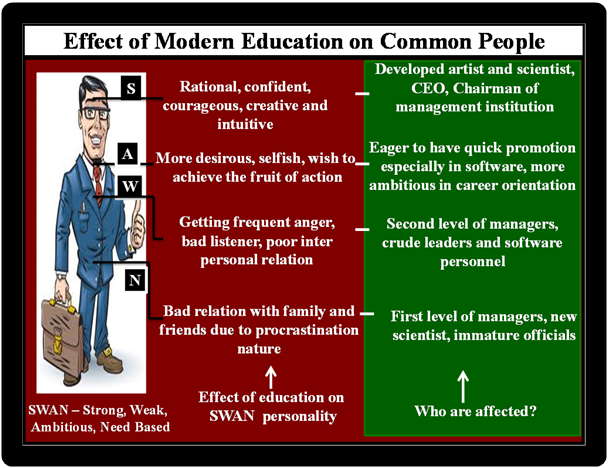
The absence of EQ or even the lower index of EQ ensures the poor behavioral pattern of the brain. This (underdeveloped Right Lobe) creates weak minds, and the same disturbs the stable thinking process. This kind of situation does not provide a creative approach for the young politician. The experience explores that if modern education is integrated with spirituality Gurukul Education or Yogic Education, the gap between IQ and EQ can be narrowed down. In this connection, modern education tries to develop the overall personality of an individual. Personality development is based on four dimensions namely i) Need-based requirement ii) Strong self-desire iii) Index of Resolution (Sankalpa) and iv) Willpower. The four bases of personality are affected by Modern Education. The effect of Modern Education has been observed on the Youth, Politicians, Managers, and Technologists. This does not mean that Modern Education is harmful to the society. To get back the benefits of Vedic education, the mismatch between two Lobes (IQ and EQ) has to be explored.
Let us try to understand Modern Education from a Psychologist’s point of view. In Psychology, it is shown that there is a deep interdependency among the conscious, sub-conscious, and unconscious states of mind. The Psychologist has exhibited that unless an unconscious state of mind is kept pure, the proper use of conscious and sub-conscious states of mind cannot be obtained. Therefore, young politicians should adopt the process of Purification for each layer of the mind; so that, the maximum efficiency of each layer of the mind (especially the sub-conscious and conscious mind) can be utilized.
3.3 Emergence of Modern Science
There is a wide history for modern history, but the same can be briefed as i) Newtonian Physics in the 17th century ii) classical physics including the theory of relativity, and iii) Quantum Physics. Both (Classical Physics and Quantum Physics) were established in the 20th Century, the 20th Century is called the era of Modern Science.
Many scientific achievements were established and their utilities are explored in the field of Nuclear Science and Engineering for peaceful purposes as well as for destructive purposes. In addition, scientific achievements are used widely in Information and Communication Technology and also in Supercomputers. However, there seem to be many
Boons of scientific achievements on the surface. However, they (Boons) are also associated with Banes; which are yet to be managed.
3.3.1 Boons & Banes of 20th Century
The 20th century was the era of Science and Technology. Many scientific theories and technological developments have been witnessed during this century. While inventing the scientific concept, scientists view certain aspects of the disadvantages associated with each development. However, they could not analyze in depth the probable effects on society and also on individual health growth & development. The associated advantage of each discovery turned into a Boon for society; no doubt as it provides more comfort and an easy way of leading life.
3.3.2 The Effect of Banes associated with Boons of the 20th Century & their solutions
Since creation started, any research provides two dimensions of the investigation; they are Boon and Bane. For instance, Ancient Indian Wisdom (AIW) scripture reveals that when there was research on the Sea (Samudra Manthan) by then researchers (Deva & Asura), the Amrit (Boon) and Poison (Bane), both came out. At that time, the researcher found the solution of Bane (Poison) as the poison was taken care of by Lord Siva. In the 20th Century, the associated Bane of each Boon was not thought over then and there effectively; because of that, the world is facing many problems.
As human beings started enjoying Boons of the scientific and technological development of the 20th Century; disadvantages associated with Boons were surfaced in day-to-day life. Some of the disadvantages (Banes) have been visualized and briefed in an image given below:
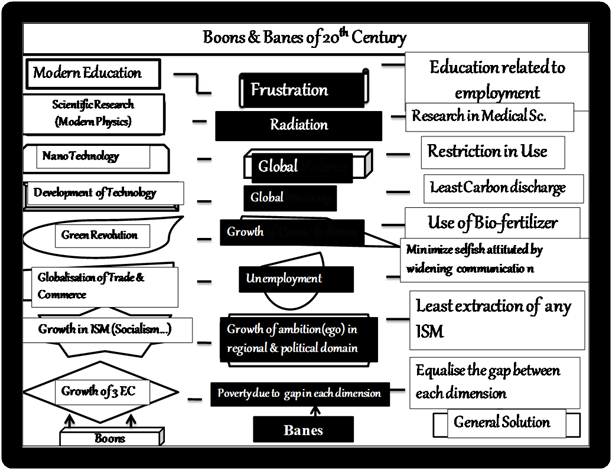
The image shows the Boons and Banes of the 20th Century in brief. For example, Modern Education, Scientific discovery (Modern Physics), Nano Technology, Technological development, Green revolution, Globalization of Trade & Commerce, Growth in “ISM” (Socialism, Communism…..), Development of Society needs like Environment, Economy, Education & Culture are the Boons for Human Civilization. The associated Banes are Frustration, Radiation, Global violence, Global warming, Growth of Cancer, HIV & diseases, Unemployment, Growth of Ambition (Ego) in regional & political domains, and Growth of Poverty because of a big gap in each domain.
The political and specialized thinkers in each field of the Bane are trying to find the respective solutions that seem to have the least possible base. The 21st Century is the era of Yogic evolution. Though Yoga is a very ancient science (revealed during Creation), the same was not unearthed in between. In this century Yoga is a solution for almost all major parts of the Banes. The image, in brief, describes the solution associated with each Bane with the help of Yoga, so that, the utility of Boons could be enjoyed without getting trapped by the effect of Bane.
Viewing the benefits of the Boons, Banes cannot be ignored. By adopting Ashtanga Yoga, the effect of the Bane could be minimized. In brief, modern scientific and technological development could be more useful by adopting Yogic means for overcoming the Banes.
3.3.3 Banes affect the social and institutional patterns
The disproportionate way of development among these four factors (Environment, Economy, Education & Culture) will also affect the institutional organizations.
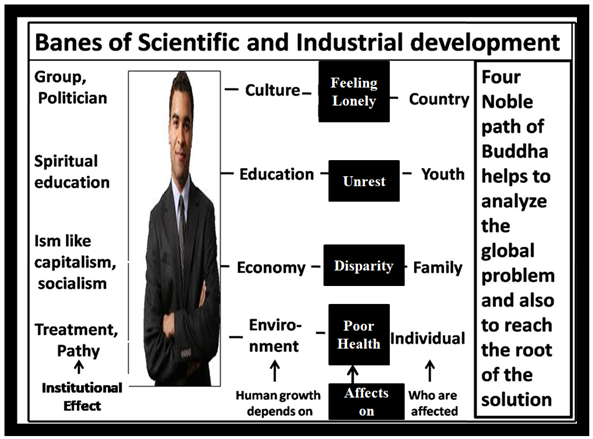
Factors like medical field (because of the eruption of many diseases) and do not uphold the economic development theory in the true sense. There is a deterioration in the growth of financial distribution. Also, modern educational institutions have resulted in imbalanced growth in people’s minds as the same lags in certain inherent factors.
The group of people working as Politicians & Industrialists (people responsible for framing economic rules & regulations) will feel lonely by losing cultural heritage aspects of Society. In brief, the effect of conflict due to the un-proportionate development of four dimensions will influence Individuals, Families, Youth & Senior citizens of society.
3.4 How does Society become restless?
Individual human beings are the fabric of family & society. If the fabric is faulty, the Society becomes weak and in the long run, it will reflect on the basic structure of a country. The scientific and industrial development of the 20th Century provides a bad impact (Bane) related to each Boon. The Bane affects the individual directly or indirectly unless the same is taken care of by any other means. As there are no sustainable solutions to the Banes associated with Boons, the individual, in turn, Society, and the overall country, reflect the impact of the Banes in different forms.
The figure shows the impact on 3H (Head, Heart & Hands) of an individual getting associated with Idleness, Rejection, and Frustration at the respective level because of many means to spend an easy way of life. The impact of Bane reflects failure, rejection & disillusion while leading life. In turn, society imitates unrest in many dimensions and increases looting, idleness, shooting & snatching because of Unhealthy Fabrics (Mass) of the same.
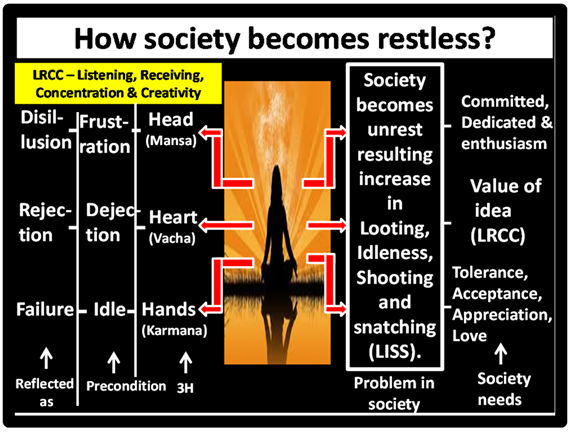
Society needs a fabric containing commitment, dedication, and an enthusiastic approach along with the value of peaceful means of listening to receptive, concentrative, and creative ideas. In addition, important factors like Tolerance, Acceptance, Appreciation, and unconditional love also evolve in an individual so that the fabric of Society will be strengthened.
3.5 How is it possible to achieve sustainable results?
Any research that has yielded Boons and Banes; from there, Boons are utilized, but the Banes are not given much thought. However, they (Banes) could at least be tackled if not utilized. For this, Yoga is one of the solutions to manage the Banes. For instance, the research has been extended and found quite satisfactory to manage the Post Nuclear Leakage Crisis (PNLC).
Modern thinkers have the view to achieve good results on the Banes of scientific and industrial development by acquiring external knowledge. For instance, human beings can acquire rational, emotional, intellectual & intuitive knowledge with the help of certain facts and figures.
The image shows that these types of knowledge are reflected in Society as “Building knowledge from the past” and people become self-praised (Miya Mitthu); “Wrapped with imagination and formation due to Mental activity (Mano Raaj)”; “Wrapped with a judgmental approach like firming certain ideology (Buddhi Vilas)”; and “Totality of situation” respectively.
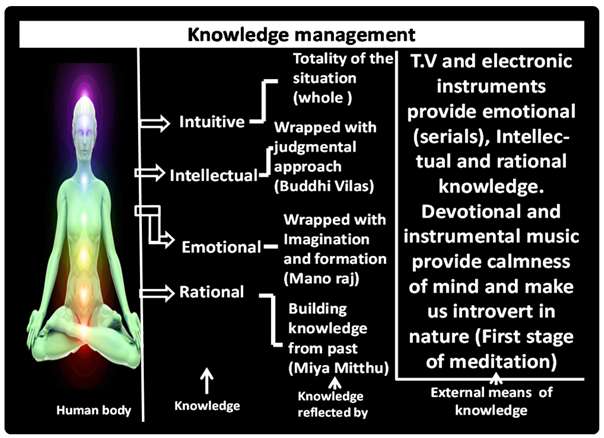
The external means of knowledge could be obtained from Modern Gadgets like the Internet, IPod, T.V., and Electronic Instruments. They provide rational, emotional, and intellectual knowledge. However, these gadgets cannot provide sustainable knowledge as they are extroverted. To have control over knowledge Management, the individual has to develop an introverted nature. This is possible to obtain the same, with the help of devotional and instrumental music (generates calmness of mind) and make an individual introvert. The introverted nature is supposed to be a stepping stage of meditation; which in the long run, will help to have proper knowledge management. This law of Nature has to be understood which needs the understanding of the combined role of Purusha and Prakriti.
3.6 Combined Role of Science and Spirituality for Effective Knowledge Management
Modern Science has yielded effectiveness in internet browsing; which in turn provides the facility of external library like cloud computing, Artificial Intelligence Management, and Utility of Animation etc., For external library, we have to use the inner strength (Energy) effectively without getting tiredness and boredom. This needs that there should be effective time management to harness the productive knowledge from Internet Browsing.
For effective Time Management, Spiritual Knowledge like devotional songs, instrumental music, and chanting of Mantras along with yogic practice will certainly help to overcome tiredness and boredom-like situations. In this connection, the Pranayama and Meditational aspects of Yoga will be very suitable to calm down the mind while internet browsing in larger dimensions. Whenever a mind is calm and peaceful, the effectiveness of time and mind management will be fruitful. This indicates that to achieve sustainability in knowledge management, we need to have both instruments like Scientific Gadgets (Internet Browsing) and Spiritual Means (Yoga and Meditation).
4. VISION OF GANDHI JI FOR RAMRAJYA AFTER INDEPENDENT INDIA
Gandhi Ji, the Father of the Nation also cherished a dream after achieving the Freedom from British Raj. This is because, he foresaw the disparity among the people of the society in an Independent India, and he wanted to free the shackles of bondage that were created under British Rule, so that, the golden days along with peace and harmony could be achieved. Bapuji dreamt about this in the very same land, during King Rama’s rule in the Treta Yuga.
4.0 Vision of Mahatma Gandhi about Ramrajya
Ram, Allah, and God were convertible terms to Mahatma Gandhi, and his concept of Ramrajya represented not Hindu rule but principled rule. Gandhi Ji meant Ramrajya as Divine Raj, the Kingdom of God. He stated that Ramrajya of my dream ensures equal rights alike of prince and pauper. Bapu has visualized that Ramrajya is a system where the society is run by the principles of Lord Rama.
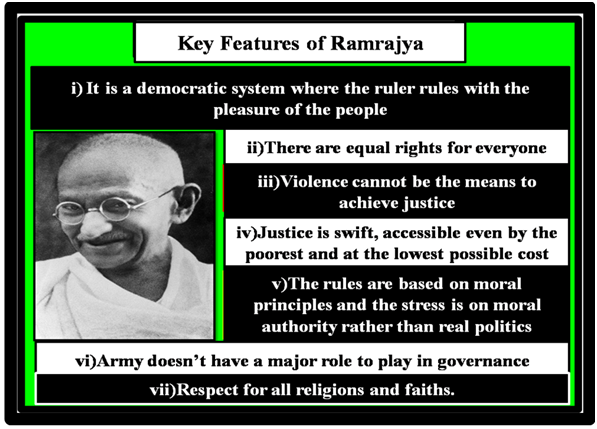
Mahatma Gandhi talks about some of the key features of this Ram Rajya: They are i) It is a democratic system where the ruler rules with the pleasure of people ii) There are equal rights for everyone iii) Violence cannot be the means to achieve justice iv) The justice is swift, accessible even by the poorest and at the lowest possible cost v) The rules are based on moral principles and the stress is on moral authority rather than real politics vi) Government should uphold truth in its actions and also expect the same from others vii) Army doesn’t have a major role to play in governance & viii) Respect for all religions and faiths.
The key features of Ram Rajya have been briefly described in the image. All the important features of Ram Rajya should have the reinforcing effect of honesty, integrity, transparency, and accountability so that the manipulation and corruption in the fields of Administration, Judiciary, and Business can be eliminated or minimized.
To achieve the goal of a vibrant India in the coming years, we have to make a specific mission like “Dream India 2047” (being 100th anniversary of independence).
4.1 What is Ramrajya?
Ramrajya is the land of Dharma, poetically described as a realm of peace, harmony, and happiness for young and old, high and low, all creatures and the earth itself, in recognition of a shared universal consciousness. The message of the Ramrajya is the need to hold to Righteous Duty (Dharma), perfection in Action (Karma Yoga), and respect for the sacred nature of all life. The modern concept explores that Ram Rajya is said to be the type of ruling in which all the citizens are happy. The employed people should be able to feed themselves & also be contented. There should not be any situation for crime, terrorism; theft, or communal riots, and no citizen ever needs to sleep hungry. The ruler of the land should be wise, honest, and able to protect its citizens from foreign invasions. The ruler should also have the motive of being selfless and hardworking.
The stepping stone-like development of every segment of society along with all (“Sab Ka Vikas with Sab Ka Saath”) has been initiated by the present Government. This, in turn, will establish a strong foundation for Ramrajya in due course provided all other factors related to Ramrajya are met.
4.2 Dream India 2047 needs Ramrajya
The question arises of whether a conducive atmosphere is prevailing in India for Ramrajya. Despite turmoil like the atmosphere of anti-social elements in the field of crime, violence, restlessness among youth, unstable socio-economic conditions, malpractice in dealing, erratic psychological conditions, etc., any possibility exists to fulfill the dream of Mahatma Gandhi for establishing Ramrajya.
The Indian Nation is going to celebrate its 100th year of Independence enthusiastically. Naturally, the vision of Gandhi Ji must be remembered and an attempt should be made to achieve Ramrajya by the Government as well as the people of India. Some of the thinkers have visualized the vision of Gandhi Ji as the basis for modern Ramrajya. They have nicely elaborated that Gandhi’s Ramrajya does not mean Hindu Raj. Hinduism teaches us to respect all religions. Gandhi Ji has acknowledged only one God, which is Truth or Absolute. Gandhi Ji said the withdrawal of British power does not mean Ramrajya. How can it happen when we all have been nursing violence in our hearts under the garb of non-violence?
In his vision, Gandhi Ji wanted to see each village as a little republic, self-sufficient in its vital wants, organically linked with the larger spatial bodies, and enjoying the maximum freedom of deciding the affairs of the locality based on the principle of “simple living and high thinking”. Gandhi Ji suggested that a decentralized democratic political system is the only means to resolve worldly problems.
4.3 The Fabrics of a Healthy Society
Even today Healthy Society needs the balancing of four fabrics of society namely Environment, Economy, Education, and Culture.
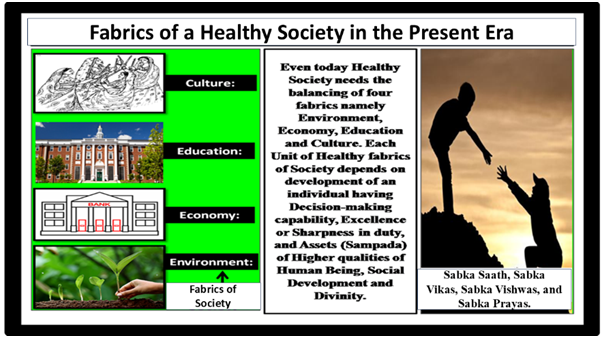
Each unit of Healthy fabrics of Society depends on the development of an individual having decision-making capability, Excellence or Sharpness in duty, an asset (Sampada) of Higher qualities of Human beings, Social Development, and Divinity (Manvik or Humanity, Samajikor Equality in Society & Daivik Gunas or Divine Quality).
The decision-making capability of individuals will lead social development with proper planning, organizing, leading, and controlling every aspect of the fabric of society. This means that individual has to be trained in such a way that they should have leadership qualities with Ancient Indian Wisdom concepts like uplifting of Energy or Prana, Space or Mind, and Consciousness or Spirit in the background.
4.4 Concept of Developed Countries in the 20th Century
Concepts expressed by progressive countries are different in spiritual traditions; but the views on the development of the individual, society, nation, and creation are more or less the same. The different traditions have shown the impact on the individual, society, nation, and cultural wisdom. But it (tradition) should be kept alive along with the scientific & technological development. There are many models developed in the context of spirituality like i) Chinese & ii) Japanese models and the same needs exploration.
4.4.1 Practical Approach by Chinese
The Chinese language has nouns, adjectives & verbs and follows only emotional punch (no specific Rules & Regulations of Grammar). This provides constraints in the global market. But, China has Confucianism containing ancestors worship and regard. It also has Taoism consisting of observation of nature & discovery for real happiness along with following natural order in life and trusting intuitive knowledge. Confucianism was mainly to educate children to follow the rules and regulations of Social life. Tao’s concept was to remind the people of the lost value of old Tradition, Heritage & Legacy. The same applies to repairing and retaining human values.
That is why, the Economic Development of China mainly is based on two dimensions namely i) Confucius’s model of Civilization and ii) Tao’s (Spiritual) model of Cultural wisdom. Because of soundness in both dimensions, the overall Economic Development of China is in healthy condition. This is similar to the “Ramarajya” concept of Indian Wisdom to some extent.
4.4.2 Practical approach in the Japanese model
Zen is a unique blend of the philosophy of different cultures, consisting concept of Buddhism, the Taoist’s love of naturalness, and the thought of Confucianism. It is a mystical Japanese way of life. Despite all, Zen is purely Buddhist; it aims to attain enlightenment (the highest abode of Buddhism). Enlightenment does not mean the withdrawal approach from the world; rather, it means active participation in worldly affairs. It is typically the Japanese mind; based on intuitive wisdom, not by intellectual approach. It provides facts without much of comments. Living entirely in the Present & giving full attention to everyday affairs are taken as Enlightenment mystically. This (Highest aim) has helped them to remain in the present & to achieve perfect enlightenment. Zen believes in manifesting in everyday affairs. Enlightenment has influenced all aspects of the traditional Japanese way of life. It includes the fields of Arts, Science, Gardening, Design, Arrangement of flowers, and Martial Arts including Judo.
These models have shown good results. AIW concept seems to have added features of Veda & Upanishad. Raja Ram was given the details of Veda & Upanishad through “Yog–Vashishtha”. The sermon helped demonstrate the ideology (prevailing in Indian Wisdom), which later on flowered as “Ramrajya” with the richness of civilization and cultural wisdom. The Economic model of Ramrajya is still remembered because the people (Praja) at that time enjoyed good Health, enough Wealth, Peace, and Prosperity without any conflict. If the proposed model is properly analyzed& implemented, India is going to utilize a holistic model; which will be superior to the Chinese & Japanese models.
4.5 Society Deterioration Causing World Problems
We have achieved good development of Science & Technology and got many advantages in day-to-day life. The achievement is very good as people feel more comfortable and easygoing. But the stability of social life is in danger as the quality of cultural wisdom is in bad condition.
This happens because i) the spread of more diseases due to poor environment ii) family disturbance as a selfish nature has grown among the elders and young people iii) anti-social elements are springing up because of unemployment & iv) poor mingling between youth and senior citizens, which has yielded more rooms for generation gap.
Many developed countries have organized in a clever way to hide the facts caused by to instability of the social structure; whereas, underdeveloped countries did not exhibit cleverness and they got exposed as they have. The sufferings of rich and poor countries seem to be persisting type. For Instance, Developed Countries have put the problems in the name of Old Age Home, Central Jail, Mental Hospital, and Night Club under the carpet; whereas, Underdeveloped countries honestly accepted the problems andsituations.5
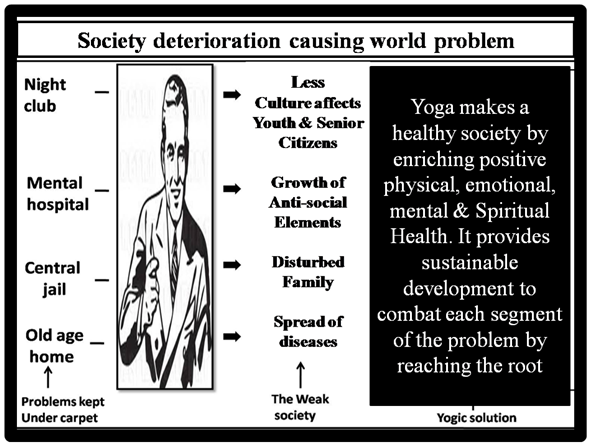
The yogic way of lifestyle helps to combat each segment of problems, enabling individuals to manifest the true nature of the self. To achieve this, the new holistic model should be searched.
4.5.1 Vibrant Individual and Vibrant Society
In the 21st century, the basic elements that can provide the sustainable form of Ramrajya are i) a Vibrant Individual and ii) a Vibrant Society; To eliminate corruption, materialism, and manipulation (the root cause of non-development or weakening the society and country); honesty, integrity, transparency and accountability are to be followed by the people for achieving the best possible development in the society. The analysis indicates how the vibrant individual and vibrant society can make the strong foundation of Ramrajya.
Normally, common people have weak and need-based personality. This means that they are always hankering for bread butter, shelter, and clothes. For this, they adopt the means of manipulation and corruption. In Ramrajya, these needs are automatically met; hence they will be free from this kind of hankering. But, next to that is materialism. When the basic needs are fulfilled, the people become materialistic. To eliminate or minimize the materialistic approach, they need a Spiritual or Yogic approach so that they can work for others or selflessly. This kind of personality can perform the job of a vibrant individual. To achieve this, the identification of two poles existing in a human system i) civilization and ii) cultural or heritage wisdom is to be integrated. The civilization part consists of a pollution-free Environment, adequate Economy, and balanced Education; whereas, the cultural part consists of the prevailing Heritage in the Society. Integration reveals that in an ideal situation, where both the poles (Civilization and Cultural Wisdom) get unified, the interface result (interplay of two) will yield maximum value. The achievement of conducive and sustainable quality in any domain (like Economic development, Good governance, sound Social Structure and strong Individuality) can be armored with moral, ethnic, and virtuous values. Many great thinkers of India including Pandit Deendayal have visualized the same.
4.5.2 Search for New Holistic Model with Yogic Science (Maharishi Patanjali Vision)
To have the welfare of all, the Economic model should be an ideal & holistic one. This could be arrived at by taking stock of the models under the background of dynamic spirituality. Chinese and Japanese models have been dealt with while comparing the effectiveness of the models. India is fortunate to have witnessed the golden period of Ramrajya, where the civilization of Lanka and the cultural wisdom of Kishkindha were integrated. Ramrajya’s model got lost because of many reasons. The same can’t be implemented in the modern age as there is deterioration in every segment of society. The problems associated with its rehabilitation have been visualized along with the yogic concept & found effective. Ramrajya’s model reinforced with the Yogic concept can be the ideal holistic model as Yoga takes care of the problems associated with them (each segment of personality and society).
4.6 Model resembling Ramrajya concept
This provides a balanced society by maintaining good health along with awareness of proper lifestyle & also by developing all “pathies” (Allopathy, Homeopathy, Naturopathy, Ayurveda, Siddha Vaidya, Unani, etc.), including Yogic concept. It manages even distribution of wealth to reduce the gap between rich and poor. It helps to frame policy related to job orientation to reduce the unemployment burden. It will be ideal to preserve the cultural heritage to minimize the educational drawbacks which otherwise, lead to the rat race for hoarding materials.
The Civilized and Cultured Society should have the benchmark where i) the Environment is kept pure by protecting Ecology and minimizing the polluted discharge of chemicals ii) Adequate Economic resources are generated to have the least gap in wealth distribution iii) Modern Education along with Vedic and Yogic Education could be strengthened and iv) Cultural and traditional heritage are grown by scientific means.
4.6.1 Importance of cultured Society for a holistic model
Many developed countries gave the importance of civilization for economic development. They feel civilization is a barometer for development. They could not realize that civilization alone cannot provide human happiness. Whatever growth the civilization carries in terms of stability in government, progressive social life, good moral values, and better human relations; it also needs complementary aspects of cultural wisdom for strengthening the quality of life.
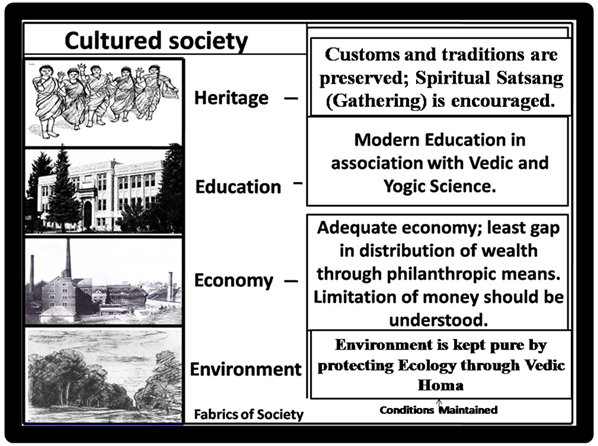
In cultural wisdom, an individual will follow the natural order at the Heart (Vacha) level; will act spontaneously at the Hands level, and (Highly cultured) will trust the intuitive knowledge. These aspects, along with Civilization, will provide the basis of human happiness. This shows that the subtle aspects of Human nature (dependent on traditional, custom, and legacy values) will be more beneficial. A balanced Society should always be reinforced with a well-developed, cultured Society. This will help to keep anti-social elements in the minority. The advantage of a cultured Society is reflected by the adequate growth of positive thinkers. In the Ramrajya model, the cultured Society will preserve the environment by ritualistic means, and the same is kept pure by protecting ecology and pollution-free discharge. Society should have more philanthropic people with an adequate economy. This will result in the least gap in the distribution of Wealth, and people will be aware of the limitations of money.
Likewise, the education of modern science will have the association of Vedic and Yogic Science. Voluntary organizations will be more active in this regard. Similarly, cultural customs and traditions are preserved by participating in Spiritual Satsang and keeping nearness of enlightened people.
In summary, Ramrajya is the land of Dharma, poetically described as a realm of peace, harmony, and happiness for young and old, high and low, all creatures, and the earth itself, in recognition of a shared universal consciousness. For this, Gandhi Ji had a similar kind of vision for the people of India after obtaining independence. The fabrics of a healthy society, consisting environment, economy, education, and culture, got to be stabilized after a few decades of Independence. In the meantime, it is analyzed that society deterioration is causing world problems, and the same has to be minimized or eliminated to move forward towards the achievement of 21st Century Ramrajya. For that, the youth have to be cultured to become committed, dedicated, and vibrant in an enthusiastic way while taking care of any kind of Job or employment. Fortunately, India has a backup of Rishi’s Vision to inculcate the spirit in youth as well as to have the Strong fabrics of Society in India.
5. MAJOR DIFFICULTIES DURING INDUSTRIAL DEVELOPMENT
The major difficulty opens up the analysis between individual identity and universal identity to avoid mental anguish (Vishaad). The synchronicity between Industrial progress and Inner Individual development is missing which leads to temporary unhappiness. The Vishad (Anguish) of an Individual, when becomes large in number; then the society or the country as a whole is in the grip of Vishaad. This depends on the underdevelopment of the right lobe. This means that when a large number of people are in the grip of an underdeveloped right lobe, society, and the country will be always in trouble. The right lobe has three major petals of the mind (manas) and two halves of east and west petals; which are responsible for keeping the mind under the grip of anguish or Vishaad. Individual Vishaad is well known as Arjuna in Bhagwad Gita. When several people in a society are having poor development of the right lobe; then the society in particular and the country at large will be under anguish or in Vishaad.
5.0 Self–Centeredness with a possessive attitude is a cause of unhappiness
The 20th century was the era of scientific and industrial development. These developments have provided many advantages for humans, giving them an easy way of living comfortably. For example, modern gadgets (Internet, iPod, T.V., Computer) have provided an easy way for information and communication. However, they have many drawbacks (Banes) that have made an individual’s life self-centered and possess a nuclear family. The people have become more materialistic; yielding unhappiness in life. The peace of mind is lost because of the unnatural way of living under the influence of industrial and scientific development.
Reasons for unhappiness could be i) not fulfilling the evolution process of Purushartha ii) not up-lifting the personality, mainly from being need-based, weak, and ambitious iii) a large disparity between the basic structure of society, and iv) a mismatch in the cause of creation. All happens because of inharmoniously evolved body, mind, intellect, and soul. The same has resulted in material possessiveness without discriminating against the harmful effect on the individual, society, and world as a whole.
5.1 Mental Vishaad (Anguish) conditions of the individual, Society, and Country
To remember the Vishaad Yoga of Arjuna let us recall the five petals of the Right Lobe (Given in Hans Upanishad), from East to Southward direction. The first petal is for Purity & Dharma. So, Arjuna has seen that this war would be Adharma Karma because he was on the first petal, he had a pure heart at that moment. Once he started visualizing, he found his Dharma was Adharma. The second petal (East South Direction) belongs to Alasya (Procrastination) exists; where he has lost his courage, confidence, creativity, and power. All he has lost internally so he says it is not fair to fight friends & relatives, especially Gurus and Bhishma Pitamah (Dada Ji), who are to be worshipped and not to be fought with. This conflict in the mind is also in the modern-day individual and Society. In addition, the root of War existed in the middle petal of the Right Lobe.
5.1.1 The Root of War is in the Inner Mind of the Individual & Society
On the third petal, Arjuna saw the cruel aspects of war. He saw that War is very cruel, War has cruelty and nothing else, so why fight? Why have this cruel scenario? The fourth petal he saw is Paapam (Sin). In this connection, It is to be noted that “Ahimsa Parmo Dharma” says Himsa is not a Dharma. It is Paapam (Sin). Fifth Petal said what is he going to do with the kingdom once none of the relatives were there, especially Kith and Kin will not be there, so why should we have the kingdom? All five petals indicate the Vishaad of Arjuna and that is our Vishaad (Anguish). Especially our Moha, cruel nature as a sign of Paapam (Sin), and fear of doing Paapam (Sin), are the indications that we are under the grip of underdeveloped Right Lobes. To come out of the grip of Vishaad (anguish), we have to evolve the right lobe; so that, the bare minimum effect of anguish exists in individuals, society, and the country as a whole. For this, we should have a program for progressive development with systems, values, quality, & sustainability.
5.2 The Need for Progressive Development
The image describes the progressive development. We do have certain lust related to Physical, Mental, Intellectual, and Spiritual domains; which get attached to successive development of the human personality. The lust related to negative emotion has to be changed. Naturally, the positive emotion has to be grown; which can be obtained by progressively developing the four divine qualities.
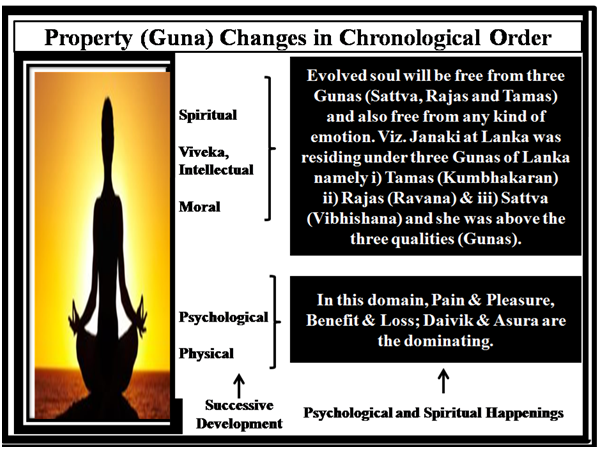
During self-development, we have to come out of dual phases like Pain and Pleasure, Birth and Death, Profit and Loss, and Respect and Disrespect. This kind of introspection at each stage of divine quality development is needed to review our internal progress.
The image provides clarity for successive and stepwise development and the same can easily be obtained to get change from negative emotions to positive emotions. The divine qualities evolved at four centers yield a change in behavioral patterns. This is because; the Consciousness (Chetana) has evolved which anchors the respective field of Energy (Networking) and Space (Trafficking) necessary at that center. The downfall in Consciousness lowers the Physical, Emotional, Mental, and Intellectual levels of a person. We come out of the weakness when we get well established at four conscious levels of functioning (Chetana centers). The progressive growth of goodness is desirable for scientists too.
Progressive Development is strengthened when we go for total knowledge or profound knowledge that exists in the universe and the same should be harnessed by intellectuals and scientists. In this connection, it is interesting to note that Yajurveda emphasizes acquiring Spiritual Knowledge and Scientific Knowledge together. Verses number 12, 13, and 14 of the 40th Chapter of Yajur Veda advocate that Eternal Knowledge or Gyana (Spiritual Knowledge) and changeable knowledge or Gyana (Scientific Knowledge) have to be understood together to have the welfare, development and complete peace in Human Civilization. The verse explains that those who follow the changeable knowledge (Scientific approach) only may lead the life of “Eat, drink, and be merry”. They use their changeable knowledge (Scientific Knowledge) for partial evolution in life and they are in the dark (ignorant) as they have never explored the possibility of Spiritual Knowledge (Eternal Gyana). Likewise, those who are learning only Spiritual Knowledge are also in the Dark (Ignorant) as they have not understood the function of Biological life; which forms the basis of Evolution. The above analysis indicates that a common platform is needed for the Scientists as well as for the Spiritual Masters to exchange their respective knowledge; so that, Civilization can enjoy the materialistic world in Peace. That is why, Swami Vivekananda used to advocate that “The best of the West, that is Science” and “The best of the East, that is Spirituality” should be brought together to explore the highest possible knowledge for the utility of the world.
5.2.1 Need for Development of Individuals amid Technological Development
Conflict prevails between individual and social structures. The impact of Science & Technology is reflected in the conflict between individual nature and weakness in social structure. This is because; the impact has created many missing links in personality development, which has resulted weak, ambitious & need-based personality. In addition, the Banes of Science & Technology have affected the Environment, Economy, Education, and Cultural wisdom of the Society. The same has been reflected in Ill health, Poverty, Unemployment & Crime in Society. In turn, the people are in unrest, and the scenario of looting, idleness, shooting, and snatching of wealth is reflected.As a result of conflict, the internal nature is visible in an individual (the state of being- Purushartha). Weak Human personality and disparity among Environment, Economy, Education, and Cultural heritage are also visible. Both reflect the mismatch in proper governance, developing possessiveness, and self-centered attitudes among the people. Because of the conflicts, most of us misuse largely the fight or flight mechanism prevailing within us.
5.3 Misuse of the “fight or flight” mechanism by most of us
This mechanism is a part of the endocrine system. When people make an emotional response, a chemical known as adrenaline is secreted from the adrenal gland, and the same is injected into the bloodstream. This causes contraction and dilation of blood vessels and increases the heartbeat and respiratory rate. This kind of scenario is widely visible when people become more tense. This affects the digestive system too. These three systems are more vulnerable to Influenza A (H1N1). This is because these systems help Influenza A(H1N1) or Swine Flu to spread and sustain in the human body.
Nature has provided a “fight or flight” mechanism and the same is intended to be used in emergency cases. But the scenario is different everywhere, especially among the so-called advanced people. People in the competitive and modern world remain in a stressful life. This is bound to happen because of i) having intense responsibility and ii) desiring for high targets to be achieved and iii) facing the cut-throat competition in the busy scenario of the modern world.
The natural mechanism of fight or flight, supposed to be used once in a while, is now being used every day and every moment to face the problems and challenges arising while interacting with the people, items, and Combined Role of East & West Spiritual Awareness Against Influenza A (H1N1) situations. The interaction creates the scenario of Fear, Inferiority complex, Dullness, and Boredom in the mind, whenever we are tense.
For instance, most people live amid fear of losing health, wealth, money, respect, relations, and peace of mind. Some feel like losing business, being deprived of opportunities, and losing husband or wife. In this process, the adrenaline is getting secreted most of the time in the bloodstream; which in turn, keeps the people tensed most of the time. This vicious circle yields a high state of physical and mental stress. This can eventually lead to a breakdown in the adrenal gland and other endocrine systems. That way, the systems become vulnerable to common diseases.
5.3.1 Control of fight or flight mechanism
The answer to controlling the fight or flight mechanism lies in the hands of the East because of its spiritual nature. Many people use tranquilizers as the solution to control the tension that arises due to the secretion of adrenaline. But they bring many side effects and further interfere with the normal function of the body. They may provide temporary peace of mind but can produce negative effects on physical and mental health.
East provides the answer to how to reach the root of the “fight or flight” control mechanism. Normally, East suggests adopting the technique of relaxation, the process of meditation, and the application of Pranayama as the solution.
Among them, relaxation is prominent and easy. Though, the West follows certain aspects of relaxation they seem to be temporary. Most of the time, their approach is to understand the crude meaning of relaxation.
For instance, West adopts entertainment as a prime reliever of tension. They use television, cinema, alcohol, and tranquilizers for the removal of tension. It has been observed that these entertainments provide temporary solutions but many times they add more amount of tension. They may bring a pleasant atmosphere for some time, but cannot bring deep relaxation to the body and mind. This is because; the mind gets bombarded with many incidences, situations, and horrible scenarios that have been shown in the name of entertainment programs. Many intellectuals feel that the temporary measures of tension remover provide some escapism of tension and on many occasions, they add to the tension. This is because they many times lead to a confused and well-strained life. As they are new to the situation, they need to know & identify the problem and understand the need to solve it. The absence of Gurukul Education needs certain factors that lead education to temporary unhappiness because of the lack of a continuum concept.
5.4 How does education yield temporary unhappiness?
The analysis shows that the subjects that we are studying in college and universities are bookish. This is because; the study to which we are introduced in our educational institutions is a gathering up of information about things. In fact in Veda, this kind of institutional education is called “Avidya” (not true education or Vidya). It is not knowledge of things. The knowledge related to matter or object reveals that matter is in continuation with the associated one; whereas, education patterns separate each subject from the other and provide the information in depth. This does not mean that the information in depth of a particular subject is not necessary. Rather, this (in-depth knowledge of a subject) is also necessary for analyzing the subject. However, a continuum concept among the matters or objects is also needed, which is missing. That is why; with all our knowledge and education we remain unhappy. To achieve happiness in education, we have to add the concept of the continuum (interdependent principle) to the knowledge we are likely to achieve.
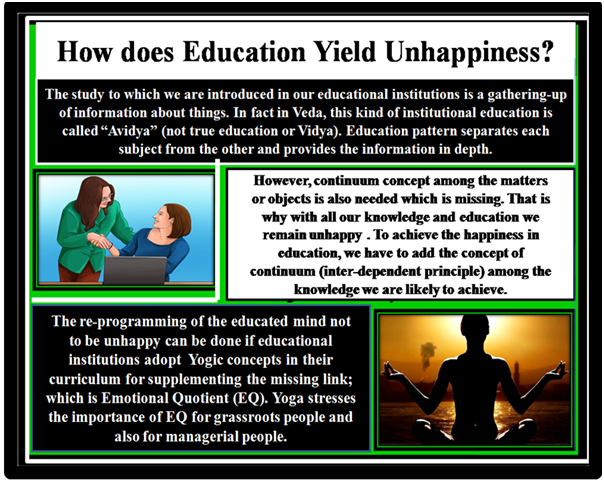
An educated person need not necessarily be a happy person because happiness is altogether different from education and the knowledge that we have of things. Though, it is said that knowledge is happiness and knowledge is power, we see the reverse is the case in society. We are miserable with all our qualifications. The reason is that we do not have real knowledge. We have only information about the outer form of things rather than an insight into their real nature. To have the feeling of misery even after proper education reveals that a correction factor (to perceive the real nature of the subject) is needed in the thinking process of the mind, so that this (miserable feeling) will be minimized or erased. This means that reprogramming individual minds or educated minds, is necessary.
The reprogramming of an educated mind (not to be unhappy) can be done if educational institution adopts the Yogic concepts in their curriculum to supplement the missing link; which is the Emotional Quotient (EQ). Yoga stresses the importance of EQ for grassroots people and also for managerial people. Society as a whole is having sustainability in all rounds, especially in the fields of Environment, Economy, and Education; which needs Emotional Quotient (EQ) in the developed form. Otherwise, the growth and development of Individuals &Society may tumble at any moment even with a weak blow of an unseen situation.
In conclusion, there are many pros and cons of scientific and industrial development all over the world. In brief, we can say that hurdles like Vishaad or Anguish, Mismatch of Fight or Flight mechanism, and others can be minimized overcome with the help of Yogic methods suggested in Different Upanishads. If the right brain structure is equalized with the left brain; then, most of the inner problems of duality connected with human lives will be automatically solved. In that way, Hurdles caused by scientific and industrial development can easily be overcome or Minimized
6. SPIRITUAL PRACTICE TO CREATE THE BEST POSSIBLE POLITICS FOR ENHANCING RAMRAJYA CONCEPT
For a long, it has been debated whether Spirituality and Politics can go hand-in-hand. This Chapter aims to provide the traditional viewpoint that they definitely can move together and some of the important points are dealt here.
6.0 Spirituality in Politics
Spirituality? Politics? How can we mention these in the same breath? Most people would say you can be either a spiritual seeker—or a political activist—but never both. For those caught in dualistic, “either/or” thinking, politics and spirituality seem worlds apart– two different arenas that should never be mixed or they produce deadly results–such as we see today with certain politicians trying to impose their religious beliefs on everyone else through public policies.
But there’s a big difference between spirituality and religion. “Religion” refers to an organized institution and community of believers, with specific dogmas and practices. But Spirituality relates to one’s inner, moral-centered life about the Transcendent. It is concerned with qualities of the human spirit such as Love and Courage. Religion can help a person be spiritual, but Spirituality isn’t dependent upon religionand it is for all without any boundaries.
In actual practice, true Spirituality can ennoble Politics and Politics can ground Spirituality. Spirituality can help people leave ego and power trips at the door and truly serve the good of others. Politics can provide a practical arena for applying spiritual principles such as Compassion, as instant feedback is given if someone doesn’t “walk the talk”— if their words are more pious than their deeds. Bringing spiritual values such as Altruism and Courage into Politics could offset the immense power of moneyed interests to influence policy, and offset the cynicism and apathy of much of the public.
Gandhi Ji had no trouble bringing his Spirituality and Politics together. He said, “I could not lead a religious life unless I identified with the whole of mankind, and that I could not do unless I took part in politics.”
6.1 Can Spirituality Go Along with Politics?
As US Congressman Dennis Kucinich once said, “Our Founders never meant to imply that we should separate…the actions of government from spiritual principles.” Nor did they intend that we should avoid discussing spiritual ideas in the public arena. They only intended that the State not impose religious beliefs on citizens or interfere in the practice of religion.
People today are yearning for a spiritually based Politics guided by moral values—a Politics that doesn’t appeal only to self-interest and pit one group against another. They seek a type of political discourse that speaks to their deepest values as human beings, that provides a greater sense of community and a transcendent purpose as a nation, that offers us a higher vision of Public Life and Service to the common good–rather than appealing only to greed and lust for power.
As Jim Wallis writes in God’s Politics, we shouldn’t be asking if God or Spirit is on our side, but rather ask, Are we on God’s side? Are we embodying our spiritual values and promoting compassion, justice, and peace?
A recent poll found that 84% of Americans agree that “our government would be better if policies were more directed by moral values.” Another poll in The Washington Post found that the issue of greatest concern to voters wasn’t healthcare or education, but rather moral values.
If citizens make it safe to discuss spiritual values in public life, then they can hold politicians accountable for the spiritual values they espouse. The public has made it very clear they don’t want negative campaigning, and candidates today often try to convince voters that their campaign is the most positive. A refreshing call to honesty, service, and sacrifice from a candidate often draws people to vote for the first time in many years.
6.1.1 What the common man feels about mingling of Politics and Spirituality
Spirituality in Politics is most apparent where citizens altruistically engage in Politics to help others, rather than just protect their self-interests (e.g. lowering their taxes, providing healthcare they need, etc.) Although promoting self-interest may be necessary and certainly is not wrong, it is not motivated by unselfish concern for others. However, even when the public motive is to help others, one needs to also honestly assess whether the private motive might be increasing one’s power or fame, as this would reduce its spiritual value. And ultimately the measurement of Spirituality is integrity—whether someone embodies the spiritual principles they promote.
There are many ways in which spiritual values impact politics today. (Of course, depending on your political leanings, it may be harder to see the spiritual motivation in the politics of your opponents.) Providing food for the poor, the homeless, and the handicapped, as well as reducing violence and drug abuse have always been key arenas for spiritual activism. Liberals generally promote Government-funded Social programs as solutions, while conservatives promote private solutions, including Faith-based organizations.
Another arena is fighting injustice and inequality by speaking truth to power. Liberals and Reformers have generally taken more of this approach. Issues include Human rights, Racism, Women’s rights, etc. Many spiritually oriented people have been increasingly concerned about the protection of wildlife and stewardship of the natural world. Environmental protection, endangered species protection, and Energy conservation are key issues. The invocation of service and sacrifice for a higher ideal to activate political will is another major arena for Spirituality.
One of the most contentious areas recently for Spirituality and Politics has been what one side calls “declining morals and family values” in schools and popular culture. Fundamentalist Christians have been the most vocal about this, but others have also expressed concern. The issues here are school prayer, censoring sexuality in movies and TV, banning abortion, etc.
6.2 The Need for Spirituality in the 21st Century amid the Boons and Banes of the 20th Century
The twentieth (20th) century was the era of Science and Industrialization. In that period many modern scientific concepts and laws were established. Among the established concepts and laws, a few are worth to be mentioned and they are namely i) Atomic energy ii) Nanotechnology iii) Industrialization iv) Green Revolution v) Multinational organizational Community vi) Economization service utility to customers vii) Growth of Capitalism, Socialism, and Communism and viii) Modern Education etc. They are no doubt Boons for society. The Development (Prakriti) always keeps Boons and Banes together. Whenever Boons are achieved; the same will be associated with the Banes. The best example is research on sea churning (Samudra Manthan). During the sea churning, the Nectar (Amrit) and poison (Visha) came out. Similar is the case with Research and Development in the scientific domain; where many advantageous laws were established for Science and Technology keeping their Banes unattended.
The Boons connected with the development of the Green revolution, Nuclear energy, White revolution, Nanotechnology, Space technology, and Material technology of the Twentieth (20th) Century are worth welcoming. At the same time, the Banes related to each Boon should be separately tackled; so that, the same (Banes) can easily be managed. In this context, Swami Vivekananda Yoga AnusandhanaSamsthana (SVYASA), Bengaluru, and Spiritual Awareness Program (SAP), Hyderabad are working to tackle the Banes of each Boon. This is because; Spirituality and Yoga provide an easy methodology to solve the Banes positively so that the Boons are fully utilized; keeping the Boons free from adverse conditions of the Banes.
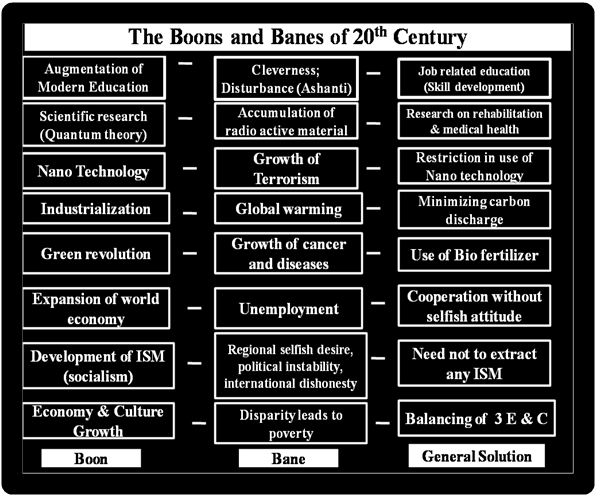
In this connection, Scripture can be utilized for minimizing the imprints of Banes that exist in the brain cells. The brain cells are the Treasure-house for providing good solutions if the same is free from bad imprints. By developing the Right Hemisphere, the scientist can get the solution to the Bane; while discovering the Boon. To achieve better results, there should be a common platform where Scientists and Spiritual Masters should come together to analyze and solve the Banes (whatever came out during the evolution process of Boons).
6.2.1 What is Righteous Action (Dharma Karma)?
Dharma is defined as a tendency or inner nature of a person, where the mind is above the name and fame, respect and disrespect, gain or loss of day-to-day scenario, and the same (Mind) keeps us in the present movement without fluctuating past and future direction. This (Dharma) leads us to understand our Duty and Responsibility with the associates in the righteous direction. When a person falls into Dharma (Dutifulness), he or she will work in a righteous direction. It is worthwhile to note that the divine quality of a person will reinforce the Dharma of the person.
The institutions which uplift our mental status above the selfish level and expand the selfless action of the mind in a proper direction; then the same are known as Dharmik Sanstha. In our mind, there is a strong sense of Righteousness that stops the fall of the mind below a certain level of unrighteous thinking and this kind of fencing in the mind keeps us in the Dharmik (Righteous thinking) way.
Yama (Don’t) and Niyama (Do) are two limbs of Aastang Yoga for maintaining Dharma. When there is a fall in Dharma, there will be a fall in the faith (Bhagya). For example, the item obtained from Unrighteous means such as stolen, snatched, bribed, and forcibly taken items leads us to become the prey of Adharma (an Unrighteous way of functioning). The same is the root cause of the debacle in the journey of life.
To get rid of being unrighteous quality, the people must follow the divine qualities narrated in the prayer of Upanishad. This is because; people are the means to communicate the process of life among the different segments of society. If the people segment is not hail and healthy, the growth of other segments of society will be disturbed and the complete society will remain in fragile condition. The four divine qualities and they are namely i) Bala (Strength) ii) Klesh Vikar (Malnutrition of mind) iii) Buddhi (intellect) and iv) Vidya (Knowledge) can help people to uplift the hidden personality within themselves.
The people should follow a certain Code and Conduct (Acharan) concerning their behavioral patterns while dealing with the associates along with moral values (Naithik Mulya) in a certain Frame of Law (Niyam). These values (Code and Conduct, Moral value & Frame of Law) depend on the four positive knots yet to be developed in the people’s personality. In this connection, the people have four major positive knots within hidden personality namely i) Honesty (Imandari) ii) Integrity (Akhandta) iii) Transparency (Pardarshita) iv) Accountability (Lekha-Jokha), and the same can be the strength for people with the help of four divine qualities given in Scripture.
6.3 Using a “higher common ground” process for resolving conflicts and making policy
Many of the new political approaches transcend the usual adversarial approach to find higher ground on polarized issues. There is usually a grain of truth on each side in any political conflict. Healing, reconciliation, and forgiveness are spiritual qualities very much needed today.
The training of initiates in ancient mystery schools included training in paradoxical thinking–holding two opposite ideas at the same time and seeing the truth in both. Taoists teach about Yin and Yang–the opposites–that are held in a dynamic balance. Buddhists follow the Noble Middle Path between the pairs of opposites. In the Jewish Kabbalah or Tree of Life, the middle pillar shows the path of balance between the opposites.
As Einstein said, we can’t solve a problem on the same level of consciousness that created the problem. We have to find a higher common ground. Multi-stakeholder dialogues, which involve all parties in a collaborative dialogue, are proving to be the most effective way to develop viable policies and reduce conflict on divisive issues such as race, abortion, and the environment. For example, The Institute for Multi-Track Diplomacy helps resolve Ethnic conflicts worldwide by involving all stakeholders in dialogues – Government, Business, and Non-profit groups and listening deeply to all perspectives. Search for Common Ground helps opponents on both sides of the abortion debate find common ground by working together to prevent unwanted pregnancies and to make adoptions more easily available. America Speaks creates innovative citizen dialogues on local issues such as neighborhood development and national issues such as Social Security.
The ageless wisdom of East and West emphasizes that Unity is needed before there can be lasting Peace in the world, and Peace is needed before there can be shared Abundance. Peace is built on right human relations. Through efforts to transform conflict and listening to the voices on all sides of an issue, the seeds of new politics are beginning to emerge. It is a Politics that recognizes the underlying unity of Humanity and builds a new synthesis based on identification with the whole.
6.3.1 Synthesizing the Spiritual aspects of both Hierarchy and Democracy
A new approach to politics takes the spiritual aspects of Hierarchy–Leadership and Quality and the Spiritual aspects of Democracy–Caring and Inclusiveness–and raises them into a higher synthesis. The synthesis of the best of Democracy and the best of Hierarchy creates enlightened Leadership. Democracy provides a loving container to hold and nourish people’s development, and hierarchy models the direction for others to grow into.
The principle of Hierarchy acknowledges current abilities, quality, and excellence (actualized potential). Hierarchy recognizes current accomplishments. It values leadership, purpose, direction, and vision. It can be very efficient and provide clarity and accountability, encouraging and rewarding initiative. It can provide models of achievement for others to aim for, offering mentoring for those who are younger or less experienced.
Each of us must learn to recognize whom we can learn from because they are more advanced in certain areas (and thus we can learn humility). But we must also recognize whom we can serve because they haven’t yet developed certain qualities that we might have (and thus we can learn responsibility).
The principle of Democracy acknowledges future potential and empowers its development, giving people the maximum freedom to grow and developwith quality and sustainability. It provides opportunity and encouragement. It values for access inclusiveness, relationships, listening, and compassion. Equal opportunity, political rights, and decision-making power are bestowed on all so that individuals may develop their full potential. There is an emphasis on inclusiveness with quality, where everyone is equally honored and encouraged to participate. This can be especially reassuring, especially for those lacking self-worth or self-confidence.
Several new groups are experimenting with this innovative approach, such as the Foundation for Global Community in Palo Alto, CA, and the Findhorn Foundation in Scotland. Governance structures include enlightened, empowered leadership at the core with very participatory, decentralized decision-making. Leaders listen carefully to the concerns of all participants and build consensus on major issues.
6.4 Promoting “best practices” (spiritually based solutions) to social problems
Many new solutions have been pioneered by “civil society” groups (non-profit organizations) which represent a powerful third force beyond Government and Business that embodies the spirit of service found in all religions. Their spiritually based solutions are effective because they address the whole person–body, mind, and spirit–and change lives, rather than just provide food or shelter.
Sojourners in Washington, D.C. has helped juvenile gang members give up violence and drugs and find a new life through a spiritual approach. The Restorative Justice Institute in Virginia brings together crime victims and offenders for reconciliation and forgiveness. The Alliance of Concerned Men in Washington, D.C. helps unmarried fathers reconnect with their sons and take responsibility for their education. The Sarvodaya self-help movement in Sri Lanka is built on Buddhist principles of loving kindness, sharing, and service, with thousands of participants meditating together each day.
In the widespread trend to bring spirituality into business, an increasing number of Americans are working to make their companies reflect their values in how they relate to their employees, their community, and the natural environment. They are promoting a triple bottom line—people, planet, profit—and making their companies more socially responsible. Many people are hungering for a deeper sense of meaning and purpose at work and want to apply their values practically.
Similarly, many citizens want their politics and government to reflect deeper, more universal spiritual values. They demand that politicians embody the values they espouse—but without imposing these values on others. Bringing together spirituality and politics is a key idea whose time has come, it’s long overdue! But as the French say, everything begins in mysticism and ends in politics!
6.5 Working to transform consciousnessto explorethe causal factor
Our negative patterns of thinking are the deeper cause of problems in our world. As medical researchers in psychoneuroimmunology are discovering how our thoughts affect our health, we need to explore how our collective thoughts are affecting our collective social health. The Ageless Wisdom of both East and West reveals how to change the world by changing consciousness. To create peace in the world, we must create peace within ourselves. In the West, the Bible says, “As a man [or woman] thinketh in his heart, so he is.” Likewise, the Buddhists say, “With our thoughts, we make the world.” Energy follows thought–the mind is the builder. The interplay of Human and Divine Thought creates all Reality.
For example, The Foundation for Global Community, (formerly Beyond War) based in Palo Alto, CA, successfully enlisted hundreds of teams around the country to help Americans reframe their consciousness about nuclear war. They learned to see it as obsolete because no one could win a nuclear war. So a new, non-violent strategy for security was promoted. Tikkun, an interfaith community started by Rabbi Michael Lerner, produces a national magazine and “Spiritual Activist” conferences that promote the consciousness of a “new bottom line”—compassion, generosity, and caring—instead of the old bottom line of materialism and selfishness. To address the spiritual crisis in America, they have created a “Spiritual Covenant with America” to encourage spiritual people to stand publicly for their highest vision and values.
Other groups such as our Center for Visionary Leadership, are helping people study the deeper spiritual causes of current events and crises and the Karma involved. Events can be a rich source of collective learning if we’re willing to explore the lessons being offered through shared national experiences. We can interpret events as the symbolic out-picturing of the inner forces at work and explore their hidden causes in consciousness. The Native Americans called this “Reading the Book of Life.”
For example, collective disasters and wars provide major opportunities to learn compassion for victims, as well as to learn the consequences of our actions. “As you sow, so shall you reap,” as the Bible says–or “Karma” as the Hindus say. When the Mississippi River flooded major portions of the U.S. several years ago, for example, sewage dumped in its tributaries backed up and returned to the towns that had dumped it. This new spiritual approach to politics does not look for others to blame but rather takes responsibility for our thoughts and actions.
6.5.1 Using meditation to invoke the soul of a nation as a helping hand for Policymakers and also for Crisis Management
A spiritually based Politics recognizes that we humans do not have to struggle with our problems alone, as help is always available from higher dimensions when it is asked for. There are many examples of guidance by higher spiritual forces throughout history, such as George Washington’s vision of an angelic presence at Valley Forge, the help received by the Allies during the Battle of Britain in World War II, and Egyptian President Anwar Sadat’s vision of Mohammed inspiring him to create peace in the Middle East.
Prayer has been used by all religions down through the ages, but today many groups promote meditation for creating peace and justice, such as the Buddhist Peace Fellowship in Berkeley, CA. For example, organized prayer vigils to ask for spiritual help in crisis. A major meditation vigil around the world helped support the peace process in Bosnia at a crucial juncture. Pathways to Peace and many organizations promote meditation for the United Nations every September 21st on International Peace Day. Intuition in Service in New Zealand sends out regular notices about important events and crisis to be held in the light of meditation.
The Faith and Politics Institute in Washington D.C. provides retreats and reflection groups to support Congress people and their staff in being true to their deepest values when confronting difficult issues such as campaign fundraising.
At The Center for Visionary Leadership, we encourage people to invoke the soul of their nation, because, like individuals, each nation has both a self-serving personality and a more altruistic soul. We also created a meditative prayer to help heal the divisions that divide us as a nation, and many people around the country have been using it for years. Citizens of several other nations have also adapted it to their own country.
We also encourage people to “Adopt a Leader” –find a national leader who needs help spiritually, but has a lot of potential, and follow his or her career, praying or meditating for him/her, so that she/he may align with higher spiritual principles and serve the good of all. In india, the meditation of different kinds are adopted since long to invoke the soul of the nation whenever india is under crisis. This is because, india is spiritually evolved. and having the wisdowm of Tattva Gyana too.
Tattva Gyana is connected with the main ingredients (Tattva) needed for any creation. The same has been visualized by Maharishi Kapila Muni; which is being used by the primordial matter (Nature) to create any form on this earth.
In the Bhagavad Geeta, Lord Krishna says that if you understand the philosophy of Tattva Gyana, which was discussed by Kapila Muni as well as Patanjali, and the followers of Tattva Gyana, known as Tattva Gyani, like Arjuna, they can just go to them, catch hold of their feet and try to know what way Tattvas are working, in what way our ingredients by which we have been made our working.
This Tattva Gyana is not essential in Rama Rajya for common people or those who are not up to the mark, not making Niti or making laws for Society, for them it is Karma, and it is very much sufficient. But Tattva Gyan is in the evolution path for those politicians who want to understand the complete philosophy of Life, how we should be free from all the knots, they should know this, they must try. At least those who are on the path of evolution like Maharishi etc. Those who are trying to establish the key points of Gyana should know.
7. A COMMON PLATFORM NEEDED AS A JOINT VENTURE TO SOLVE THE WIZARD OF SCIENCE AND TO HAVE BETTER CLARITY IN THE SPIRITUAL FIELD
Swami Vivekananda, after he visited the “World Parliament of Religions” in Chicago, came in contact with scientists, namely Tesla and others of the Western world. At that time, he felt the need to establish a “common platform”, where “the Best of the West (Modern Science)” and “the Best of the East (Spirituality and Yoga)” should be realized; to understand each other and also to solve many problems connected with them. The factors associated with the common platform are dealt with here.
7.0 Science and Spirituality
Modern science exhibits that Matter (atoms) comprises many Subatomic Particles (Elements). When Matter is disintegrated, only Energy is available. For example, Uranium on the surface looks like Sand, but the same (Uranium) provides Energy after disintegration. This means that Matter consists of Energy. This is because Matter is inert and keeps unevolved Energy. Similarly, the Human Brain is like Matter, which is composed of certain associated elements. For instance, the Brain is composed of five gross Elements (PanchamahaBhoota), information centers for ten Senses (Dash Indriyas) associated with objects or the Vishaya-like essence of Panch Maha Bhoota, which is known as Tan Matra. All these are composed of grey mass like a Brain, where interconnecting elements like Neurons (Manas or Mind) are made active in due course. When the composed and intact Elements (Brain) get disintegrated, then the hidden Energy is the only substance (Tattva) that is left over. The same (Energy) is experienced as the Power of the Soul (Atma Shakti).
In other words, the scientific disintegration in the Brain and the evolutionary process in Spirituality can easily be compared with the atomic change in the Brain. Science disintegrates Matter to take out invisible Energy from inert Matter. Similarly, the Spiritual Master disintegrates the Brain with the help of the associated Inner Instrument (Antahkarna) (concerned with the five Elements) to evolve lastly in the form of Pure Energy. The same (Pure Energy) is known as Consciousness. The Spiritual Master, while evolving (nearer to Pure Energy), becomes creative and powerful. Scientists can make use of the above-mentioned evolution process of Spirituality to prepare them to be more energetic while investigating the Cosmos. After obtaining this kind of scenario, scientists can discover many inert and unknown substances available on Earth and also on many planets. It is interesting to note that science could establish a formula related to the disintegration of matter in the Twentieth century (20th Century). This formula (E=mc2) has become the universal law between Matter and Energy.
However, the sages of India have already established similar kinds of concepts based on experience. Now the same (Scientific formula) endorses the achievements of sages who experienced hundreds of thousands of years ago. In brief, the 21st Century can have a common platform for Scientists and Spiritual Masters to work together to discuss many unknown facts with the help of each other’s experiences and results. That is why, Swami Vivekananda advised both (Scientist and Spiritual Master) by stating that “The Best of the West (Modern Science) and “The Best of the East” (Spirituality and Yoga) should be brought together to take advantage of each other’s discovery. This kind of joint venture will provide the clue to resolve the complexity of scientific wizardry and will also be helpful to the Spiritual Master in understanding the difficulty in the process of Evolution.
7.1 Nearness of Science towards Spirituality
The oneness of Eastern Spirituality, along with AIW (Ancient Indian Wisdom) concepts, is endorsed by Modern Physics to a certain extent. According to it, oneness becomes apparent at the atomic level and manifests itself more and more as one penetrates deeper into Matter, down into the realm of Subatomic particles.
The unity of all things and events will be a recurring theme throughout. (Reference page no.131 of “THE TAO OF PHYSICS” by Fritjof Capra; published by Shambhala – Boulder 1975).Fundamental features of all traditions are awareness of unity, the interrelationship between everything and events, and the manifestation of the world from oneness.
As manifestation happens from oneness, all things are interdependent and inseparable from the cosmic whole. This includes the oneness of the totality of all things, and that is known as the “soul”. This way, all other things are dependent and inseparable from the soul.
7.2 Description of SETU (sequential entanglement between truth and universe)
SETU (Sequential Entanglement between Truth and Universe) provides the sequential structure of eight nuclei connected with Truth (Satyam), indicated as the “Garland of SETU” in the universe, to indicate the hidden “intelligent’s appearance” for the smooth functioning of life.
It is obvious that all eight beads are connected, as Garland, but have different functions to carry out to keep all the entities of the Universe in the respective place in motion to have the existence of Animates and Inanimates.
The Invocation (Prayer) of “Taittiriya Upanishad” states that Om, May the sun, Lord of Day (Mitra) and “In Breath” (equivalent to Electron in Science); May Varuna, Lord of Night and “Out Breath” (equivalent to Proton in Science); May Aryama, Lord of Sight and Sun Domain (equivalent to Neutron in Science); May Indra, Lord of Strength and Force (equivalent to Photon in Science); May Vrihaspati, Lord of Speech and Intelligence (equivalent to Gluon in Science); and May Vishnu of Wide Strides (equivalent to Gauge Boson in Science). May you all provide your Grace and Blessings to us. We bow to you, Almighty Brahman, the soul of all the Gods.
We salute you, “Vayu” (equivalent to Neutrino in Science). I will always speak for what is Right, I will always speak for what is True. May the Almighty Brahman (Pure Consciousness) protect my Teacher. Let Brahman protect me, let Brahman protect my Teachers. Om Shanti ShantiShanti.
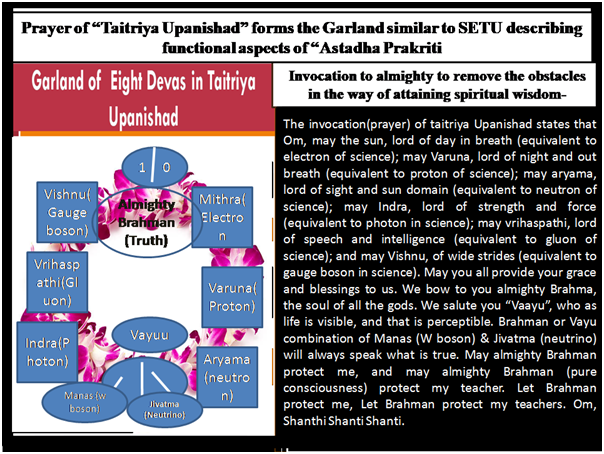
Likewise, Bindu number 6, Bindu number 7, and Bindu number 8 stand sequentially at the right portion of the Garland, and they join the Bindu number 1, which is at the top of the Garland.
These Bindus (Nuclei) represent Devas on the left side of the Garland and also the respective Devas on the right side of the Garland; whereas, Bindu number 5 indicates the separation zone for the left and right sides connected with beads of the Garland. If the Circular beads (Element) of the Universe, which are in the Garland form, are kept in a vertical arrangement, they will look like disconnecting the top right of the Bindu number 8 from Bindu number 1.
7.3 Similarity of Ashtadha Prakriti in Garland and SETU Diagram
The image describes the Invocation to the Almighty to remove the obstacles in the way of attaining spiritual wisdom. The image is the description of the connectivity of Ashtadha Prakriti, which is known as the “Maya of Brahman”, and because of the same, Brahman (Consciousness) becomes eight along with nature (Prakriti). That is why Maya holds the power of Brahman in Ashtadha Prakriti.
In Garland, the nuclei have a sequential arrangement, and they are interdependent among themselves, and the same is indicated as a Bindu number (point of existence of nuclei). They start from Bindu number 1 as truth (Satyam) at the top of the Garland. Similarly, Bindu number 2, Bindu number 3, and Bindu number 4 start at the left side of the Garland as a bead. In the case of Bindu number 5, the same is vertically down in the line with Bindu number 1, indicating the middle point of the Garland for the Macro and Micro-universe.
The image represents the invocation of the Taittiriya Upanishad, which bears a resemblance to the functional aspects of the “Particle Physics Model”. It explains the Swaroopa, which is the mirror image of Brahman, in association with nature (Prakriti). This indicates that Brahman has become Ashtdha Prakriti. The Bindu number (nuclei) provides the structural entanglement for different limbs of nature (Prakriti) to function as Maya. The Garland, which is a circular arrangement of nuclei, has been shown to have a similarity with the unfolding of Bindu number 8 from the right limbs of the Garland in a vertical arrangement.
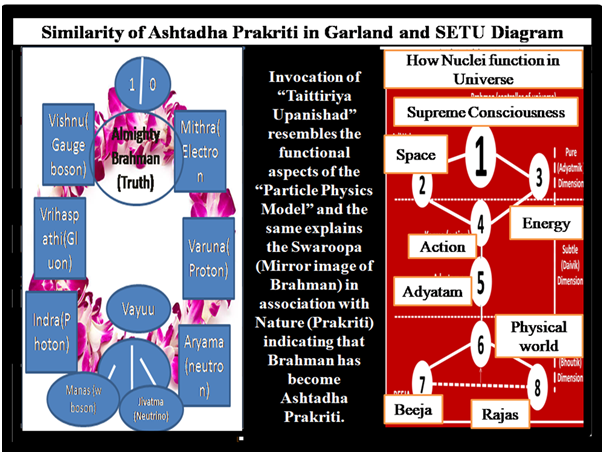
The SETU Diagram is presented in a vertical arrangement, which separates particles, forces, and force carriers – the main elements for the development of Quantum Field Theory. The diagram also satisfies the concepts of Astavakra Geeta, which deal with the body and mind separately. By separating biological life (which is deeply connected with the body) from the higher domains of spiritual life, the analytical aspects of the Astavakra Geeta fulfill the connectivity arrangement of the Universe with Truth. The Garland arrangement, on the other hand, is circular, and it also provides a demarcation zone for these elements.
7.4 How do Nuclei (Bindu) function in the Universe and the Human system?
The Bindu (nucleus) diagram indicates the existence of different nuclei (Bindu) having Energy, Space, and Consciousness, which are linked together. Energy represents the networking process, Space is connected with the trafficking aspect, and Consciousness is concerned with the balancing of networking and trafficking.
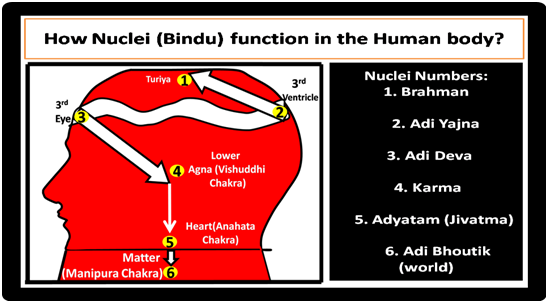
This kind of concept exists in each nucleus of the Human Body and Brain, and also in the Universe. Among them, six nuclei are very important to have symmetry in the Universe among Stars, the Sun, the Galaxy, the Moon, and the Earth. This indicates Bindu (nucleus) number 1 is the controlling aspect of the Universe and the Human Brain and Body. This means that Bindu number 1 (nucleus) is the controller of the Individual (Microcosm) and the Universe (Macrocosm).
The diagram shows that Energy, Space, and Consciousness are also closely related to nuclei, which are represented by numbers 3, 2, and 1, respectively. Similarly, the fourth aspect of Bindu (nucleus) is the linking mechanism of Body and Brain, known as Vishuddi Chakra in Yoga. The fifth aspect represented by number 5 is the Jivatma, or any living being that exists. Number 6 represents Bhoutik Loka, which is the material world we inhibit. Therefore, in all six aspects, only Truth or Parmatma can witness the existence of each nucleus. Each nucleus has its Energy, Space, and Consciousness. The analysis of the Bindu (nucleus) diagram indicates that the Truth (Parmatma) is living somewhere else in Turiya Teet and coming up to 1 to 6 layers, and that way the whole Universe and whole Body are functioning in symmetry. The layers distributions are as follows: in between 6 to 5 there is 1st layer, in between 5 to 4 there is 2nd layer, in between 4 to 3 there is 3rd layer, in between 3 to 2, there is 4th layer, and between 2 to 1, there is the 5th layer. So, the whole Universe is divided into 5 layers for that, and all creation proposes.
In the Human system, the Turiya (top of the head), also known as the crown, is the entry point for Truth (Paramatma), and the same is known as the nucleus (Bindu) for the witnessing point (Sakshi Chaitanya). In this way, the largest energy nucleus is the Turiya. Bindu (Nucleus) 2, which is the space and is the top back of the head, known as the third ventricle. The nucleus 3, which is nothing but the energy center, is also known as the networking for the domain. The nucleus 4 is the connecting point between the body and the brain. This nucleus provides the demarcation between the body and from brain. The fifth nucleus is the presence of Prana (Energy) keeping sufficient oxygen for biological needs, and also the same is the place for Jivatma to reside. Below the sixth nucleus (Bindu) is the material world, also known as physical domain (Bhoutik Loka). In this way, Truth or Paramatma exists; for which Lord Sri Krishna says in the Gita that “I am there and I am present in all the 6”. Lord Sri Krishna also indicates that these nuclei (Bindu number 2, Bindu number 3, Bindu number 4, Bindu number 5, and Bindu number 6) do not know my presence in them.
The analysis clarifies that 6 major nuclei, which we call the creation development center and the whole Creation, either in the Body or in the whole Universe, follow the same scenario and the same kind of work. This means that 6 nuclei are only responsible for all the Creation. In Meditation, the creation development center (Bindu number 6, Bindu number 5, and Bindu number 4) is taken for purification and energization in the process of Pranayama and Pratyahara (Bahiranga yoga). In higher meditation (Antarang Yoga meditation), the three major centers of the brain, namely Bindu number 4, Bindu number 3, and Bindu number 2, are dealt with for evolution. In this way, the meditator uses 6 major nuclei (Bindu). The Upanishads explain the connectivity between Microcosm and Macrocosm.
7.5 Inner instrument exhibits force carrier of the Particle Physics Model
Bhagavad Gita clarifies the force carrier of the particle physics model and the transparent quality of the inner instrument for exploring the higher dimension in the Cosmos. The Brain contains five states of Matter, especially the fourth and fifth states of Matter, which can be explored with the help of concentration (Driti) if the nucleus for the intellect and the concentration are kept in transparent quality. The transparent (Sattva) quality of concentration before proceeding to meditation will make the Inner Instrument (Mind, Intellect, and Ego) of transparent quality, which (transparent quality of Inner Instrument) will show properties similar to the force carrier explored in the particle physics model.
It is to be noted that Perfection in meditation needs certain factors, which have been explained in the 18th chapter of the Bhagavad Gita. In this connection, verse number 29 of the 18th chapter of the Bhagavad Gita states that the nucleus of Intellect (Buddhi) at Bindu number 3 is also the nucleus for Driti (concentration). This means that Bindu number 3 is the nucleus for Intellect and concentration. The three qualities (Sattva, Tamas, and Rajas) are acting on intellect (Buddhi) as well as on Concentration (Driti). To have better Concentration (Driti), the Intellect (Buddhi) and concentration (Driti) have to be of transparent (Satvik) quality.
Hence next six verses of the Bhagavad Gita are connected with intellect (Buddhi) and Concentration (Driti) to explain the scenario for obtaining transparent (Sattva) quality. This (Transparent quality) is essential for the meditator in depth to acquire the center of Intellect and concentration in satvik quality (transparent nature).In this connection, it is to be noted that, Sadhaka should have Sattva quality of concentration in Meditation, to get the power of the inner instrument (Antah Karna) as a force carrier similar to the force carrier of the Particle Physics Model. This means that the force carrier explored in the particle physics model has a Transparent Quality (Sattva Guna), and the same is similar to the transparent quality (Sattva Guna) of the three Inner Instruments available in human beings. Bhagavad Gita indicates the same in verse number 33 of the 18th chapter by distinguishing Tamas and Rajas quality of concentration.
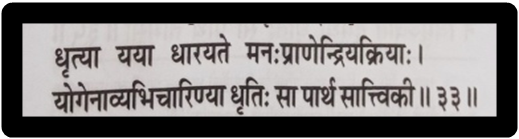
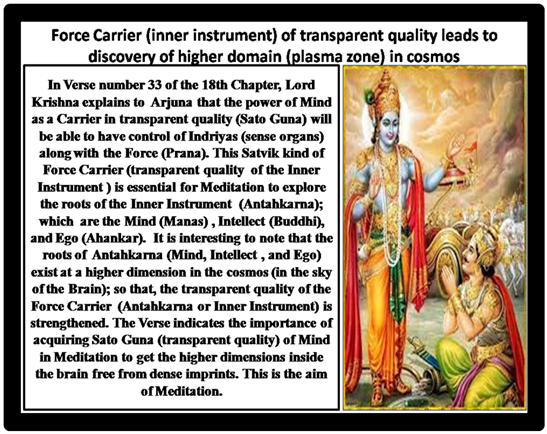
The meaning of the Verse (verse number 33 of the 18th chapter of Bhagwad Gita) indicates that Lord Krishna explains to Arjuna that the power of a mind as a carrier in transparent quality (Sato Guna) will be able to have control of Indriyas (Sense organs) along with the Force (Prana). This (Transparent quality) kind of force carrier (Sattva quality of Inner Instrument) is essential for meditation to explore the root of the Inner Instrument (Antahkarna).
It is interesting to note that the root of Antahkarna (Mind, Intellect, and Ego) exists at a higher dimension in the cosmos (In the sky of the Brain); so that, the transparent quality of the Force carrier (Antahkarna or Inner instrument) is strengthened. The verse indicates the importance of acquiring Satoguna (Transparent quality) of mind in Meditation to get the higher dimensions inside the Brain free from dense imprints. This is the aim of Meditation.
In Brief, the common platform needs the exposure of fundamental principles from both sides (spiritual as well as scientific). Hence nearness of science towards spirituality has to be examined. For this, the Structural Entanglement between Truth and the universe is compared between Microcosm (Human Body and Brain) and Macrocosm (Jagath or Universe) for better understanding, along with the Garland Model stipulated by the help of Garland Model, explored in Taittiriya Upanishad. Further, the Garland model of Taittriya Upanishad serves as a Capsule to examine the nature of Ashtadha Prakriti. Inner Human Instrument (Antahkarna) reveals its similarity to the Boson or Force carrier stipulated in the Particle Physics Model, which, in turn, provides the authentic parallel characteristics between Science and Spirituality.
8. RISHI PATANJALI’S VISION OF BRAIN (CHITTA) FOR POLITICIANS AND BUREAUCRATS
The complex structure and neuronal function of the brain need a simple way of exploration and that is found in the aphorism of Patanjali Yog Sutra. The matters dealt with here are Rishi’s vision of the Brain, the formation of the Chitta and its function as a container of Karma (Action) and Karma Phala (Fruits of Action), the rebirth concept associated with the ingredients of the Chitta and the Brain or Chitta can be further explored by common people with the help of three lobes as a replica of Chitta or Brain.
8.0 Rishi and Human Brain
The mind, or Chitta, is where all our actions or Karma are stored. According to the “Patanjali Yoga Sutra”, Brain’s right hemisphere stores negative actions or Adharma Karma, the left hemisphere stores positive actions or Dharma Karma, and the joint between the two (middle hemisphere) store virtuous actions or Punya Karma. When a spiritual practitioner or Sadhaka reaches Enlightenment, the mind becomes free from all Karmas (Actions), including Adharma Karma (Unrighteous action), Dharma Karma (Righteous action), and Punya Karma (Divine Action). This means that no knots are left in the mind to cause the cycle of Birth and Death.
The brain is a vast reservoir of all the knowledge and happenings since the inception of Human Civilization. It contains all the events of living beings since birth, where eight types of memories exist in the human body. This (stored memory) can be explored partly by adopting certain aspects of concentration or Dharana and contemplation or Dyana of Antarang yoga given by Maharshi Patanjali.
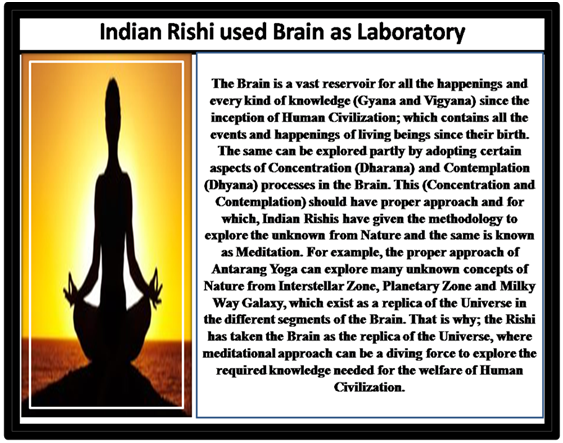
In addition to Maharshi Patanjali, there are many Rishis, who described the Yogic meditational aspects in some of the Upanishads. In this way, Indian Rishis have given the methodology to explore the unknown from Nature through Meditation. Maharshi Patanjali has provided Ashtanga yoga, which has two segments; the Bahiranga Yoga is connected with the five limbs of Yoga, starting from Yama and Niyama up to Pratyahara or the withdrawal of the Mind, and Antaranga Yoga is connected with Concentration or Dharana, Contemplation or Meditation, and Samadhi at Turiya and beyond by cleaning Chitta (Mind Stuff) free from all modification or Vritti of Mind. This indicates that the proper approach of Antaranga Yoga can explore many unknown concepts of Nature from the Interstellar zone, Planetary zone, and Milky Way Galaxy, which exists as a replica of the Universe in different segments of the Brain. The Rishis have taken the Brain as the replica of the Universe, where the meditational approach can be a diving force to explore the knowledge needed for the welfare of Human Civilization.
8.1 Scientific Approach by Indian Seers and Sages
It’s worth noting that Indian Rishis have discovered the brain to be a laboratory to explore the mysteries of the Universe. They do this by focusing on Prana as Energy and Breath as Space at different segments of the Brain. This helps them to eliminate the imprints of duality and re-establish positive aspects of vision, leading to a peaceful and harmonious life. Similarly, scientists use telescopes and electron microscopes to study the position and characteristics of interstellar, interplanetary, and milky galaxies, and balancing zones. Indian Rishis use Prana and Breath as a telescope. Rishis uses the three Inner Instruments of Manas (Mind), Buddhi (Intellect), and Ahankar (Ego) as measuring instruments during deep Meditation. Through this method of Meditation, Indian Rishis have discovered the mysteries of the Universe for millennia, while modern Scientists have been exploring the Universe for only a few hundred years.
Thus it is that we can very safely call this a scientific method of approach to life. It is scientific because it is the most systematic approach to life and it is the most inclusive of all the approaches. It includes all possible aspects of human nature. It starts from the lowest type of experience and aspires to reach the highest possible existence. It is a very graduated technique, and it is a system of living that can be applied to every human being.
8.2 Patanjali Yoga Sutra views Chitta (Mind Stuff) as Brain
Patanjali Yoga Sutra explores Chitta (Mind Stuff) containing Energy (Prana) domain, Mind (Manas) domain, and Collective senses domain as its compartments; where Action (Karma) imprints are executed for providing the respective fruits (Karma Phala). When Chitta (Mind Stuff) is purified; then the same is called “Chitta Vritti Nirodha”. This means that three compartments of Chitta (Mind Stuff) become free from any “Mind modification” (Vritti). This kind of Scenario (Chitta Vritti Nirodha) makes the meditator have a face-to-face experience (Sakshatakar) with Truth (the Effulgent Light). The chapter elaborates on the functional aspects of Chitta as collective compartments of Action and the resultant fruits of Action (Karma Phala).
8.2.1 The Chitta is the major part of the brain as the storage house for Action (Karma)
According to Maharshi Patanjali’s “Yoga Sutra,” the two hemispheres of the Brain and the joint between them are collectively referred to as “Chitta.” The Brain has three compartments: the Right hemisphere (Right Lobe), the Left hemisphere (Left Lobe), and the joint between the two (Middle Lobe). These three compartments serve as storage for Action (Karma) and Vasana imprints (Sanskara) resulting from different types of Karma. The Right Lobe stores Adharma Karma, the Left Lobe stores Dharma Karma, and the joint between the two lobes (Middle Lobe) stores Punya karma. Actions performed in day-to-day life can be categorized into three types: Unrighteous action (Adharma Karma), Right Action (Dharma Karma), and self-oriented action (Punya Karma). The imprints of Adharma Karma rest on the Right Lobe, while those of Dharma Karma exist on the Left Lobe. The imprints of Punya Karma stay at the joining part of two Lobes (Middle Lobe). It’s important to note that there is a big difference between Dharma Karma and Punya Karma. Dharma karma involves helping others, providing pleasure to associates, creating a smooth environment for others, and providing physical and mental joy (Sukha) to others. On the other hand, Punya Karma is done only for oneself. This means that Punya Karma cannot be used to do Adharma Karma or Dharma Karma for others.
Adharma Karma refers to actions that are carried out to displease others, assault them, cause trouble, or behave inappropriately. This type of Karma is also known as “Paap” or sin. We have learned about three types of Karma and their placement on three parts of the Lobe called Chitta. Chitta is the storage place for Vasana imprints, which are formed due to repeated Karma of the three types. These imprints can lead to either ignorance (Avidya) or knowledge (Vidya) domains. The text discusses the impact of repeated Adharma Karma on a person’s mind. This type of Karma can attract the mind towards either Tanmatra (Vasana) or the perceptions of the senses, including Intellect or Ahankar. This repeated Karma can lead to a state of Agyana or Ignorance in the domain of Avidya Maya.
On the other hand, when the mind is attracted to the senses, along with intellect and ego, it yields the experience of knowledge under Vidya Maya. The analysis suggests that the Chitta serves as a storage house with three compartments for the imprints (Sanskara) of different types of Karma as well as for the Imprints (Sanskar) of different types of Vasana (Karma carried out repeatedly).
At the end of a person’s life, before death, there will be an arousal of Karma Phala (fruits of Karma) in all three compartments. The image “Chitta as a storage house for different Karma and Vasana” describes the different types of Karma stored at different compartments of the Brain {Chitta}and how the Karma Phala {fruits of the Karma} becomes the decision maker for the next birth or upcoming birth after death.
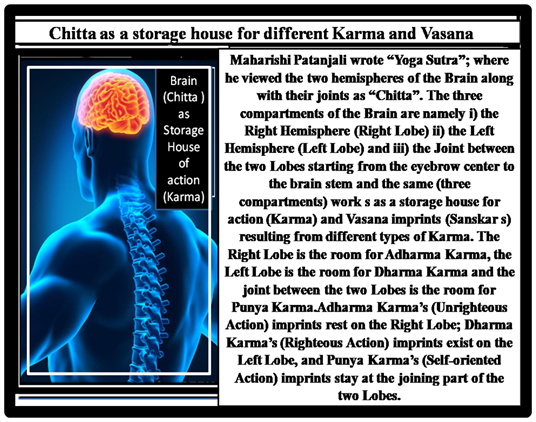
The analysis indicates that these fruits of Karma will be the decision-making factor for the person’s next birth. For example, the Punya Karma compartment will have the fruit of Action (Karma) to decide the age or Prarabdha Karma (Karma to be consumed) connected with the upcoming life. Similarly, the fruits of Action (Karma) in the Adharma Karma compartment, situated in the Right Lobe, will decide the type of Species for the next Life. Likewise, the fruits of Action (Karma) connected with Dharma Karma, also existing in the Right Lobe, will be the deciding factor for the resources to be Consumed (Bhoga) in the next birth. However, after taking out the fruits of Action (Karma) from each compartment, there will be leftovers for Karma and Vasana Karma in each compartment, known as Sanchit Karma, which is the finally stored Karma.
8.3 How Chitta is formed
Chitta is formed because of Primordial matter. What is Primordial Matter? Primordial matter consists of Atoms (Parmanu) of Sato, Tamo, and Rajo Guna in a proportionate way. This means whatever Karma is lodged there, they do have the association of the three Gunas (Anu of the three Gunas). Ingredients of three Gunas together are associated with Action, either Vasana Action imprints or direct Karma-oriented imprints. So Vasana Karma or direct Karma gets associated with the ingredients of the three Gunas of Prakriti. That is why it is called Prakriti Nirmit. Chitta is dominated by Prakriti.
8.3.1 How Prakriti creates Chitta
It is understood that Chitta is a combination of Purusha and Prakriti, but normally whole creation is carried out by Prakriti. So Prakriti creates Chitta. In chronological order, we see how Prakriti creates Chitta. In this connection, Nature or Prakriti recalls Mahan, which is also called Buddhi. Actually, Mahan is a Tattva (element); which is a helping hand to Nature and the same (Mahan) brings the ingredients from Soul (Atma) Tattva.
The Mahan brings Ahankar (Ego) and other Indriyas (Senses) including the Mind and then the same (Mahan) takes into account Panch Tanmatras and Panch MahaBhutas. So these are the ingredients recalled by Prakriti with the help of Mahan. In this way, Nature or Prakriti gets twenty-four Tattvas (Elements) including Mahan. This is the way by which Nature (Prakriti) creates Shristi (Creation).
The Jiva (Jivatma) takes the help of the Mind (Manas) as an observer to dissect the Sky (Akasha) of Chitta (Brain). The Mind and Chitta (both) are created by Prakriti (Nature). While doing creation, Nature or Prakriti makes two sub-groups. One group is Bhoothathmak and the other group is Indriyathmak. The first is connected with Panch MahaBhutas and the other is connected with Indriyas.
The quality of Nature is associated with ten Indriyas (Senses) and Mind (Manas). Among twenty-three elements of Tattva, eleven Tattvas exist at the Right Lobe. Likewise, twelve bodies consisting of Panch Mahabhutas, three Inner Instruments (Mind, Intellect, and Ego), and their (three Inner Instruments) roots along with Yama (Death) exist at the Left Lobe. Altogether, twenty-three elements or Tattva are the ingredients for Nature (Prakriti) for Creation; and the same are taken from the Right Lobe and Left Lobe during Creation.
The three qualities of Nature are Sato (transparent quality), Rajo (distorted quality), and Tamo (turbid quality). Sato is Prakash (Effulgent Light), Rajo is Kriya or Action and Tamo is Stithi or Inertia State.
This means that Prakash, Kriya, and Stithi are represented by Sukh (Happiness), Kriya (Action or Karma), and Moha (Attachment). In this way, Tamo is also called Moha, Rajo is called an action-oriented event having movement and Sato is called Light or Prakash or Sukh.
So these Gunas are also associated with Purusha (masculine characteristics). This means that Purusha is associated with the three charges.
Prakriti takes these ingredients (twenty-three elements) through Mahan. The Mahan itself is the element working for Prakriti and Nature or Prakriti works for Purusha (Atma Tattva). Altogether there are twenty-five elements including Purusha, the emergence of Truth, or Parmatma. This means there are twenty-six Tattva or elements existing in Cosmos including Truth.
Indian Rishis including Kapila Muni had visualized the functional arrangement of these Tattva (elements) in Creation. They (Rishis) found that the Human Brain or Chitta has twenty-three elements as ingredients. Because of these ingredients, Chitta consists of imprints (Vritti or Mind Stuff), and the same should be cleaned or removed with the help of yogic means or Meditation.
The Rishi says that Chitta should have the highest quality of Satva, Sukha, or Prakash amid lower strength of Rajas and Tamas ingredients. So Chitta should be highly dominated by Sattva. But it has been observed, that most of us are unable to evolve Chitta in a very Satoguna way. Mostly we are having Chitta dominated by Rajo Guna and Tamo Guna. This kind of scenario exists in Nature’s creation.
8.3.2 How Mind Modification (Vritti) Comes in Chitta (brain)
Chitta is the storage yard for the Sanskara (impressions) of three types of Karma and Vasana Karma (repeated Karma). It has three compartments, namely: storage of Adharma Karma on the Right Lobe, storage of Dharma Karma on the Left Lobe, and storage of Punya Karma on the joint between the Left Lobe and Right Lobe (Middle Lobe). When the Prarabdha Karma (Action to be consumed during lifespan) is taken out from these compartments, it (Prarabdha Karma) interacts with people, objects, places, and situations to form a certain kind of experience connected with the three Qualities (Guna) of Nature (Primordial matter). This is because the Chitta (Storage Yard) is under the influence of Primordial Matter with three Gunas.
Similarly, the Kriyaman Karma (Action to be added during the present life span) adds the three kinds of experience under the influence of the three qualities of nature. Accordingly, the result of experience after interaction will have Sato Guna (transparent or glow of light), Rajo Guna (Action-oriented or momentum in nature with distorted quality), and Tamo Guna (still condition or Moha quality) as Vritti (Mind modifications).
The Vritti (Mind modifications) is a form of cover on Chitta along with three qualities due to interaction. If not eliminated or minimized, it gets added and becomes a hindrance for Sanchit Karma available in three compartments of Chitta. Maharshi Patanjali visualized this kind of scenario and gave a solution to eliminate or minimize the Vritti (Mind modification) to uncover the Sanchit Karma with the help of Meditation. After the removal of Vritti, the direct vision of stored Karma in three compartments can be tackled to make them all in Sato Guna condition in a progressive way carried out in deep Meditation.
8.3.3 Three segments of the Brain help to coordinate the evolution of Chitta (Brain) in respect of Sabka Saath, Sabka Vikas, Sab ka Prayaas and Sabka Vishwas
A Good Governance depends on the proficiency and efficiency of the politician, Bureaucrats and their associates. If they are free from bribe, and dishonesty with the public service orientation; then, the Government is termed as Healthy Government. The prosperity of Nation depends on the methodology followed by Policy Makers and Bureaucrats so as to serve the nation in very effective way. Present Day Government Efforts is to have i) Sabka Saath ii) Sabka Vikas iii) Sabka Prayaas and iv) Sabka Vishwas; this was the main principle of Treta Yuga Ramrajya.
Ancient Indian Wisdom hints at the coordination between Rishi and the King, which was the part of running a Healthy Government for the welfare of All. For example, in Ramrajya, Rishi Vashishta and King Rama were the two segments of the Ramrajya to have desired progress amidst of General Public Welfare. This indicates that if the King is guided by the Rishi’s Vision, then the progress of the kingdom, along with the welfare of the public, is bound to happen.
In the absence of Rishi’s vision directly given to the government, at least Rishi’s Principles suggested for the “Chitta Vritti Nirodha” given by Patanjali should be adopted. Due to various Lacunas, the working methodology adopted by the Government has to be strengthened in such a way, so that the Government’s Principle and Action can be in par with Rishi’s Vision. The question arises that Whether Government thinking can be compared with Patanjali three segments of Chitta (brain) along with stability. The same has been analyzed; which provides the answer in affirmation.
The image is self-explanatory.In this connection, Swami Vivekananda has given the guidelines that “Every soul is potentially divine”. The divinity can be manifested either by Karma Yoga or by Gyana Yoga or by Bhakti Yoga or by Dhyana Yoga; which resembles with the process of adopted in evolving the four segments of the brain, explained in the image.
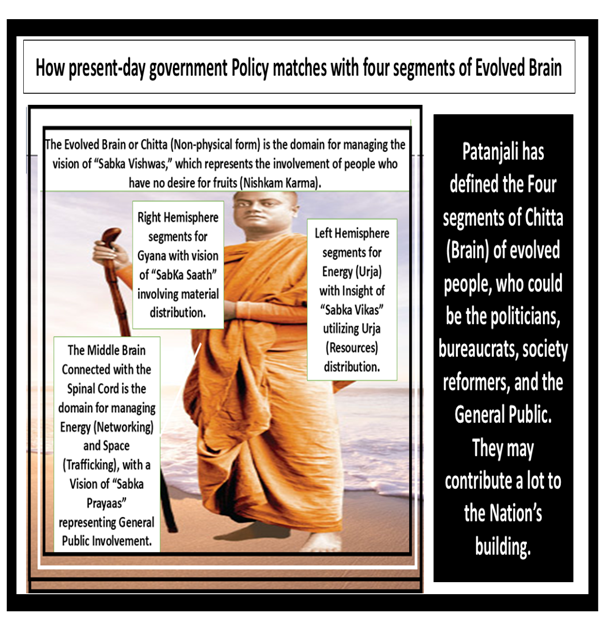
The present-day government efforts are also in tune with the Brain evolution process given by Swami Vivekananda and Patanjali.Summation of four evolved nodal parts of the brain will make the Chitta free from unnecessary imprints (Vritti).
This indicates that if politicians, bureaucrats, service people and public follow the Honesty, Integrity, Transparency, and Accountability (HITA Principle), a nation can always be progressive and healthy.In brief, Brain Evolution provides welfare to Politicians, Bureaucrats, Society, and the Individual Public.
8.3.4 Patanjali views on Three Lobes with Karma Phala
Under this, Dharma Karma & Adharma Karma, in-between Dharma Karma and Adharma Karma, Dharma Karma is carried out at the Left Lobe, and Adharma Karma is carried out at the Right Lobe. For these two types of Karma, People, Objects, Places and Situations (POPS) are the means. So, if we are troubling People, Objects, Places, and Situations (POPS), we are doing Adharma Karma, and if you are helping People, Objects, Places, and Situations (POPS), we are doing Dharma Karma. People, Objects, Places, and Situations (POPS) is the central instrument for Dharma – Adharma Karma. But Punya Karma, in that instrument or reason or cause, is Tapas, Swadhyay& Dhyan.
Tapas is by Karma Yog (Left Lobe), Swadhyay is by Gyan Yog (Right Lobe) and Dhyan is by Dhyan Yog (Central lobe). So Tapas, Swadhyay, and Dhyan are the ingredients or we can say that Karma Yog, Gyan Yog, and Dhyan Yog are fruits of Punya Karma. That is why Punya Karma cannot be utilized or cannot be used for doing Adharma Karma or Dharma Karma. It is quite separate. So Punya Karma depends upon Tapas, Swadhyay, and Dhyan (meditation).
8.3.5 Role of Purusha and Prakriti in Chitta
Purusha’s role is to expose or to have the Karma and Prakriti’s role is to add the three qualities in that Karma. This means that Purusha’s role is connected with positive, negative, and neutral charge agglomeration, which we call Bhavna or Bhava. So, Sato, Tamo, Rajo are qualities or Gunas of the Pakriti. So, Bhava with three Gunas is Chitta. So, Chitta contains the Bhava part (Bhavna part) due to charges and the Guna part due to Prakriti. So, both Purusha and Prakriti together are Chitta. Chitta will have both things.
8.4 How can the Patanjali Yoga technique be used in personal life?
It is difficult to believe that the implications of the teachings of Patanjali can be easily grasped by even the highest academic intellect because it is nothing but intricate practice that is being taught in this system known as the Yoga Sutras of Patanjali. It is not merely a theory, not a doctrine, a faith, or a religion that is propounded in these famous aphorisms. It is a technique of practice or conduct in personal life that is supposed to go into the very roots and vitals of the system and bring about a thorough transformation of the various patterns of manifestation of the individual organism.
8.4.1 Atheists and Three Lobes of the Brain (Chitta) for Karma Phala
Some people may disbelieve those who do not believe in Krishna or the Bhagavad Gita. But at least they have the belief in themselves. So they should think logically that whatever action they are doing, good or bad, or normal, naturally no action goes without giving any fruits; which means all actions have to yield some fruits. So where does it go? Where does it take place? If they follow Patanjali Yog Sutra, then they will be able to understand the meaning behind that. Yog Sutra means aphorism or capsule.
So, if they decode it, they try to bring to their structure meant for own body, then they should believe, that what for is our Right Lobe, Left Lobe, and Middle Lobe. The question arises in what way the lower-level movement, leading the spinal cord is connected to the Muladhara. There is no secret about this and they can understand the purpose of that. For that at least they should try to know “Taittriya Upanishad” (second part) where Panch Kosha is dealt with.
In that, at least they should know our five layers of Kosha, and how they are working for which kind of Karma, which kind of force, which kind of level, how the Mind and Intellect are working, and how we have Ananda (Bliss). In this way, whether they are believers of Gita or not they will have convincing facts based on the Patanjali Yog Sutra as well as Bhagavad Gita.
8.5 Different states of Chitta after Karma Phala
There are five states of Chitta (brain) namely i) Moodha state (Ignorant state) ii) Kshiptha state (Distorted state) iii) Vikshiptha state (Confused state) iv) Ekagratha state (Concentration state) v) Nirodha state (Clean state). All 23 elements (Tattva) of Creation exist in all the five states of Chitta haphazardly.
These states indicate how much Satoguna is explored among all the ingredients. If it is fully explored i.e. Nirodha, if it is less than Niruddha state then only Ekagratha state. In Meditation, Ekagratha (Concentration) comes first, and then Meditation (Contemplation) proceeds. In Concentration, the highest property of a higher quantum of Satoguna is supposed to be exposed and in Meditation (NiruddhaAwastha), once we are reaching that state, further we are exploring the same Satoguna. In case Satoguna is reduced, we can say that in Vikshipta, Moha, and Chitta, these three lower states will be dominated. In the case of the lower state of Chitta (i.e. Moodha, Kshiptha, and Vikshiptha states), Tamo Guna and Rajo Guna will be the dominating factors. It is to be remembered that Tamo Guna is heavily associated with Moha (deep attraction to objects).
In this way, Yoga makes Satoguna explore all ingredients without changing whatever ingredients we are having. While doing meditation, we purify, energize, and transform the ingredients connected with Tamoguna and Satoguna and keep them in Satoguna condition in a stable way. This kind of scenario is called Niruddha or Nirodha state of Mind (Chitta).
The clean state of Chitta (Nirodha state of the brain) can be viewed in parallel with the windscreen of a car. If the windscreen is kept clean, the outer scenario of the windscreen will be the pure state of the environment. Here, the environment can resemble with Swaroopa of Self (Brahm), the windscreen can be a replica of Chitta and the driver of the car can be associated with Jivatma leading to get alliance with Soul (Atma). In this way, the windscreen analogy helps us to understand the Nirodha state of Chitta (brain) during meditation & to achieve the Effulgent Light (Param Prakash).
The question arises as to whether Meditation is needed regularly. The answer is affirmatively and that is Yes! This is because, the purification, energization, and transformation ability of Mind from Tamo Guna and Rajo Guna to Sato Guna will not be effective if the Meditation is not done regularly. This indicates that retention of Sato Guna in our day-to-day action can be achieved with the help of Antarang Yoga i.e. Mediation, and other means of Tapas (Penance). In the absence of Tapas (Penance), Meditation is the only means to retain Sato Guna along with the Mind for day-to-day interaction with people, objects, places, and situations.
9. PRESENT-DAY GOVERNMENT’S EFFORTS BASED ON RISHI’S VISION
Every Govt. has a vision for its nation and the best minds get together to formulate a policy by best practices of the past and existing practices adopted by other countries, who have like-minded visions on the subject. When the country has a youthful population, it needs a policy that goes by the psyche of the Youth who are, talented and resourceful yet pliant and easily led. In such a scenario this chapter highlights what spirituality provides as a sure-fire solution for the same.
9.0. Rishi Vision is a compatible and guiding factor for the Present Government’s Efforts
The Indian Rishi has dissected the Microcosm (Body and Brain) and found it similar to a reading of the structure of the Universe (Macrocosm). That is why they have coined the term ‘YathaBrahmande Tatha Pinde’. This means whatever objects, events, and Laws of Nature are observed in the Universe (Macrocosm), similar are observed in the Human Body and Brain (Microcosm). They found that each individual is trying to attain Happiness, Love, and Peace on a progressive level. They also have visualized that ultimately Ananda (Highest Happiness), Prema (Unconditional Love), and Shanti (Eternal Peace) are the fundamental needs for a Human Being to attain salvation.
This indicates that there could be three domains in the Brain; from which, these fundamental needs could be explored sequentially. Rishi also found that the structural segment of the three compartments of the Brain should have the permutation and combination in such a way; so that, the fundamental needs (Ananda, Love, and Peace) could be obtained. They visualized that these needs could be obtained by using different strengths of Energy, Space, and Consciousness parameters at each Nucleus (Center).
In brief, the fundamental use of Energy, Space, and Consciousness is the basis for obtaining the needs of the Human Civilization with the help of three segments or compartments of the Brain to be understood; so that, individual, society, country, and world as a whole can lead towards healthy, wealthy and prosperous society with quality and sustainability. This indicates that proper utilization of Energy, Space, and Consciousness can make individuals, societies, countries, and the world hail and healthy with peace and prosperity.
Indian Rishi’s vision is stated in the Upanishad based on fundamentals given by Veda and the same was coined by Maharshi Patanjali in Yoga Sutra; which works as a capsule in the present era. Though, the Yoga Sutra of Maharshi Patanjali seems to be a very complex form; however, the same (Yoga Sutra) can be utilized and understood in layman’s language.In layman’s language, the utility of three compartments of the Brain could be explored for Karma and Karma Phala while eliminating Chitta Vritti (Mind Stuff). The exploration of these three compartments of the Brain will yield the fruits of the three needs (Happiness, Peace, and Prosperity); for which, a combination of Energy, Space, and Consciousness will be implemented.
9.1 How can Common People understand Rishi Patanjali’s Chitta as the Brain?
Worldly people understand that the implications of the teachings of Patanjali can be easily grasped by the highest academic intellect because it is nothing but intricate practice that is being taught in this system known as the Yoga Sutras of Patanjali. Patanjali Yoga Sutra is generally studied by a seeker who tries to evolve in higher dimensions of life to obtain Salvation (Moksha). However, If we take the theme “Chitta Vritti Nirodha” of Patanjali in a layman’s language; then we find a clue that when common people can make use of the Patanjali Chitta as the Brain for day-to-day correction and enjoy the progressive life. This is because, through successive evolution processes, the Yoga Sutra provides a way to obtain Harmony, Peace and Prosperity progressively.
The common people should also know that it is not merely a theory, not a doctrine of faith, or a religion that is propounded in these famous aphorisms.
It is a technique of practice or conduct in personal life that is supposed to go into the very roots and vitals of the system connected with psychological problems and their corrections and also to bring about a thorough transformation of the various patterns of manifestation of the individual system and organism.
For example, Human Beings have five systems. They are the central nervous system, circulatory system, and excretory system associated with the respiratory and digestive systems. Among them three systems are prominent and they exist in the Brain; which has three compartments namely i) the Right Lobe (R.L) controlling the central nervous system, ii) the Left Lobe (L.L) controlling the circulatory system, and iii) the Middle Lobe (M.L) controlling excretory system associated with spinal cord consisting control for the circulatory and digestive system.
The concept describes the “Patanjali Chitta as the Brain”; controller of all the systems, organs, tissues, and cells of the Human System. This indicates that the three compartments of the Brain are kept hale and healthy, and the physical, emotional, and mental functions of the brain can be utilized in the best possible manner in Karma Yoga; especially in day-to-day transactions of government for the benefit of common people in a nation.
The group consisting of Government people with Bureaucrats can perform the day-to-day duty efficiently; if the purification, energization, and transformation ability of the three lobes (R.L, L.L, and ML) are kept hale and healthy.Though Maharshi Patanjali provides complete inner transformation; his concept should also be taken by common people to evolve in creative aspects of vibrant personality for achievement in progressive day-to-day life.
9.2 Swami Vivekananda’s view for good governance and political stability
Swami Vivekananda wanted “Vedanta (Spirituality) to be spread at every doorstep of the people, especially among the youth, so that a balanced and healthy society can grow”. This also gives the message that the Government, NGO, Social workers, and other members of Society can maintain a decent interpersonal relationship with the least possible disparity so that criminal growth can be reduced from the negative approach taken by them. This requires the exposure of spiritual messages to every member of the society. The Vedantic approach will lead to achieving a harmoniously balanced mind among the members to have overall growth cum development of individuals and the society at largequality and sustainability.
Swami Vivekananda visualized the potential approach of Vedanta even for the society makers such as Rulers, and Political leaders, and also for the Society destroyers (such as Criminals and Terrorists). For example, if the Criminal and Anti-social elements are simply led by the laws and uniformity is sought from them by punishment; they will try to escape the punishment and will have no sense of shame. If they are led by virtue, moral and ethical values and a certain amount of uniformity sought among them through the practice of Vedantic concepts, they will possess a sense of shame and they will be back to follow the law of the land. That is why; Swami Vivekananda wanted this high-level philosophy for the political people as well as for criminals.
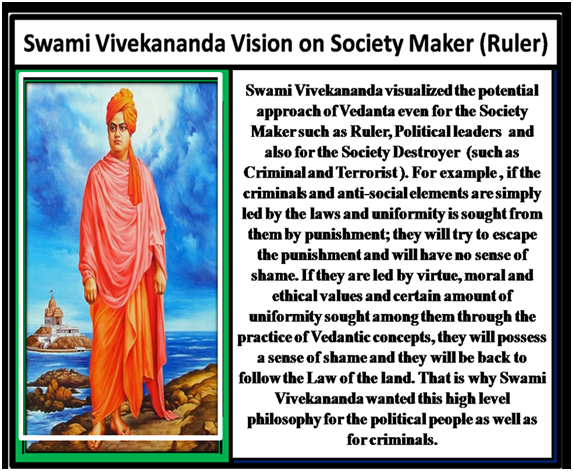
Vedanta advises that good governance depends on the awareness of the respective role of an individual’s responsibility & alertness to others’ rights such as “ruler being a ruler, a father being a father, a mother being a mother, a son, and daughter being son and daughter” for dutiful roll. This will help to understand the respective duty and also to protect the other’s rights. Normally, we try to visualize the other’s duty and self rights whereas Vedantic philosophy says it should be vice versa. This means we have to visualize our duty and associate’s rights so that the difference of feeling in the generation gap will not arise. Vedanta advocates the science of values in terms of virtue, moral, and ethical approach. The political philosophy of Vedanta provides for a good social and political balance if the logical & rational concept of Vedanta is followed.
To utilize Vedanta along with Yogic concepts, an experienced Yogic institution should be involved to frame a suitable course for different types of individuals and criminals. While planning Ramrajya in India, refresher courses designed by Yogic institutes (like SVYASA) are to be implemented. In addition, a concept on skill development for i) Teamwork work ii) Supervisors iii) Managers iv) Management people (Policymakers) is also to be evolved with the help of Yogic institutions.
9.2.1 Vedanta speaks on the Criminal domain
Whenever there is a big gap or inequality or disproportion between one section of society and a strong negative personality, it leads to criminal growth. For instance, the disparity is more between master and servant, rich and poor, capitalist and workers, aristocrats and tenants, there could be the growth of criminal action. This is because the greater quantum of disparity leads to top bitterness in the relationship between servant and master, poor and rich, worker and capitalist, exploited and strong person, and tenant and aristocrat. However, till a balanced mind exists with servants, poor, workers, exploited and tenants then there won’t be much problem in the society. If the discrepancy is beyond the threshold value there could be the scenario of an exchange of blows, emotionally charged behaviors, majority feeling, and suffering at both ends. This in turn will result into loss of the balance of mind, which in turn paves the way for criminal attitudes, depending upon the character and type& severity of criminal personality.
That is why Swami Vivekananda wanted Vedanta to be spread at every doorstep of this society, especially among the Youth, so that a balanced and healthy society can grow. This also gives the message that the Government, NGOs, Social workers, and other members of Society to maintain a decent interpersonal relationship without any disparity so that criminal growth can be reduced from that angle. This requires the exposure of Vedantic message to every member of the society to achieve a harmoniously balanced mind among the members to have overall growth of the individual and the society at large.
The Youth get affected by the negative thoughts in two ways, namely getting individually affected in a negative direction acquiring “sorrow and ignorance” and affecting the others or associates by becoming “cruel and evil” to them. Vedanta illustrates how to overcome sorrow with joy, ignorance with wisdom, cruelty by kindness, and evil by goodness. The topic dealing with “failure, frustration, boredom and suffering” explains the Vedantic way of overcoming these problems.
Whenever youth get affected by negative thoughts, they act in such a way that they will have failure, frustration, and suffering. Whenever they get dominated by negative thoughts for others or associates they will be cruel, jealous, harsh, and bad for them. The topic deals with “Crime and Terrorism” and explains the effect of negative emotions, thoughts, and opinions developed for other sections of society. Vedanta analyzes the approach to handle such kinds of situations.
Normally, Youth will have (i) Ability (ii) Intellect (iii) Talent (iv) Opportunity seeker quality in different proportions. When they tend towards the criminal profession, they develop (i) an Alertness to escape the law of society (ii) Use their intellect in the negative direction (iii) Convert their talent or skill to that profession and visualize the opportunity to be always safe so that they don’t come under the control of any laws. The environment helps them to grow their inner faculties (in the negative direction) to the highest extent. The disparity in Society enhances their growth in Criminology and they adopt this profession enjoying whatever they do without any shame.
9.3 How Government follows Rishi’s path
Rishi’s concept endorses the present-day Govt.’s performance. If we analyze the Brain or Chitta viewed by Patanjali, we find that Patanjali has nicely dissected the Brain into three parts namely i) Right Lobe ii) Left lobe iii) Central Lobe, whereas scientists have also visualized the Brain in their way by dissecting it into different parts like Cerebellum, Cerebrum, Middle Brain, Side Brain, Lower Brain, etc. There is no ambiguity in finding of scientific concept but one plus point found in Rishi’s path is the simplicity of Brain analysis connected with our day-to-day action (Karma) along with fruits of action (Karma Phala).
Having compartmentalized the brain into three parts in a simple way, Rishi has seen many activities of our day-to-day interactions with people, objects, places, and situations and their findings placed in the brain accordingly. For instance, the Right Lobe is a place for Action and its fruits; when one is performing Karma in an Unrighteous way (Adharma Karma). Unrighteous actions carry performance under the six temperaments of man which are Desire, Anger, Greed, Lust, Ego, and Jealousy. The result of this kind of action is in an Unrighteous way, the results will be lodged at Right Lobe. Similar Righteous action (Dharma Karma) will be lodged under Left Lobe and Punya Karma (Pious actions) will be deposited in the Middle Lobe.
Finally, these three Lobes guide the individual as a warning for one’s performance to lead day-to-day happily and also the plan of one’s life. For example, the result at Right Lobe will lead to an unhappy life as well as the decision-maker of future life or next Janma. To lead a happy or unhappy life in the present moment as well as to go into future species in the next life, the result at the Right Lobe is the determinant.
Similar is the case with the Left Lobe and the Middle Lobe. The Left Lobe shows the enjoyment (Bhoga) ingredients to be activated in the present life and also to be available in future life. Likewise, the Middle Lobe will lead to happy or unhappy moments, at the same time Middle Lobe is the decision maker to have longevity in future life.
The above analysis indicates that the Right Lobe allows us to reform or minimize our six temperaments to have a better present and also a better future (next life). Similarly, the Middle Lobe provides the signal for pious action or performance to have self-upliftment in the present life as well as to have longevity in the next life (life after death). Likewise, the Left Lobe will transform to enjoy life with the available ingredients as well as in future life based on accumulated Righteous Actions (Dharma Karma). In conclusion, we can say that the Right Lobe is a place for Reformation, the Middle Lobe is a place for Performance and the Left Lobe is a place for Transformation. This is a natural way of leading life according to the Law of Nature.
9.3.1 How Present-day Government functions with Reform, Perform, and Transform concepts
Present-day Govt. follows truly the Laws of Nature by reforming the country’s laws to have better performance, so that the same can be transformed into a three-dimensional manner for the betterment of society. This kind of Government action plan for performing and transforming will have sustainability will support for the Nation’s growth and development.
In this connection, the analysis of Reform, Perform and Transform concepts connected with the Right Lobe, Middle Lobe, and Left Lobe of the Yogic Brain can be explored. In Yoga, the main emphasis is given to purifying and energizing the three Lobes of the Brain along with the spinal cord (vertebra). These concepts (Reform, Perform, and Transform) are needed for the best possible implementation of any Righteous Ambition (Sankalpa) to be carried out for common people.
”How reform, perform and transform” are integrally related to Right Lobe, Middle Lobe (spinal cord), and Left Lobe? As per Yogic Upanishads, the Right Lobe covers the weakness of the mind (Manas) carried by all senses (Indriyas) and the same are to be purified; so that, Unrighteous work (Adharma Karma) like bribes and corruption have to be minimized. Once the Right Lobe is purified and energized, this will reform the weakness of the mind concerned with Politicians and Bureaucrats.
Similarly, the Middle lobe is the domain for Pious Action (Punya Karma). When this Lobe (Middle lobe or spinal cord) is purified and energized, the Pious Action (free from corruption) will be performed by the concerned officials to implement the mission of the Government.
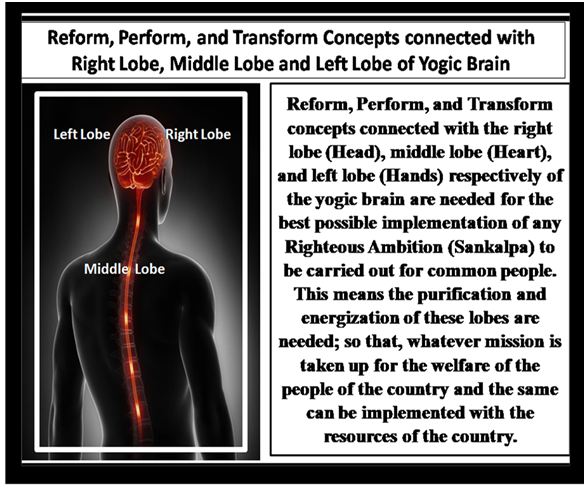
Likewise, the Left lobe is the domain for Righteous action (Dharma Karma). When this lobe (Left Lobe) is purified and energized, the Righteous action (Dharma Karma) will be transformed among the people of the society by the Politicians and Bureaucrats.This indicates that Politicians and Bureaucrats should possess the three domains of the Yogic brain (R.L, M.L, and L.L) in purified and energized form; so that, reformation of the Law of Land and vision of Government could be implemented, keeping Reformation, Performance, and Transformation concepts effectively.
9.3.2 Why Politicians and Bureaucrats should follow Rishi’s Path
Normally, Politicians and bureaucrats do not follow Rishi’s Path; especially, the path shown in Rishi Patanjali’s Concepts. While analyzing the Karma Theory amid the Patanjali Concept, the rebirth concept connected with Jaathi(species in the Next Birth), Bogha (means for enjoyment and suffering of Next Birth), and Age or Life for Next Birth is auto-determined based on Adharma Karma, Dharma Kharma, and Punya Karma carried out in the present life respectively. If this (Next Birth auto Processing) is well known to the politicians and Bureaucrats; then, there will be a Great Check on day-to-day Corruption carried by them.
If Politicians and Bureaucrats were to adopt the Rishi concept with a focus on the betterment of conditions for Society to gain from it, then Politicians and Bureaucrats would benefit by leading a happy life in the current birth as well as creating a better future for themselves in the next life. In turn by their actions, Society would also get benefitted. This is possible when Politicians and Bureaucrats inculcate the concept of HITA (Honesty, Integrity, Transparency, Accountability) principle in their day-to-day lives. HITA Principle along with the Patanjali auto rebirth concept will make them (politicians and bureaucrats) serve the public in a committed, dedicated, and enthusiastic way.
9.3.3 Need of Antaranga Yoga for Bureacrats, Administrators, and Ministers
There are two parts in Astanga Yoga and they are i) Bahiranga Yoga and ii) Antaranga Yoga. The Bahiranga Yoga is essential for the common public including Youth to explore the bodily inner potential for day-to-day progress and success. This (Bahiranga Yoga) has five dimensions of Ashtanga Yoga starting from Yama – Niyama to Pratyahara and the same is widely discussed in “Sadhana Padha” of Patanjali Yoga Sutra.
The Antaranga Yoga, which consists of Dharana, Dhyana, and Samadhi segments of Patanjali Astanga Yoga and the same is elaborated in “Vibhuti Pada” of Patanjali Yoga Sutra. This (Antaranga Yoga) is essential for Bureaucrats and Ministers especially to understand the in-depth meaning of the “Reformation, Performance and Transformation” concept of the present-day government; so that the progressive performance of the Government could reach to common masses (Janata Janardhan) of the country in three-dimensional form. To achieve the complete knowledge of Action (“Reformation, Performance and Transformation”), deep Contemplation (Meditation) is the means; which can be inculcated with the help of Antaranga Yoga of Patanjali explained in Vibhuti Pada.
9.3.4 Yogic Test (On three Lobes) for the involved Ministry and Bureaucrats
Government efforts should be focused on administrative reforms by the Ministry with the help of the Right Lobe (RL), performance by video crafts with the help of the Middle Lobe (ML), and translation of the policy to the public with the help of Left Lobe (LL). The young generation of any country is the country’s wealth, provided they have a competitive nature, & are well-skilled in different fields, have proper education, social culture, and are well-disciplined.
They (Youth) occupy one-third of the nation’s population and they are supposed to be the future of the country. Hence they are to be cultured and should be kept in the domain of well-disciplined citizens, and they should be free from violence and anti-social activity. That is why they have to fulfill the requirements needed for a healthy structure of the younger generation. The healthy structure of youth hood needs full awareness of the environment around them, the economy available in the family where they live,resources available around them, inner and outer education to the extent possible and culture in local heritage.
9.4 Domain of Political justice with a Spiritual approach
Political justice should be backed with the theme of Spirituality; so that the projected Government scheme should be implemented in complete sense for the common people. The social structure at the grassroots level consisting of Village Panchayat, Municipal Ward, and Society should be well aware of Yogic science like Asanas and Pranayama. For achieving good governance, there should be a general approach to develop the Head, Heart, and Hands (3H) of the common people (Janata Janardhan) and also for Bureaucrats and Ministers. This development (3H development) will ensure the satisfactory implementation of Government Law and Order. The administrative reformation, performance by video craft, and transformation to the public are to be discussed with the help of the Human Brain Model (Head, Heart, and Hand). In this connection, the present-day Government’s efforts connected with the Reformation, Performance, and Translation of projected aims for the three-dimensional progress of “Sab ka Saath, Sab ka Vikas, Sab ka prayas, and sab ka vishwas” are being implemented successfully; which is the sign of healthy domain of political justice with a spiritual approach.
9.4.1 Government and NGO approach for rehabilitation of Criminals
The mental disorder among the people has grown mainly in the field of Criminology. This is because the criminals become more confused and aimless to lead a peaceful life. The living pattern of criminals has to be reworked to rehabilitate them into the mainstream of a favorable society. Though many professionals are working to improve the behavioral aspects of criminals, a prominent one is the psychologist. The science of Psychology deals with the intersection of General Human Psychology and the legal aspect related to criminals. The role of a psychologist is to help criminals in person, at hospitals, institutions, and also at community centers to counsel them to adopt a better social life.
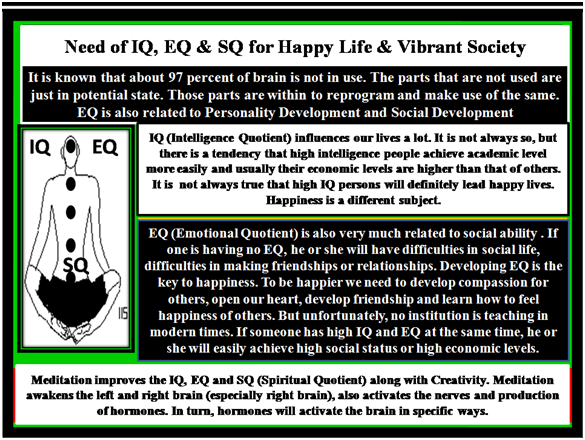
In addition, the Emotional Quotient (EQ) of the victims or criminals has to be developed or nurtured; so that, they can understand their inner potential to utilize the same for the minimization of their negative emotions. It is a well-known fact that criminals have adequate development of Intelligence Quotient (IQ). However, they lag very much in the development of EQ and SQ. Hence there is a need to develop their Emotional Quotient (EQ) and Spiritual Quotient (SQ). This is because; criminals have strong IQ (Intelligence Quotient), of course, utilized in the negative aspects of intelligence and very much lagging in the growth of EQ and SQ. This needs either a Yogic or philosophical approach to improve the same to bring them on the mainstream of peaceful, value addition, and social life.
That is why; Vedantic philosophy can be used as an applied tool to evolve their EQ and SQ. To implement this Yogic concept, the government, NGOs, and reformers should keep these Quotients in mind to develop criminals’ nature towards Sattva Guna (kindness and goodness of their nature). Mainly criminals lead their lives in Darkness (Tamo Guna) which keeps them very much ignorant of the prevailing facts and figures of a healthy and happy society. They are very active (Rajo Guni) but because of ignorance, their mindset is very extreme in a negative direction. Various yogic concepts along with meditation help them to transform their behavioral pattern. To make this process more effective, NGOs should get an opportunity to work with the Government on a Partnership Model with a priority on Developmental Rehabilitation covering Medical, Social, Economic, and Environmental Areas.
Meditation improves the IQ, EQ, and SQ (Spiritual Quotient) along with creativity. The meditation awakens the left and right Brain (especially the right Brain) and also activates the nerves and production of hormones. In turn, hormones will activate the Brain in specific ways. The development of the Brain along with IQ, EQ, and SQ; have been tabulated in the image in brief.
9.5 Importance of EQ to obtain the vision of Ramrajya
After independence, there was thinking about the establishment of Ramrajya in India (of course at a later stage) when the background to achieve Ramrajya is supposed to be fulfilled. Because of the inherent problems prevailing after the independence, policymakers of India could not pay attention to the subject (Ramrajya). However, Mahatma Gandhi, the father of the nation, kept in his mind the concept of Ramrajya.
Emotional Quotient is also important for nurturing the common people who are part and parcel of the society. Earlier, we analyzed that the development of EQ helps even criminals to adopt the mainstream of social life. This quotient (EQ) is equally important for common masses. It is understood that factors like Vibrant Individuals and a Vibrant Society are very important for Ramrajya. Among the two, the first one (Vibrant Individual) is the most important and will be responsible for implementing the rules and regulations of Ramrajya. Generally, people are intellectually developed having high IQ (Intelligence Quotient) but lagging in EQ (Emotional Quotient). There are many methods to develop or evolve EQ but Yoga seems to be the easiest one. When IQ and EQ are equally developed there will be the least possible chance of corruption in the society. This is because corruption exists wherever IQ is more but EQ is less.
Similarly, another factor that is dragging society is materialism. People become more materialistic and try to hoard the wealth, whenever there is a large disparity in financial conditions between rich and poor. By developing EQ, this disparity will be minimized or eliminated. Likewise, the problem of manipulation (another factor of poor society) depends on caste, language, area, and religion. When EQ is developed the factor like manipulation is minimized or eliminated. The analysis indicates that whenever these factors (corruption, materialism, and manipulation) are minimized or eliminated, the favorable atmosphere of Ramrajya will prevail. By this means we can conclude that the development of EQ of individuals is very important for the establishment of Ramrajya and the same can be built up with the help of Yogic practices.
9.6 Healthy and Cultured Youth is a Need for Present-day Government
In this connection, it should be noted thatthe function of life is a combination of Energy and Matter; which is the natural scenario. Physical illness (disease) is the main hindrance to the utility of Inner Energy. The same is analyzed and explored. When Energy and Matter are kept balanced, the Youth have a vibrant personality due to the utilization of Pure Matter existing at the Right Lobe. The Right Lobe is the domain for eleven senses including the Mind (Manas) and the same consists of all negative aspects of Life Chakra. Hence the Youth of the Modern Era should have a complete understanding of the Right Lobe to contribute to the development of a happy and prosperous life; and to have the progressive development of the country.
In this connection, in the Life Chakra, immoral values are bound to erupt in the Right Lobe. For this, complete knowledge is required to eliminate the same with the help of Yogic Science.If the ability, intellect, talent, and vision of Youth are turned into awareness, inspiration, positive skills, and a vision of organizing capability; they will become good management professionals with scope for their empowerment covering Social and Economic Domains.
10. APPROACH TO MANAGE CRIME BY DIFFERENT SEGMENTS OF SOCIETY
It seems to be illogical to talk about Spiritual Awareness in the context of Crime; where people know that the Law of the Land can be used as a preventive measure and punishment can be used as a curative measure. But still, Crime is increasing. It has been observed that certain aspects of spiritual skills can also be used as preventive and curative measures in case of rapid growth of crime.
10.0 Criminality in Society
The administrative way can also reduce the criminal aspects of Society but that cannot sustain all types of criminals. For instance, the Government can give signals, clues, and warnings against Crime; still, the Human Mind can overlook these messages and ignore them because of certain weaknesses like negative thoughts & approaches prevailing in the minds of criminals. A criminal who is a little positive can be alert to warnings and signals given by the Administrator & Government; still, many criminals may get caught by the strong impact of the criminal mind. This attitude of mind can be minimized by developing hidden divinity in criminals.
10.1 Criminals and Anti-Social Elements in Society
Criminality is imposed by the Inner Mind (Subconscious Mind), which makes it bad in terms of cruel & tough criminals adopting violence. But the criminality imposed has to be solved; otherwise, individual criminals will try to escape the Rules and Regulations of Society. Let us examine the type of criminal. If we see the difference between a progressive personality and a criminal, we find the main factor is Cruelty in place of Compassion like a progressive Personality.
Criminals will develop Reaction, Rejection, Condemnation, and Hatred attitudes in place of Compassion, Mercy, Pity, and Kindness. Criminals will not have a sense of Forgiveness, Tolerance, and Acceptance of others which will not be good for him or her. The antisocial element will also have more sense of Jealousy, Hatred, and Malnutrition of the Mind. This is clear when we explore a question like “How do the young become criminals?”
10.1.1 How do the Youth become Criminals?
The tendency of Youth towards the Criminal scenario is because of Poverty, Unemployment, Dependence on welfare, and children through Illicit Relationships.
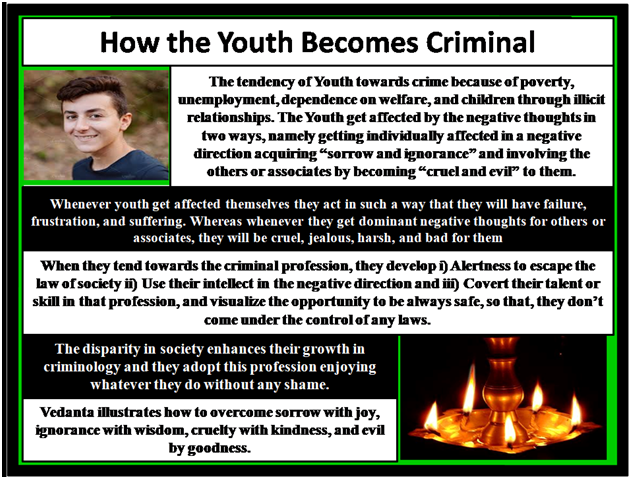
The Youth get affected by negative thoughts in two ways, namely getting individually affected in a negative direction acquiring “Sorrow and Ignorance” and affecting others or associates by becoming “Cruel and Evil” to them.
Vedanta illustrates how to overcome Sorrow with Joy, Ignorance through Wisdom, Cruelty by Kindness, and Evil by Goodness. The topic dealing with “failure, frustration, boredom and suffering” explains the Vedantic way of overcoming these problems. Whenever Youth get affected they act in such a way that they will have failure, frustration, and suffering. Whenever they get dominant by negative thoughts for others or associates, they will be cruel, jealous, harsh, and bad to them.
The topic deals with “Crime and Terrorism” and explains the effect of negative emotions, thoughts, and opinions developed for other sections of society. Vedanta analyzes the approach to handle such kind of situations.
10.2 Spirituality speaks on Criminal domain
Swami Vivekananda wanted Spirituality to be brought from the forest to the doorstep of every individual especially, to the young. This was because; he visualized the potential approach of spiritual culture even for the masses in Society & also for Society makers such as Rulers, and Political leaders, and also for the Society destroyer (criminal, antisocial element, and terrorist). For example, if the criminal and antisocial elements are simply led by the laws and uniformity is sought from them by punishment; they will try to escape the punishment and will have no sense of shame. This is because they don’t take their acts as feeling ashamed and they aim to escape from the punishment. If they are led by virtue, moral and ethical values and a certain amount of uniformity sought among them through the practice of spiritual concepts, they will have a sense of shame and they will be back to follow the law of the land. That is why Swami Vivekananda wanted Spiritual Culture (which seems to be a high-level philosophy) for the Political people as well as for Criminals.
10.2.1 Role of Spirituality from a Criminal point of view
Money is the prime attraction for everyone. For criminals, it is one of the main objectives to achieve as much as wealth.
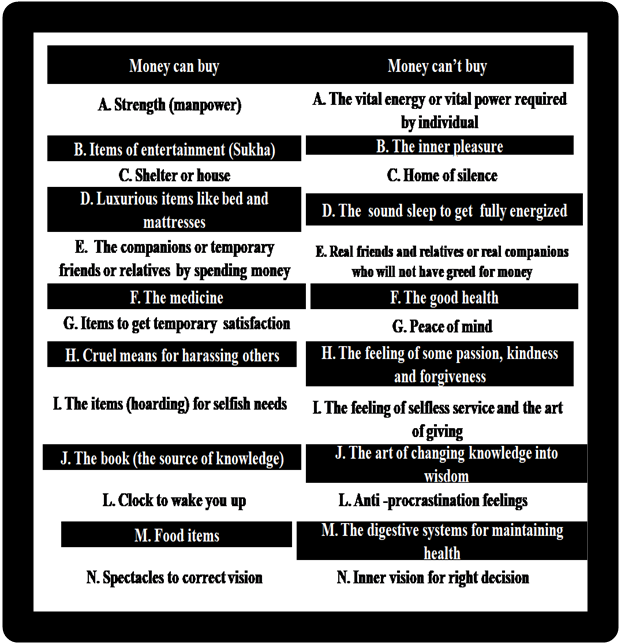
When they understand the limitations of money, their attitudes towards money will be reduced. It is a difficult task to get detached from money. However, an attempt can be made to have less dependency on money with simple living and high thinking. In brief, Spirituality can be defined as the attainment by which the limitation of money can be understood. Many items or things can’t be bought with money. For example, money can buy certain amusing instruments like musical instruments but cannot buy the inner pleasure of having a trance or inner silence. It is difficult to get separated from money, but the same can be effectively used to transform people’s drawbacks. In this process, people develop the attitude and feeling to get inner satisfaction which, otherwise, would have not been achieved. Likewise, there are several things which money can & can’t buy and the same are listed on the above image. The Table illustrates the limitation of money, which in turn helps us to realize unfair means of doing activities.
10.2.2 Spiritually evolved people should tackle the criminal situation
It is also true that if an individual understands the possession of three forms of energy & their positive utility, they become spiritual. The analysis helps to illustrate the transformation of energy to nurture people to become spiritual-oriented. In the case of Physical energy, the dormant energy (Prana) is changed into positive or constructive energy; then Physical energy is utilized for spiritual purposes. Similarly, Mental energy balances the conflict between Emotion and Intellect for spiritual application. Likewise, the conscious energy balances the two opposite circumstances like negative and positive forces, sleep and awareness, work and no-action, ambition and lethargic attitude & psychic power, and intellectual power. This kind of balancing of energy is the purpose of Spirituality. Mental chattering or inner dialogue is mainly the by-product of negative thinking or mal-nutrition of the mind. This needs the process of decoding from the inner self otherwise; the same may work against the evolution process of the mind.
10.3 Social Disparity Leads To Criminal Growth
There is something about this proverb “Prevention is better than Cure”. If little preventive approach is taken then big incidents related to criminal offence can be avoided. This can be demonstrated with the help of an incident that occurred during the Mauryan Rule. Once, there was a theft in the house of a big businessman who was a miser & used to hoard money & jewels. The thief was caught & the case was put up in the judicial court of King Maurya. The King asked the thief “If you have no means to take two times meals in a day, you could have appealed to the kingdom & certainly you would have got the food to survive”. The thief answered “Your honor! That was not a problem.” The king wanted to know further reasons for his commitment to theft. The thief answered, “Your honor! the way the miser businessman was hoarding and accumulating the wealth, that tempted me to do this kind of act.” The King referred this matter to his management Guru “Chanakya” as he wanted to seek his Guru’s advice on this complicated matter.
Chanakya, the management Guru of the Maurya dynasty, had given a verdict that both the miser businessman & the thief should be punished. The businessman should be punished as he had made a huge disparity in society by not using his wealth properly. Had he taken proper care in case of expenditure of his wealth (for his own needs and also for his family’s requirements), the gap between his hoarding and distribution of money in Society could have been narrowed down. The miser businessman would have taken preventive measures against the theft by properly using his wealth in Society, but he lagged. Society needs to narrow down the disparity between Rich and Poor, between Greed and Generosity, and also between Knowledge and Ignorance. The absence of preventive measures in social life allowed the thief to get tempted to commit that kind of act. Hence Management Guru Chanakya said that the miser businessman should also be punished.
Whenever there is a big gap or inequality or disproportion between one section of the society consisting of a strong negative personality and common people in the society, it leads to criminal growth. For instance, if the disparity is more between master & servant, rich & poor, capitalist & workers, aristocrats, and tenants, there could be the growth of criminal action such as terrorism, hi1jacking, economic offense, murder, and rape.
This is because the greater quantum of disparity enhances the bitterness in the relationship between them (servant & master, poor & rich, worker & capitalist, exploited & strong person, and tenant & aristocrat). However, till a balanced mind exists with servants, poor, workers, exploited and tenants, there won’t be much problem in Society. If discrepancy beyond the threshold value persists, there could be the scenario of an exchange of blows, negative emotionally charged behavior, bad feelings, and suffering starting at both ends.
This, in turn, will result in the loss of the balance of the mind, which paves the way for a criminal attitude. There will be a reaction in the minds of the criminal who will reject the law of uniformity, will go for criticism of the existing laws, and will hate the affluent masses. The scenario will depend on the type of criminal and his or her characteristic behavior.
That is why Swami Vivekananda wanted “Spirituality to be spread at every doorstep of Society, especially among the youth, so that a balanced and healthy Society can grow”. This also gives the message that the Government, NGOs, Social workers, and other members of Society to maintain a decent interpersonal relationship with the least possible disparity so that criminal growth can be reduced from the negative approach angle taken by them. This requires the exposure of spiritual messages to every member of the society to achieve a harmoniously balanced mind among the members to have overall growth of the Individual and Society at large.
10.4 Types of Criminals
If we see the difference between a progressive Personality and a Criminal, we find the main factor is Cruelty in place of Compassion like that of a progressive Personality. Criminals will develop reactions, rejection, condemnation, and hatred attitudes in place of compassion, mercy, pity, and kindness. Criminals will not have a sense of forgiveness, tolerance, and acceptance of others who will not be good for him or her. The antisocial element will also have more sense of jealousy, hatred, and mal-nutrition of mind.
Forensic Science categorizes many types of criminals like terrorists, economic offenders, abductors, murderers, criminals committing rape, and criminals because of depression in Mind. The criminals are committing offenses because of poverty, meanness & pettiness attitude, and exploitation. The poverty in Society enhances the criminal activities and they do economic offences and certain other types of crime. Likewise, meanness & pettiness prevail in Society because of a lack of moral and ethical values. This kind of situation leads to rape, violence, aggressive attitude, and murder. Similarly, exploitation in Society creates violence, abduction, and murder. Forensic Science provides the analysis, investigation, and reports of the cause of incidents or crimes of different types. Another reason for the growth of Criminal Society is a misuse of fight and flight mechanism happening in our adrenal gland.
10.4.1 Type of criminal as per Spiritual approach
Spiritual Culture categorizes mainly four types of criminals namely (i) Strong criminals (ii) Ambitious criminals (iii) Weak criminals (iv) Need-based criminals. In connection with Strong criminals, it can be noted that they are sensitive and full of awareness of their activities. They are creative but cruel, have no compassion, are dynamic in a destructive direction, efficient, energetic, forceful, keeping guiding ability and helping hand for destructive force. For example, murderers, terrorists, and abductors come under this category.
There are two kinds of ambitious criminals such as (a) Selfish & mean-minded and (b) Crooked and clever type. Selfish & mean people, they exploit & cheat others, thinking themselves clever & getting successful in life. They can’t evolve in the process of mental evolution. They are very much ambitious.
At the same time, crooked & clever types of criminals come due to the malfunction of the cerebral system of human beings. If the cerebral system is not completely developed for the criminal mind, then there will be vast destruction of society due to the cleverness of the criminals. In that case, they are better than animals as animals are also clever.
In the case of the crooked and clever type of criminals, the malfunctioning of the cerebral system is the guiding factor for this type of criminal to act in a way detrimental to society. The Weak criminal does not pose much of a problem to society. However, this kind of criminal can become need-based, ambitious, and strong criminal in due course. Weak criminals are the victims of fear, anxiety, and depression. Suicidal cases are mainly due to fear, inferiority complex, depression, and anxiety.
In the case of the Need-based criminal, he or she develops his or her attitudes based on the Scientific and Technological development prevailing around them. However, the criminal will not have the means to achieve or fulfill his or her needs.
This creates a sense of jealousy, hatred, and a cruel attitude towards the affluent one. This kind of criminal shows no control over biological dissatisfaction and becomes the victim of biological needs. This type of criminal mainly drifts towards petty offenses and goes for rape, violence, and aggressive attitude.
Swami Vivekananda said, “When we were uncivilized [cannibalistic state] we killed each other & ate. But now we are in a civilized state, we should not be so clever or mean-minded”. He advised spiritual correction to be added while dealing with any type of criminal. In this context, Swami Vivekananda highlights the ambitious type of criminal and mentions that murderers, abductors, and economic offenders mainly come under this criminal category. He further implies that this type of criminal still has room for early correction. However diagnostic tool is necessary to categorize the type of criminal. For this, yoga is an important tool to categorize the criminal.
10.4.2 Types of Criminal Characterized in Yoga
As criminals have peculiar personalities like strong, weak, ambitious, and need-based, they try to develop in each domain by which they become the source of disturbances for Society. For instance, strong criminals may take the help of ambitious criminals by understanding their psychology. This principle is followed in the case of terrorist activity where Need-based and Ambitious criminals are inducted.
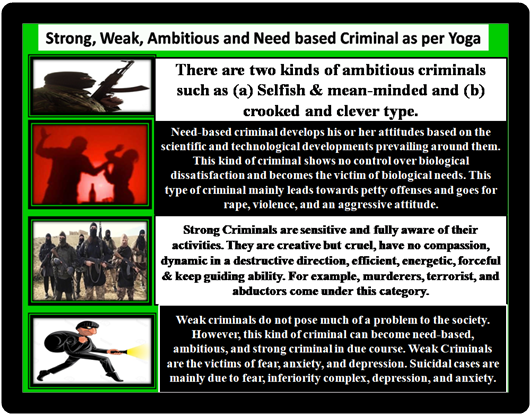
The characteristics of Weak criminals mostly prevail in uneducated mass and poverty-based Societies. Whenever development work is carried out for them in the fields of Education and Economy, the maximum number of young criminals having negative attitudes (tending towards criminality) will be minimized or eliminated.
11. REHABILITATION APPROACH FOR CRIMINALS
Before Rehabilitation, Criminals need to be categorized and for that certain tools and approaches are necessary like a spiritual approach to prevent crime and a forensic approach for the same. Important steps should be taken to rehabilitate the criminals in an appropriate way; so that, they (criminals and anti-social elements) can be re-inducted into the mainstream of Society.
11.0 Diagnostic tools
There are mainly two kinds of tools; that can be used to diagnose the types of criminals. They are i) Scientific tools – generally used by Forensic science and ii) Spiritual tools – categorizing the Quality (Guna) of the criminals.
Regarding Scientific tools, there are many tools to diagnose the type of criminals. DNA investigation is regularly used by the Forensic science department. DNA stands for De-oxy Ribose Nucleic Acid. It is a complex molecule found in the cells of the body. This counts the hereditary information. It provides characteristics such as gender, race, eye, and hair color as each person’s DNA is unique. That is why in Human Creation, each one is known for uniqueness and evolution either in the materialistic world or in the spiritual world.
If the DNA count is poor, the person will have poor physical health. Criminals are normally in good health or, often, they possess robust health. The criminal’s DNA profile is more significant in cases of violence because there will be a transfer of body materials between the accused and the victim.
In connection with Spiritual tools, Human Beings, whether good in nature or criminal in temperaments, possess certain qualities (Guna) or properties. They are of three types and each of the constituents is known as Tamsik (darkness, lethargic, idleness, dullness, and inertia), Rajsik (passion, active, workaholic), and Satvik (goodness, quiet & calm).
The criminals are mainly Tamsik (full of darkness) and Rajsik (productive for materialistic achievement mainly in a selfish way) in nature. The criminals are rarely Satvik in nature. Hence, they have to be transformed from Tamsik and Rajsik nature to Satvik nature. During Rehabilitation, criminals are brought back to the Satvik in nature with the help of Spiritual Culture.
Tamsik criminals, in terms of body and mind, are lethargic, idle, inactive, and depressed. They see less opportunity to transform around them. Therefore, they have to be nurtured first from Tamsik to Rajsik and then to Satvik in nature.
The criminal of Rajsik in nature will be productive of good quality, talented, and intellectual but under the grip of criminal attitude. They can see some opportunities around them for rehabilitation. However, they may not possess ethical and moral values in a positive sense. They use their intellects for cheap and clever purposes. When the quality of Sattva (goodness in nature) is developed, criminals can see a lot of opportunities around them. They develop human values, sensitivity, awareness, and spiritual values.
11.1 Spiritual Approach to Prevent Crime
Spirituality is the combination of Yoga and Vedanta. Vedanta has three limbs namely (a) Upanishads (theme of the Vedas) (b) Brahma Sutra (the reasoning aspects of Vedas or Upanishads) and (c) Bhagavad-Gita (Practical Laboratory for Spiritual Development). Spiritual Awareness is a wider field where the Yogic concept is one of the special configurations. Spiritual Awareness accommodates the true aspects of all religions & different cults, whereas Yoga is the means to travel towards achieving the aims of Spirituality.
Many elevated people have taken the simple concept of Spirituality & they guided people to lead life positively. For instance, Confucius, a spiritual master of China, had viewed Spirituality to be used for good governance in a Society where moral, ethical, and virtuous human values were much deteriorated. This was because, he visualized that “whatever people do not wish to have, they should not do for others. At the same time, whatever people wish to have for themselves, similar kind of attempt or action, they should do for others”. The simple but very effective spiritual concepts made China grow up to the present level, though Confucius gave the concepts about 2200 years ago.
11.2 How does Spiritual Culture help to change Duty Consciousness?
Spirituality advises that good governance depends on the awareness of the respective role of an individual’s responsibility & alertness to others’ rights such as “ruler being a ruler, a father being a father, a mother being a mother, a son and daughter being son and daughter” in a society for dutiful roll. This will help the individual to understand his or her respective duty and also to protect the other’s rights. Normally, we try to visualize the other’s duty and self rights whereas Spiritual Culture says it should be vice-versa.If a civilized person of Society does his or her duty required for fellow beings and visualizes or feels whatever rights other deserves from him or her; the problem of the generation gap and conflict between the two will be minimized and a peaceful leading Society will emerge. The criminal domain of Society will have minimum opportunity to get flared up.
It is observed that there is a downfall of moral, ethical, and righteous values in a criminal-led Society. In turn, people are poor in Honesty, Integrity, Transparency, and Accountability to Society in general. Spirituality provides the methodology to improve the value system of the individual; so that, a harmoniously balanced Society can exist. In that way, Spirituality advocates the Science of Values in terms of virtue, moral, and ethical approach. The secret of the Spiritual approach provides a logical and rational concept for a good Social and Political balance.
11.3 Importance of Rehabilitation
If Rehabilitation for them is not considered by the Government, NGO, and Society; there could be more crime because more experienced criminals will be made available to propagate their technology with dedication and enthusiasm. When positive factors are inculcated, they can become an example for those who are in the first stage of criminal growth. The Rehabilitated criminals will convince the other criminals more easily than the service-oriented NGO and Government machinery can do.
For Rehabilitation, we have to awaken the consciousness of the criminal at a higher level of everyone’s threshold value by enhancing moral, ethical, and virtuous values. The commitment, determination, and enthusiasm for uplifting the Value system of Society (hidden in individual criminals) have to be assessed during the Rehabilitation process; so that they can be relied upon for the services to be given in Society for materialistic growth. The next step is to enhance the awareness of the individual criminal’s spirit with the help of concentration, equanimity, kindness, broadmindedness & discipline of each criminal. This is because Criminality (imposed by the Inner Mind) makes the criminal bad to worse unless factors like disparity in Education, Economic field, and Cultural aspects are narrowed down. In addition, criminals can become further bad or tough due to the mental makeup of the criminal. During Rehabilitation, the conditions and circumstances in & around the criminals are made conducive to bringing them into the mainstream. For this, the Forensic approach and Spiritual approach for Rehabilitation have been addressed.
11.3.1 Forensic Approach for Rehabilitation
The mental disorder among the people has grown and has been observed in the field of Criminology. Though, many professionals are working to improve the behavioral aspects of criminals; a prominent one is the Forensic Psychologist.The science of Forensic Psychology deals with the intersection of General Human Psychology and the Legal Aspect related to criminals.
The role of Forensic psychologists is to help criminals in person, in hospitals, and correctional institutions, and also at community mental health centers while counseling them to adopt a better Social life. However, there is a need to develop their Emotional Quotient (EQ) and Spiritual Quotient (SQ). This is because; criminals have strong IQs (of course in the negative direction) but no touch of EQ and SQ. That is why the Spiritual approach can be used as an applied tool, which speaks on the advice to be followed by the Ruler as well as to the Destroyer (Criminals) of the Society.
11.3.2 Spiritual Approach to be followed in Rehabilitation
Strong, ambitious, need-based, and weakcriminals need rigorous Yogic practices like the Science of Breathing and Introspection.
The image provides the types of “Swan”-based criminals, along with their nature and urges, which need a spiritual approach for their rehabilitation.
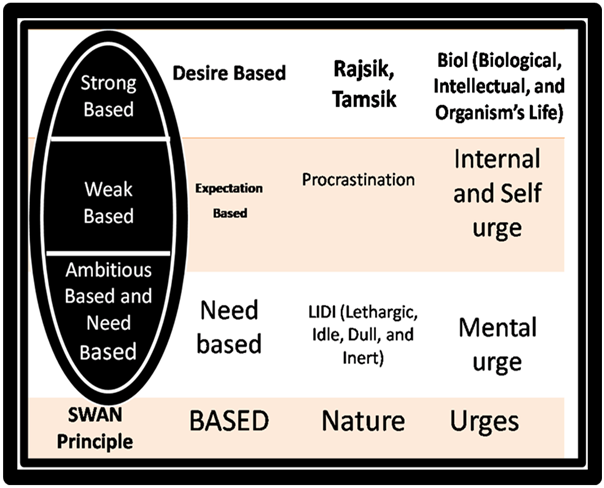
In yogic practice, they need relaxation in action, with Righteous posture in Action, and Meditation in Action. They should be taught how to make use of Keval Kumbhaka (when there is no need to Breathe In and Breathe Out in between the two spells of Breath). They should inculcate the Value system in their life, especially concerning moral, ethical, and virtuous values.
They should be inspired to adopt Spiritual Culture along with the administrative tasks given during the punishment. They should be encouraged to pass out the curriculum of Spiritual Education with the incentive of reducing their punishment time.
For better Rehabilitation, there could be a need for change in Legislation to achieve a reduction of Crime in Society.
11.4 Steps in Rehabilitation
Criminals of Tamsik nature have their virtue, creative attitude, positive skills, and talent in a dormant state. The hidden aspects are more resistant to sparking the virtuous value as the conditions of the criminals resemble a completely wet matchbox. In a wet matchbox, no stick (virtue) could be used for ignition (action in the positive direction), and it becomes hard to change their nature from Tamsik to Rajsik and Satvik. To spark the light (virtuous value), the match box including the matchstick has to be dried up for usefulness. Similarly, the dormant virtues of Tamsik criminals have to be explored to bring them into the mainstream of Society. Otherwise, the virtuous energy remains dormant in a stagnated way and the Criminal will be a nuisance for Society.
The Rajsik criminal is just like a partly wet matchbox, where wet sticks will not get ignited. When the virtuous and moral values of the criminals are brought to the surface; those work like drying (by patting their positive quality) their dormant positive energy (otherwise in stagnant form) and which will make them to be useful for the society. When the stagnant energy begins to flow; the Criminal then becomes alive & virtuous. The Criminals become constructive and come back to the mainstream of Society.
The Criminals who are Satvik by nature are like a dry matchbox with a partially wet matchstick (very little wetness). When a very small amount of heat (approach) is applied, the effectiveness of hidden energy is fully raised. All the energy gets transformed into dynamic goodness which provides a positive thinking & helping approach in a true sense.
11.4.1 How does Rehabilitation work?
During Rehabilitation, strong criminals will change like normal men or women possessing the Knowledge (Gyana) and will advocate the good aspects of Society. For example, Indian scriptures state the case of Valmiki, a hardcore killer, changed as soon as his hidden divine potential sprang up. Ambitious criminals will be transformed into devotees and will be an example of a peaceful Society. Indian scriptures narrate the case of Angulimal who became the disciple of Lord Buddha when his hidden divine potential was explored. Similarly, need-based criminals will become workaholics and can be quoted as hardworking people in Society. Likewise, Weak criminals will be transformed into good citizens of Society and will be more productive.
11.5 Crime and Society as Differentiated by Chanakya
There is something about this proverb “Prevention is better than Cure”. If little preventive approach is taken then big incidents can be avoided. This can be demonstrated with the help of an incident that occurred during the rule of the Maurya dynasty. The incidence of theft happened in the house of a miser businessman and consequences were reported to the Spiritual Guru (Chanakya). He (Chanakya) had given a verdict to penalize the miser businessman for creating a large disparity in the society. This indicates that large disparity always creates a conducive atmosphere for anti-social elements to become criminals.
It is very difficult to completely narrow down the disparity among the different levels of society. However, there should be an approach to minimize the same as far as possible by encouraging the affluent people to spend their resources for enjoyment on the occasion of social rituals or by visiting pilgrimage places, or enjoying the scenario of Nature by taking tourism as one of the interests. The expenditure made by affluent people will provide some opportunities to the youth as Employment and the same will work as a preventive measure to minimize their envy. In addition, the criminal attitude of youth will not have an instigating factor to become prominent in the direction of crime.
Society needs to narrow down the disparity between rich and poor; between greed and generosity; and also between knowledge and ignorance. The absence of preventive measures to reduce the gap in social life gives birth to violence & cruel attitudes in the minds of affected people.
11.6 Vedantic Approach for Rehabilitation of Criminals
Many of us may contradict exploring and applying the theme of Vedanta by giving the argument that the Vedantic concept could be possible for others not for criminals; because of their negative feelings and behavior. The theme of Vedanta works for those who are educated, rich, and have sufficient capital and alternate resources could be another point of our argument. But Vedanta doesn’t restrict to work under these limitations.
Vedanta points out that hidden potentiality namely magnanimity, personality, purity of mind and self, the concept of oneness, unconditional love, and divinity are essential to be manifested to lead a happy and secure life. They are essential to reform the evils of Society like cruelty and harassment to the members of Society or their associates.
To change from a criminal attitude to a normal attitude, they need recognition in Society. They expect a respectful life and need to get exposure to social values in respect of morals, ethics, and virtues. They desire to have recognition in Society as being important and creative.
If Rehabilitation for them is not considered by the Government, NGO, and also by Society; there could be more crime because more experienced criminals will be available to propagate their technology with dedication and enthusiasm in their way.
As criminals would be alert concerning the laws of Society and would try to escape the Law; their intellect slots would be used for negative planning, their talents would be useful for making the framework of future crimes and they would seek the opportunity on how to be free from the grip of the Laws of the Land.
For Rehabilitation, we have to awaken the consciousness of the criminal at a higher level of everyone’s threshold value by enhancing moral, ethical, and virtuous values. The alertness of the commitment, determination, and enthusiasm of individual criminals has to be assessed so that they can be relied upon in Society. Next, awareness of the individual Criminal’s spirit could be awakened with the help of concentration, equanimity, kindness, broadmindedness & discipline of each criminal. The criminality imposed by the Inner Mind makes the Criminal worse; whereas factors imposed by Society have to be solved as a duty or they will become still worse.
The conditions and circumstances in and around the criminal are conducive to bringing them into the mainstream. Criminals can become worse or tougher due to the mental makeup of the criminal.When positive factors are inculcated, they can become an example for those who are in the first stage of criminal growth. The rehabilitated criminals will convince the other criminals more easily than the service-oriented, NGO and Government machinery.Morality is the foundation of life. Inculcating the same in the minds of Criminals can help the Rehabilitation process of the Criminals.
The growth of morals, ethics, and virtuous values leads the criminals to renounce the temptation to illegally grab their neighbors’ property. They can also minimize the pleasure of robbing, cheating, and telling lies to others. The Science of Values causes criminals not to be interested in any anti-social activities and takes them to a higher plane.
11.6.1 Exploration of Vedanta from different angles
It is a natural weakness in human beings to condemn others for want of items, places, and other scenarios. For instance, if the strong Criminal sees a rich man; then he becomes jealous and condemns him. It is also true that the rich and the strong persons condemn the poor. Instead of condemning each other, if both groups develop tolerance, acceptance, and appreciation attitudes; then the whole problem is solved.
For this (development of tolerance, acceptance, and appreciation), spiritual methods will be useful to develop the Satoguna quality in Society and also for criminals; otherwise the conditions of jealousy and hatred will persist for a long time.
Before taking the steps for Rehabilitation, the criminals should be segregated based on their property, quality, and grade. This will help to take up the steps in a systematic way.
When they are changed and brought into the mainstream, they will be creative, compassionate, dynamic, dedicated and enthusiastic, energetic, efficient, and will have the ability to guide the economic and cultural aspects of Society and will be a helping hand for the common people.
If one understands the purification of hardcore with the help of the Vedantic concept, one can make it possible to change the minds of criminals and one can win the game. For materialistic people, the word “spirit” can be understood with the help of Yogic Breathing. When the breath is slow & deep, the aspirant is aware of the breath keeping the mind calm, which signifies the concept of spirit. Another way to feel the spirit is to possess more vibrant and energized breaths systematically so that the cycle of Breathing In and Breathing Out is as low as possible. Likewise, one can feel the Spirit with the help of consciousness, energy flow, and willpower developed by oneself.
11.6.2 Government & NGO Approach for Rehabilitation
Mental disorders among the common people have been noticed mainly by practitioners in the field of Criminology. Though, many professionals have been actively involved in the study and experimentation of trying to improve the behavioral aspects of criminals; the Psychologist is slightly ahead of the others. The science of Psychology deals with a cross between General Human Psychology and the Legal Aspects related to criminals. Therefore, the role of the Psychologist is important when he or she tries to help criminals in person, at hospitals and institutions, as well as at community centers; where he or she would counsel them to adopt a better social life.
There is a need to develop their Emotional Quotient (EQ) and Spiritual Quotient (SQ). This is because; criminals have a strong Intelligence Quotient (IQ), of course in a negative direction. But they lag in EQ and SQ. That is why Vedantic philosophy can be used as an applied tool to evolve their EQ and SQ. The Government, NGO, and Reformers should keep these Quotients in mind for the development of criminal nature towards Sattva Guna (Kindness and Goodness in nature).
In Brief, the different types of criminals have to be rehabilitated; otherwise, they (criminals and anti-social elements) will breed fast and society will experience a lesser number of good people. To have a bare minimum of criminals and antisocial elements in the society in a specific way and the country at large; Government and NGOs should work together to rehabilitate the criminals effectively. More than the Government, NGOs like Yogic Institutions can work to Rehabilitate different types of Criminals in Jail or Community centers; so that, a smooth way of rehabilitation work should progress without making them (criminals) feel isolated from the mainstream of society.
12. RISHI PATANJALI EMPOWERS THE BRAIN FOR SCIENTISTS AND SPIRITUAL SEEKERS
Indian Rishis dissect the brain to find different functional aspects connected with the senses of Human Systems. The approach adopted by Indian Rishis is well established in Vedic Science indicating the step-by-step manifestation and evolution concepts. Since the inception of the Universe, the Rishi found the dissection of the Brain by adopting different meditational approaches and found a similar kind of result in each kind of Meditation. That is why Ashtanga Yoga describes the importance of meditation in “Antaranga Yoga”. It is also perceived that Meditation in the Brain reveals the different states of Matter including the Plasma state.
12.0 Maharishi Patanjali explores the simple way of meditation
The Yoga Sutra states “Yoga Chitta Vritti Nirodha” which comprises three words namely Chitta, Vritti, and Nirodha. Chitta is a subject that can be understood with the help of three compartments that exist in the Lobes. Vritti can be explored through experiences while interacting with people, objects, places, and situations. These four factors are means of interaction in daily life and can create Adharma Karma, Dharma Karma, and Punya Karma. Additionally, they can also create a Vasana (repeated Karma) of three kinds. These three types of Karma or associated Vasana caused during interaction become the Kriyaman Karma (day-to-day storage of Action carried with the associates). Chitta along with the Vritti has a combination of three qualities (Guna) of Prakriti namely Sato Guna (transparent or light in nature), Rajo Guna (Movement or momentum quality with distorted function), and Tamo Guna (still or Moha or turbid quality). The ingredients of Vritti will have an association of these three qualities and need to be worked upon; so that the Tamo Guna and Rajo Guna quality of ingredients in Vritti should be changed or transformed into Sato Guna.
The word Nirodha means the separation of the ingredients connected with Tamo Guna and Rajo Guna after transforming their qualities into Sato Guna. This kind of action is carried out in Meditation without disturbing the three quantities of ingredients caused due to Primordial matter. However, the qualities (Guna) associated with all these quantities of ingredients will get transformed into Sato Guna (transparent or light in nature). In this way, the three compartments of Chitta are tackled in three steps to get freedom from Nature’s qualities.
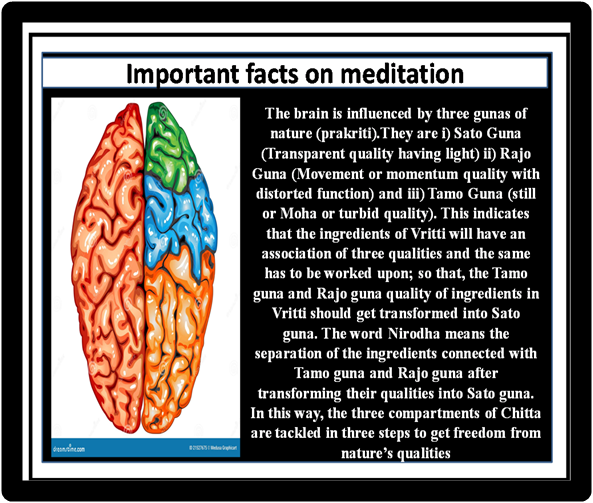
At the beginning of meditation, the Tamo Guna ingredients are activated from a still (Tamas) state to a movement state (Rajas). In the second stage, all the Rajo Guna ingredients are transformed from a state of movement or momentum (Rajo Guna) to a transparent or light form (Prakash). In the third stage of Meditation, the ingredients are kept in a glowing light or Prakash (Sato Guna condition) for an extended period, which can be maintained through regular Meditation. That is why, regular Meditation is necessary because if Meditation is interrupted for a long time, the Sato Guna can convert back to Rajo Guna and Tamo Guna. This is the concept of Meditation in simple terms, taken from the Patanjali Yoga Sutra. During the process of Meditation, the storage house of Karma at Chitta, which has three compartments, is transformed into Sato Guna qualities, which are full of Effulgent Light and the Swaroopa (Mirror image) of Truth or Parmatma. Achieving this scenario ensures that an individual’s Swaroopa will merge with the Swaroopa of Truth. This way, by performing Meditation, all the knots that exist in the Brain (Chitta) are eliminated, and Meditation aims to free an individual from all the grips of knots. It is interesting to note that a conducive scenario should prevail in all three compartments of the Chitta (Brain), i.e., unconditional love (Sahaj Prema) in the Right Lobe, concentration (Ekagratha) in the Left Lobe, and Awareness (Hosh) at the middle joints between the two Lobes. This scenario should be incorporated into Meditation to accelerate the process of deeper Meditation.
In conclusion, Patanjali views the Brain as Chitta, working like a platform with different compartments to store the action (Karma), Vasana (repeated Karma), and Karma Phala (responsible as decision maker for the Next birth). Technically, Chitta contains the compartment for i) Unrighteous Action (Adharma Karma), ii) Righteous Action (Dharma Karma), and Virtuous Action (Punya Karma). It is to be understood that Chitta works like an auto-computing mechanism in the Brain; where these actions are getting lodged and resulting Karma (Karma Phala) in each compartment will automatically be computed. In principle, the three types of Action create Mind modification (Vritti) at the time of an Individual’s interactions with people, places, objects, and situations in the external world. The emerging scenario of Mind modification in Chitta is described in the Patanjali Yoga Sutra. To remove the Mind modification (Vritti), Maharshi explores the simple way of Meditation in Ashtanga Yoga.
12.1 Utility of Breath with the Help of Left and Right Nostrils
We do the work in a day without paying attention, to whether the right nostril or left nostril is more effective. Because of this, many times we use improper energy for proper work. For instance, if a Marketing Manager is working with the right nostril, he or she is utilizing proper energy as one has to convince the client. That is why the Marketing Manager needs the right nostril’s function more than the left nostril’s; so that he or she can convince the client effectively. This is because; conveying facts and figures requires more energy.
Similarly, the Finance Manager needs a calm mind, hence he needs left nostrils should work a little more effectively; otherwise, the utility of energy will not be proper. Likewise, the Resource Development Manager needs the energy flow equal from both nostrils, especially at the time of solving any dispute; otherwise, the desired result will not be achieved. In the field of work, flow from the right nostril is desirable; whereas, at the time of dealing with family and friends, left nostril breath flow should be a little more than the right nostril. This will be more desirable. Ideally, on all occasions both nostrils should have an equal flow of breath; which can be obtained with the help of yoga. In Yoga, we have to examine that timely use of nostril energy should not affect the overall health of five major systems.
12.2 Science of Breathing and its Utility
This science makes the entire Internal Energy in dynamic form by utilizing the purification process with the help of Verses or Choupai of Hanuman Chalisa. In this way (adopting the Science of Breathing), we can remain hail and healthy. For this, the Choupai (Verse) of Hanuman Chalisa should be kept along with Prana and Mind to eliminate the intensity of emotion and fluctuation of the thinking process. This also keeps us in the present moment. Lord Buddha has also given a similar kind of process which is very popular in the world and the same is known as “Vipassana” Meditation.
We will be able to get rid of the new Kriyaman Karma (day-to-day Karma), also known as “Karma Sangraha”, by adopting the Science of Breathing or Vipassana Meditation. They (Vipassana and the other types of Meditation) also minimize or eliminate the Sanchit Karma (collective Imprints). The business community can make use of this Science (Techniques of Meditation) for evolution and better progress in Life as a value addition.
12.3 Energy and Matter in Science and Spirituality (As per Upanishad)
Energy and matter are interrelated. Energy comes out after the disintegration of atomic particles. The scientist has shown the mathematical equation of Energy and Matter. The same is expressed as E=mc2. In a Microcosm, the Energy can be understood with the help of “Prana” inside the body. For example, Prana inside the body (Energy) is the product of physical structure as Breath (Matter associated with Pingla path) and the speed of Mind. This product of Matter and the speed of Mind comes out as Energy in terms of Breath or Atma Shakti.
In the scientific domain, this Energy plays a great role in continuing any creation. For instance, in the creation of the mud pot, the Matter (Mud), Energy (Wheel), Intellect (the Mind of the Potter), and the Skill of the Potter (all together) give a good object. There, Energy is essential along with Matter and Skill.
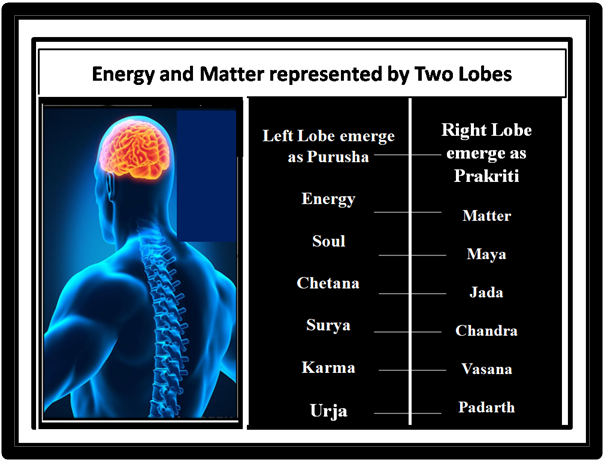
In the Universe, the Energy (Urja) comes from a higher source (Truth or Absolute), but the same (Energy) of the Cosmos, remodeling the Matter connected with Stars and Planets. The balancing of Interstellar and Interplanetary systems is due to permutation and combination of Cosmic Prana (Energy); which is also known as the Power Of Absolute (POA).
It is explained in “Prashnopanishad” that Prana provides the Energy to support nine elements namely i) five elements (Panch Maha Bhoota) like Earth, Water, Fire, Air, and Ether ii) Ear iii) Eyes iv) Mind (Manas), and v) Sound (Vani) in the Human System. Likewise in the Macrocosm (Universe), the main Energy supports five basic elements by which Planets, Stars, and Galaxies are made. The other terms described in the Microcosm (Human System) resemble three fundamental particles and a long thunder in the Universe.
In that way, the Cosmos supports three fundamental particles and they arei) Proton (Varuna in Veda) ii) Electron (Mitra in Veda) iii) Neutron (Aryama in Veda), and Thunder sound of the Cosmos. Upanishad indicates that without the support of Energy (Prana), nine elements that exist in the Human Body, and also in the Cosmos, will have no functional strength.
12.3.1 Swami Vivekananda’s Views on Energy and Matter
Upanishad provides emphasis on Energy (Prana) for the function of the Human System as well as the function of the Universe. This means that the importance of Energy (Power Of the Absolute) is the essential means for sustaining the Universe, the materialistic world, and Jiva too. In this context, it is worthwhile to recall the address of Swami Vivekananda during his tour of the Western World after the “World Parliament on Religions”. He used to invite the scientists to work on “Aakasha and Prana”; which are two important aspects of Creation. One among the two is “Prana”; which is an important aspect of the Truth or Absolute.
After a few years of his talk, the Scientist could evolve the concept of Particle Physics where Prana and Aakasha resemble with Lepton family and Quark. They (Lepton and Quark) are also termed as Energy for Networking and Space for Trafficking in Science. In the Human System, the utility of Energy leads us to grow the Atma Shakti, happy life, have a peaceful mind, acquire knowledge, and get Bliss. In addition, by utilizing energy (Prana), we evolved in a higher plane by getting energization.
12.4 Quantum Mechanics Endorses Deep Meditation
The foundation of Quantum Mechanics is based on the model of Particle Physics, which describes Fermions and Bosons. This model indicates the existence of four forces due to the interaction of Sub-atomic particles, which are carried through force carriers. Quantum Mechanics also makes use of Entangled Particles and the presence of a constant observer to explore the probability function of Atomic Particles’ existence.
The Copenhagen Declaration states that a physical system cannot be detected or determined for a definite property unless it is measured. This statement is similar to the subtle functions that occur in the Brain in the presence of an Observer; otherwise, they do not exist. The measurement or determination of this kind of similarity is achieved through Meditation.
Classical Mechanics provides a deterministic concept for any event; however, Quantum Mechanics explores the probability approach between events or incidents. For instance, there is a probability of atoms becoming molecules, a probability of molecules becoming cells, and a probability of cells becoming part of the Brain. This probable approach of Quantum Mechanics helps the Meditator (One who does Contemplation) to separate the Body (consisting of atoms, molecules, and cells) from the Brain, which has different nuclei, to progress to a higher state of matter evolved from the Body.
Matter in the higher state involves only two things to be done during Meditation. One being the Neutralization of the Charges and the other being the Enhancement of the existing Satoguna of the Meditator. These two can be achieved if the Meditator can do proper Meditation ( preferably guided by a Master initially) to reach an advanced state of Mind that is comparable with what Scientists quote as being the higher state of Matter, or in other words in the Zone of Plasma state or the fourth state of Matter.
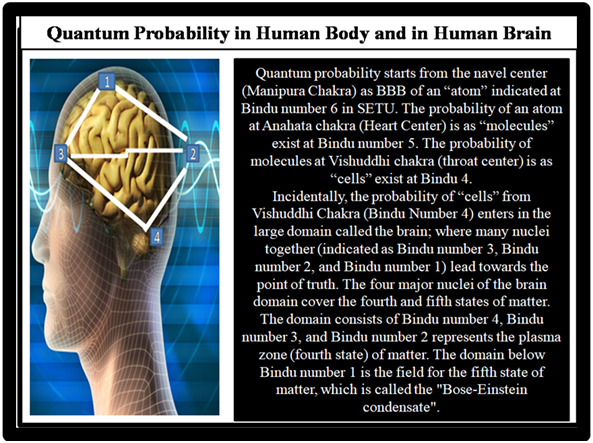
In science, the higher state of Matter exists behind the Sun’s ball including the Planetary System.In the Microcosm (Human Body and Brain), three states of Matter are connected with lower Chakra including Vishuddhi Chakra. The higher state of Matter should have the evolution connectivity with the lower Chakra or Body.
In this context, the image is self-explanatory. The image clarifies that Quantum Probability starts from the Navel center (Manipura Chakra) as BBB of an atom indicated at Bindu number 6 in SETU. The probability of an atom at Anahata Chakra (Heart Center) is as if molecules exist at Bindu number 5. The probability of molecules at Vishuddhi Chakra (Throat Center) is as if cells exist at Bindu 4, as indicated in SETU.
Similarly, the probability of cells from Vishuddhi Chakra (Bindu Number 4) enters in the large domain called the Brain; where many nuclei together (indicated as Bindu number 3, Bindu number 2, and Bindu number 1) lead towards the point of Truth. The four major nuclei of the Brain domain cover the fourth and fifth states of Matter. The domain (fourth state of Matter) consists of Bindu number 4, Bindu number 3, and Bindu number 2, which represent the Plasma Zone (fourth state) of Matter. The domain below Bindu number 1 is the field for the fifth state of Matter, which is called the “Bose-Einstein Condensate (BEC)”.
To better understand the effects of Meditation on the Brain, we need to explore how Matter behaves at different nuclei within the Brain. This requires an understanding of the Plasma aspect of Astrophysics so that we can compare the results of Meditation to Plasma Physics conditions. The structural scenario of the Universe, or Macrocosm, is identical to that of the Human Body and Brain, or Microcosm. To gain a proper understanding of how these systems connect, a model was evaluated at the Spiritual Awareness Program (SAP) in Hyderabad, India, based on concepts from the Bhagwad Geeta, Upanishads, and Tattva Shuddhi.
This model is called Structural Entanglement between Truth and Universe (SETU). Its purpose is to connect the interdependent parts (Nuclei or Chakra) of the Universe, from its Origin (Root) to the final nucleus of Nature (Prakriti), to explore the Sustainability of the Universe. Similar kinds of steps (Quantum Probability) happen in Meditation while evolving from a lower level (Chakra) of the Body and Brain to its higher level.
12.5 Deep Meditation Leads to Nishkam Karma Scenario
Verse number 12 of the 12th chapter of the Bhagwad Gita states that Nishkam Karma along with the Meditation of Swaroopa (Effulgent Light) is the best possible Meditation.
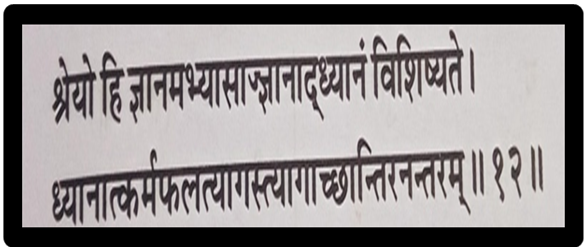
The meaning of the verse explains the revelation of Lord Krishna combining Nishkam Karma and Meditation. Bhagwan Shri Krishna reveals the secret of Deep Meditation in chronological order. He states that without knowing the right way of Meditation, the meditator does not get the advantage of Meditation. Technically, without knowing the right way of Meditation, the meditator doesn’t get the advantage of Meditation. This is because knowledge connected with Meditation with a certain aim is superior to randomly carried Meditation. Lord Krishna further explains that the objective of no desire for fruits in Meditation is still superior to the complete Knowledge connected with the “No Mind” or “Full Mind Meditation”. This is because Nishkam Karma comes under the purview of Detachment (Tyaga) in the process of Meditation; which brings instant Peace of Mind in a “Still Condition”. Lord Krishna indicates the conditions for the best possible Meditation.
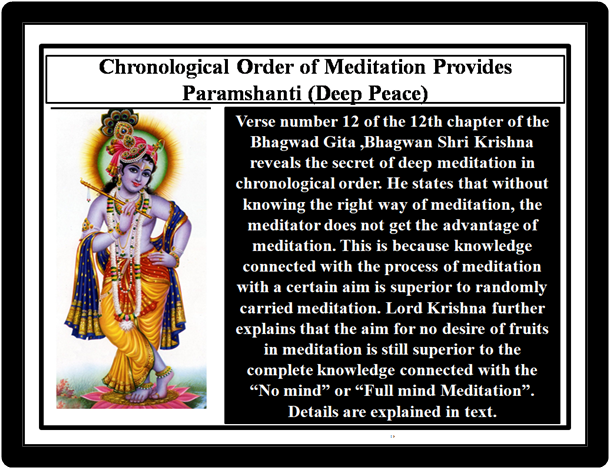
Bhagwan Krishna explains the Effulgent Light obtained during Meditation must have the backup of no desire for fruits; otherwise, there will be some imprints (trace of Mind modification or Vritti) leftover because of inbuilt evolution memory, genetic memory, Karmic memory, emotional memory, and energy memory, etc. To have complete cleanliness of the root of the knots, meditation with no desire for fruits (Nishkam Karma) is essential to have the best possible Meditation.
12.6 Cultural Environment enhances the result in the field of Neurology and Meditation
The practical approach viewed by the Neurologist reveals the parallel results as the meditator gets in the East. The approach influences the Cultural environment.
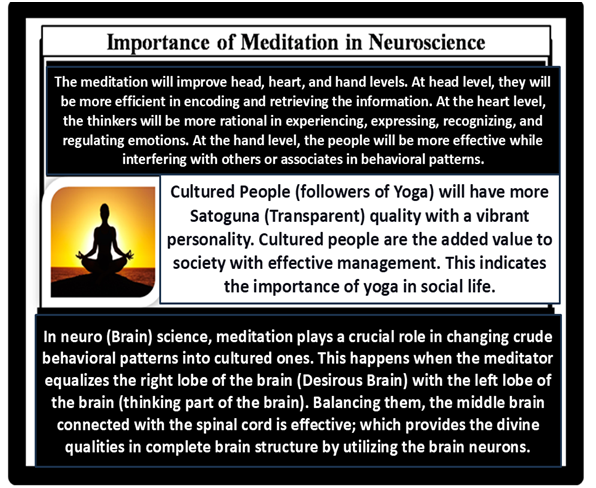
If the Cultural environment is very conducive, then neurologists as well as meditators can get the best possible result in their approach. If Thinkers are in a Conducive (Cultured) environment depending on the respective society or country, this environment (Conducive environment) will enhance the activity of observation in the mid-brain. In that case where the Brain will be reinforced with a Cultural environment and the Thinkers will gain multidimensional advantages at 3H (Head, Heart, and Hands). At the Head level, they will be more efficient in encoding and retrieving the information. Likewise, at the Heart level, the thinkers will be more rational in experiencing, expressing, recognizing, and regulating their emotions. Similarly, they will be more attentive while interacting with others or associates’ behavioral patterns at the Hand level.
The crucial role of culture in day-to-day activity at the social structure level can be examined and perceived in the form of an added Value System. This means that without having any Cultural environment, the people in Society will have certain Inner Values (Guna) but Cultured people will show massive vibrant personalities. The Cultural environment will modulate positive emotion regulation and also have coordination while dealing with interpersonal and intergroup interactions. This type of Thinker, who is brought up in a Cultured environment, will be an added feature of Society for framing the laws and effectively managing Society.
The analysis indicates that Culture plays a crucial role in the Thinkers to explore the hidden potential along with thinking and meditative processes. The query arises how to achieve this kind of scenario wherever people are less cultured or civilized? Is there any method by which the ventral pigmental area or mid area of the Brain could easily be processed to arrive at a sustainable solution wherever a lacuna exists? Yes, certainly the scenario can be overcome and people can be re-established at the mid or ventral portion of the Brain by proper and systematic Meditation. This explores the importance of Meditation required in ordinary Society as well as in civilized Society.
There are many similarities achieved by Western scientists and also by meditators in the East. But there is a lack of exchanging views among each other. Because of this, Scientists do not get the healthy and advantageous approach of meditators of the East. Similarly, Thinkers or meditators of the East do not get the scientific background of their approach to Evolution. Due to this mismatch, the world community is deprived of the real benefits obtained by Science and Spirituality, together.
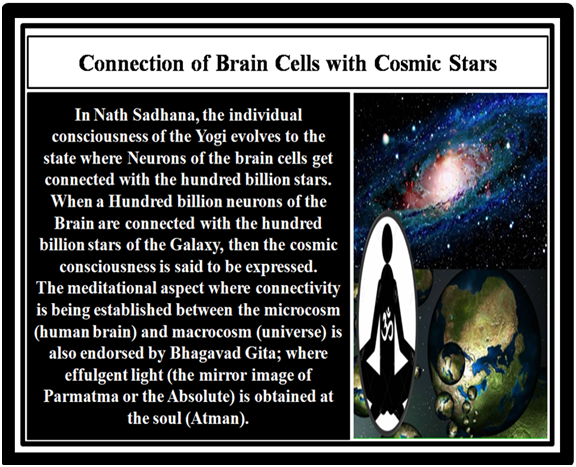
The Brain neurons are the convertors of media in between the Human Universe (Microcosm) and Brahmand or Universe (Macrocosm). In Nath Sadhana, the individual Consciousness of the Yogi evolves to the state where the Neurons of the Brain cells get connected with the hundred billion Stars. When a Hundred billion Neurons of the Brain are connected with the hundred billion Stars of the Galaxy, then Cosmic Consciousness is said to be expressed; which is in the form of Effulgent Light or Jnana Agni.The meditational aspect where connectivity is being established between the Microcosm (Human Brain) and Macrocosm (Universe) is also endorsed by Bhagavad Gita; where Effulgent Light (the Mirror image of Parmatma or the Absolute) is obtained at the Soul (Atman).
The image describes the “Connection of Brain cells with Cosmic stars” while Meditation in Nath Panth. A similar kind of scenario is obtained in every kind of Meditation. Other Meditation systems including Nath Panth interlink the cosmos with Brain Neurons to find the “unknown” of the Universe. In turn, the “unknown” reveals the mystery of the Universe.
12.7 What is the Power of Meditation?
The power of Meditation can reveal the secret of the Universe from different aspects of “Unknowability”. For this, the background of Meditation has to be known progressively.
In this connection, the connectivity between the Body and the Brain has to be synchronized. For example, there are three parts in the Human Body namely i) the left side of the body connected with the Right Lobe ii) the right side of the body connected with the Left Lobe, and iii) the middle part of the Lobe (in between the left and right Lobe) connected with the spinal cord. In these three parts, respective Nadis are Ida, Pingla, and Sushumna (vertebra) Nadis; and they have association with the Mind (Manas), Prana, and Breath respectively. This means that Ida is associated with the Mind (Manas), Pingla is associated with Prana, and Sushumna (Spinal cord) is connected with Breath. When the meditator is trying to clean and adjust Ida and Pingla to have an easy flow in Sushumna; then, the meditator is doing different kinds of Pranayama.
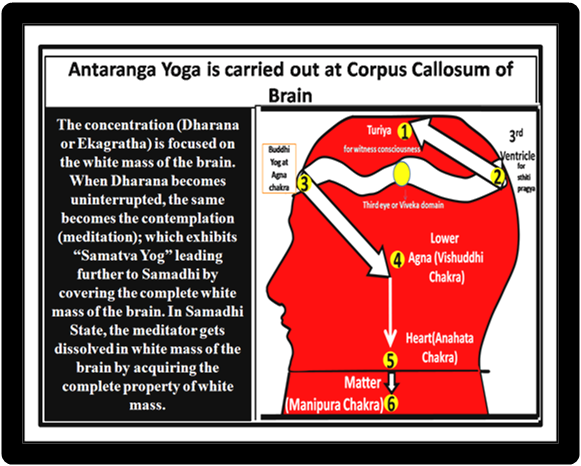
The corpus callosum part of the brain consists of white mass; whereas, the other part of the brain has grey color mass. The corpus callosum part of the brain is also known as a psychic tunnel; where Buddhi Yog (Upper Agna of Yoga in between two eyebrows), Samatva Yog (third eye opening or Shiva Netra opening), and Sthiti Pragya state (exists at the third ventricle of the brain known as Bindu Visarga) exists. This (Corpus Callosum) exhibits the presence of the soul (Atma Tattva).
However, in Meditation, the Seeker (Sadhaka) works on these three Nadis together and the same will get turned into Meditation. In this way, the power of Meditation exists by synchronizing the three Nadis together along with corpus callosum.
13. UTILITY OF YOGIC SCIENCE FOR 21ST-CENTURY RAMRAJYA TO SUSTAIN
21st Century Ramrajya has to be sustained if proper armoring is taken care of. For this, Spiritual Science is the best means along with Yogic Science. Common people belong to Strong, Weak, Ambitious, and Need-based personality (SWAN). In this connection SWAN principle has to be balanced in the midst of Purushartha to achieve a Cultured society; which will be an added factor in sustaining 21st Century Ramrajya.
13.0 The theory behind the sustainability of 21st Century Ramrajya
We presume 21st-century Ramrajya in parallel with Treta Yuga Ramrajya, and the same (21st-century Ramrajya) has to be sustained for a long time. For this, we need a foolproof methodology. Either from Veda or from Upanishad, which can ascertain parallel characteristics of Present day Ramrajya with Treta Yuga Ramrajya, and also the same should have least possible deterioration in forthcoming years. Luckily, the Taittiriya Upanishad provides the evidence using which we can establish the 21st Century Ramrajya in parallel with Treta Yuga Ramrajya, having detailed connectivity in the five systems of the Human Body, all in purified and energized form.
Taittiriya Upanishad is one of the 11 Upanishads, on which Adi Shankaracharya has given his commentary to elaborate the utility of these Upanishads in life and their management for human beings. In the second part of the Taittiriya Upanishad, where Brahmanandavali is explored in terms of “Satyam, Gyanam, Anantam Brahma”. This means that four nodal points of the brain exhibits the characteristics of Brahman (consciousness) connected with five systems of the body namely i) Circulatory System (Connected with Left Lobe of the Brain) ii) Central Nervous System (Indicating its existence and right lobe of the brain) iii) Excretory System (Concerned with Middle lobe of the brain) iv) Respiratory system (Denotes the domain between neck and heart points of the physical body) and V) Digestive System (Joining in between Heart and navel centre of the physical body).
The connectivity of five poses namely Prana (Main Energy equivalent to photon of science), Vyana Prana ( Indicating to weak nuclear force of Science), Apana Prana (Denoting gravitational force of the science), Udana Prana (concerning with electromagnetic force of Science) and Samana Prana (Equivalent to Strong nuclear force of Science) work on these systems of the body respectively to regulate and control all the five pranas in such a way; so that, there should be very limited variation in them to sustain the universal law of nature. Otherwise, the sustainability of the universe as well as the five human systems of the body will not have amicable stability.
The above analysis indicates that the spinal cord of the human system contains three forces and three systems of the body to achieve full proof sustainability; whereas two lobes of the brain (Right Lobe and Left Lobe) contain the central nervous system and circulatory systems, respectively. This means that if the spinal cord (merudand) is kept purified, energised, and fully evolved, there should not be any hindrance in the sustainability of the existing system regulated with the help of the yogic process. This means that even Treta Yuga Ramrajya can also be achieved in its original form if the yogic process explained in Taittriya Upanishad of Brahmanandavali is fully observed, understood and practiced.
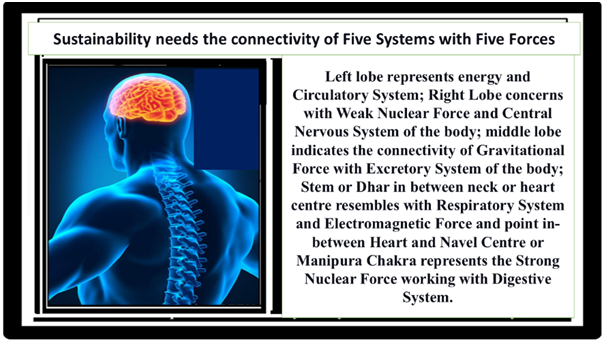
The image clarifies the strong relationship between the five systems of the body and the five forces created by the three principle particles that existed after the Big Bang. The sustainability of the universe (Brahmand or Macrocosm) and the human brain and body (Microcosm) depends on the least possible variation of poses between the systems. Even if a 0.025% variation of the forces tries to tumble down the systems from their existence. That is why the Taittiriya Upanishad, part 2, explores the connectivity of five koshas (Sheath) of the Human System (Microcosm) and the Universe (Macrocosm), indicating the progressive connectivity of the Sheath to evolve up to soul (Atman) and consciousness (Truth or Sakshi Chaitanyam).
The corresponding five systems of the human body in the Brahmand or in the Universe are Gravitational system, Science connected with Earth, the Global warming system, the Lunar System, and the Solar System. This also clarifies that “Yata Brahmande Tata Pinde” (Events of Microcosm are the same as events that happened in macrocosm).
The systems in the cosmos (in the Universe) can occasionally be readjusted to have the natural function in a hassle-free conflict. For example, the prosperity of the earth for the growth of food grains, herbs, and medicines can be increased by avoiding the chemicals in farming. Instead, manure and biofertilizer can be utilized for the growth of food grains. Likewise, Global Warming can be reduced with the help of carbon-free release of Gases, increasing the farming of oxygen-giving plants, and reducing the release of inert gases like Nitrogen in the long run.
13.1 Spiritual Culture in Sustainable Development
Sustainable Development is beneficial provided it lasts for present & future generations too. For example, the exploration of oil and coal for energy production can last a few decades, but future generations may be deprived of their use if the present scenario continues. Likewise, Modern Education seems to be advantageous for a long time, but it has lacunae as it brings disparity between the advantaged society and the disadvantaged society. The disadvantaged people, in turn, will have Psychosomatic diseases because of not being on par with the advantaged people. In the case of Economic Development, the world has faced recession because of the big gap between ambitious & need-based individuals. Similarly, the deforestation and killing of wild animals have caused us to face global warming. In the case of the disparity between the two segments of society; it has yielded the culture of terrorism and criminal mobs. Likewise, wherever win-win culture has been replaced by one-upmanship; there has been a deterioration in the relations between Political leaders of the World.
The above analysis indicates that there is a need to maintain the positive dimension of each segment in some way or the other. There could be many solutions, but among them, Spirituality-based solutions seem to be more simple, realistic and appropriate. This is because Spirituality advocates the principle of Individuality to Universality. In that concept (Individuality to Spirituality), the Ifs and Buts get sorted out easily. In that way, it directs the spiritual approach in each dimension of the existing materialistic world, which would provide Sustainable Development for Human Beings.
13.2 Integration of Ramrajya with Yogic Model
Many models could be analyzed, but the best holistic approach would be adopted by integrating the Ramrajya model and the Yogic model. The role of Yoga in Environmental, Economic, Educational, and Cultural development has been analyzed separately. The special features of Yoga could be utilized to maintain the Sustainability of the Holistic model during its implementation. We have understood that factors like Vibrant Individuals and a Vibrant Society are very important for Ramrajya. Among the two, the first one (Vibrant Individual) is the more important one, who will be responsible for implementing the rules and regulations of Ramrajya. Generally, people are intellectually developed, having a high IQ (Intelligence Quotient), but lagging in EQ (Emotional Quotient). There are many methods to develop or evolve EQ, but Yoga seems to be the simple and easiest one. When IQ and EQ are equally developed, there will be the least possible chance of corruption in Society. This is because corruption exists wherever IQ is higher, but EQ is lower.
Similarly, another factor that is dragging Society, is Materialism. People become more materialistic and try to hoard wealth whenever there is a large disparity in financial conditions between the rich and the poor. By developing EQ, this disparity will be minimized or eliminated. Likewise, the problem of manipulation (another factor of a poor Society) depends on caste, language, area, and religion. When EQ is developed, the factor like manipulation is minimized or eliminated. The analysis indicates that whenever these factors (corruption, materialism, and manipulation) are minimized or eliminated, the favorable atmosphere of Ramrajya will prevail. By this means, we can conclude that the development of EQ of individuals is very important for the establishment of Ramrajya, and the same can be built up with the help of Yogic practices. In addition, Spiritual Quotient (SQ) is an added feature in Spirituality, but the same cannot be easily developed in the Individual and Society, unless they (Individual and Society) have adequate development of EQ. However, a Spiritual Quotient (SQ) is needed for Legislators, Lawmakers, and Bureaucrats.
13.3 Integration of Purushartha and SWAN (Strong, Weak, Ambitious, Need-based) Personality to get a Cultured Society
The best possible Healthy Development could be obtained by people having fully grown human assets. One of the assets is known as “the State of Self (Purushartha),” and another is known as Personality. Both should be grown in such a way that they can surround nuclei with two polar forces. Purushartha has four limbs (Artha, Kama, Dharma, and Moksha), and they have to be nurtured in a positive direction to work as a pole (Pingla). Similarly, the human personality has four limbs (Need-based, Weak, Ambitious, and Strong), also known as SWAN Personality. Human personality has to be grown in such a way that the same works as another pole (Ida). Both the polar forces (Ida & Pingla, or female & male nature) are bound to get fused or balanced to achieve stability.
The two Polar forces (Pingla & Ida) are integrated to provide the resultant of Human Values after fusing the best possible aspects of Purushartha & Personality. The Human Values will be effective in Decision-making, Problem-solving, and extending a motivational approach to Teamwork. This way, the Integration of Humanism will show its effectiveness. The next step is to make use of the Human Values after fusing (Purushartha & Personality) for planning, organizing, leading, and communicating the utility of the Healthy Model. The Healthy Model depends on four dimensions (also known as Fabrics) of Society. They are Environment, Economy, Education, and Cultural heritage.
Integration of factors connected with Ida and Pingala has to be ensured for a “strong Personality” (leaving a Weak, Ambitious, and Need-based Personality) to evolve or fully grow. This is possible when the best of Human Values (after integration of Purushartha & Personality) will process the Healthy Model. To achieve sustainability in both (Human Values & functioning of Healthy Fabrics of Society), Yoga plays an important role in arming the same.
In this context, a Touchstone is needed to examine the Health of a Cultured society in the 21st-century Ramrajya.
13.4 Touchstone for a Healthy and Cultured Society
Having explored the factors related to weakening Society, let us conclude the milestone to be achieved for the Sustainability of a Healthy and Cultured Society in the period of Ramrajya. The image indicates “How to achieve Healthy Fabrics of Society?” concerning maintaining healthiness in the Fabrics of Society. The associates who are implementing the development projects should ensure that the four limbs of Society (namely Environment, Economy, Education, and Cultural Heritage) are proportionately balanced. The balancing of the same can also be achieved with the help of Ashtanga Yoga.
Different steps of Ashtanga yoga will be helpful for the development of different domains of Society. For example, Asana & Pranayama help to have a wholesome effect on a Healthy life. Likewise, Yama & Niyama uplift the Moral values to reduce possessiveness. Similarly, Pratyahara & Dharana create Concentration & Courage to have a productive education. Finally, Dhyana & Samadhi enhance Creativity and Intuitive wisdom. This does not mean that we have to segregate the Ashtanga Yoga for each limb of society; rather, the connected person will have to be an expert in Yoga for the respective sections.
A balanced society will ensure the effectiveness of Vedic mantras like “Sarve Bhavantu Sukhinah” for achieving an affluent Society. This means that the distribution of adequate wealth among the people of Society will be sufficient for leading a happy life. Likewise, “Sarve Santu Niramaya” will ensure the health of the man in Society in a healthy environment. Similarly, “Sarve Bhadrani Pashyantu” guarantees the effectiveness of education for the well-being of everyone with the development of EQ and SQ, along IQ. Finally, “Maa Kaschid Dukh Bhav Bhavet” makes sure that the protection of Heritage and Cultural life will enhance Wisdom and Peace in general.
In Summary, sustainability can be obtained with the help of connecting pure and energized forms of forces with relevant systems of the universe (macrocosm) and the Human body and mind (microcosm). For this, the spiritual culture has to be evolved by using the yogic model, which, in turn, will provide the anchor in sustainability. The analysis indicates that Strong, Weak, Ambitious, and Need-based (SWAN Principle) have to be interlinked with asset (Purushartha) evolution. The longer sustainability can be thoroughly weighed.
14. HOW CAN WE ACHIEVE RAMRAJYA IN THE 21ST CENTURY?
Since Treta Yuga Ramrajya, many Yugas have elapsed. The discoveries of Modern Science in the 20th Century changed the lives of People and Society because of Industrial Development. In that scenario, along with Boons, Banes were also created. Amid Banes, it was pondered whether Ramrajya could be established. It was felt that 21st-century Ramrajya could be established if world leaders could adopt the change from Individuality to Universality.
14.0 Brahman (Truth) is eternal in all the Yugas, but the other five bases need correction to get the replica of the original Ramrajya.
Impact of the 20th Century, which is the century for the development of science, can be corrected in the 21st Century, which is the Century for Veda, Upanishad, and Yoga. In this connection, let us recall the bases for the universe revealed in the 8th chapter of the Bhagavad Gita connected with queries for i) Brahman, ii) Karma, iii) Adyatm, iv) Bhoutik Loka, v) Daivik Loka, and vi) Adi Yagna. Among all six bases, except Truth or Brahman, there will be an impact of the other five changeable factors. Because of the expansion of the universe under the laws of nature (primordial matter)
This means that every century has an impact on the lives of human beings as well as the basic laws of nature. For example, the 20th century is the era for science and technology, along with a certain pattern of global warming; whereas, the 21st century is the era for yoga and the Upanishad, along with certain changes that could be made for the correction of global warming. This indicates that nature’s law (law of primordial matter and energy) can be changed or manipulated with the help of yogic science, even if scientific achievement is well established in the 20th century.
Let us take the scenario of Treta Yuga Ramrajya and imagine a 21st-century Ramrajya into consideration. The knowability of the unknown is well established in every era. The only thing we have the proper approach for knowing the unknown with the help of the Upanishad and the Veda. If the continuum concept of the six bases of the universe, as explained in the 8th chapter of the Bhagavad Gita, is well understood, the replica of Treta Yuga Ramrajya can also be established in the 21st Century. This is because the six bases for the universe (Macrocosm) and human being (microcosm) are eternal, and if understood correctly, then a replica could be established.
The six bases of the universe and human being are i) what is Brahman (consciousness), ii) what is Karma (law of action), iii) what is Adyatm (Spirituality), iv) what is bhoutikloka (physical world), v) what is Daivik loka (subtle or divine world), vi) what is adi yagna (state of Hiranyagarbha for connectivity in between consciousness and Brahmand or Jagath). Knowing and inculcating the six bases of macrocosm and microcosm will provide the concept of Tretayuga Ramrajya in the 21st Century. However, the 21st century Ramrajya will have to interlink the hidden concept of Purusha (when purusha is alone); fulfilling the law of purusha and prakriti separately when Brahman is two; adopting the three guna of nature when Brahman is three and also Brahman becomes “Brahma Vilas”, when Brahman resides with Prakriti (nature). In addition, the hidden concept of the Upanishad, when Astadha Prakriti is the projection of Brahman, fulfilling the Jada and Chaitanya Concept along with Agyana and Gyana Concept prevailing in the Macrocosm and Microcosm.
The bases of the universe and Human beings reveal the unknown of the past, even Hundred thousand years later, because of the eternal law of nature described in Sanatan Dharma and Yoga. That is why, even after the burning of Nalanda University Library, the Unknown from the past can be revealed by the existence of the eternal basis of the universe.
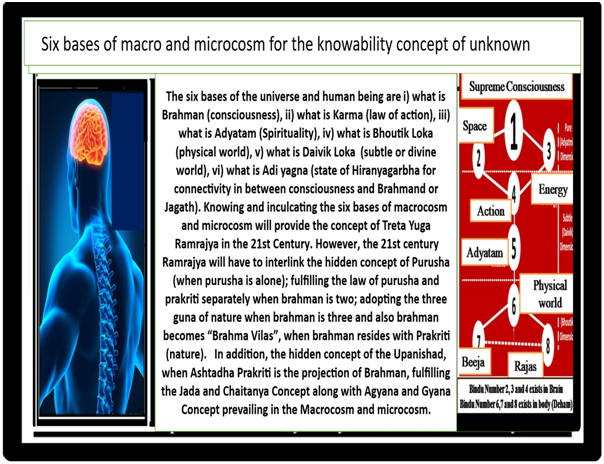
The policy makers and bureaucrats should understand the functional aspects of these bases so that they can make positive decisions for the welfare of the public. The positive decisions made by politicians and bureaucrats help to enhance their subconscious mind, where impossible aspects that seem impossible on the surface can be turned into possible action in three-dimensional form for the welfare of the public.
14.1 Possibility of achieving Ramrajya in the 21st Century
The question arises as to whether a conducive atmosphere is prevailing in India for reestablishing Ramrajya. Despite turmoil like the atmosphere of anti-social elements in the field of Crime, Violence, restlessness among Youth, unstable Socio-economic conditions, Malpractice in dealing, with erratic psychological conditions, etc., is any possibility existing of fulfilling the dream of Mahatma Gandhi for establishing Ramrajya?
On the surface, it looks impossible, but analysis indicates that if Yoga Psychology and Spirituality are followed, then corrective action in all the disturbances is possible due through which one can be confident to achieve Ramrajya.It is well supported by the call given by the United Nations to all countries to work on Global Goals (SDGs: 2015-2030) on one side and the acceptance, commitment, and efforts made by India on the other side which works as a base to achieve Growth and Development of People and Societies with Peace, Sustainability and Wellbeing of All and further to reestablish Ramrajya.
14.2 AIW (Ancient Indian Wisdom) in Respect of Civilization & Cultural Wisdom
The interplay of two polar forces (arrived by the AIW approach) is also applicable to Social Structure in terms of Civilization (North Pole) and Cultural Wisdom (South Pole). The Earth has two poles, namely i) the North Pole and ii) the South Pole. On a larger scale, the Universe, too, has two poles. Similarly, a large Society will have two poles, which can be named as i) the Economic dominating pole and ii) the Civilized dominating pole. The economically dominant pole will have two Fabrics of Society, namely, Economy and Education, prevailing in Society. Similarly, the Civilized dominating pole will consist of a conducive environment in the Society along with Cultural and Heritage aspects prevailing around it. They can be termed as the South and North Poles, respectively, in parallel with the two-pole concept in general.
Treta Yuga Ramrajya was based on a combination of North and South Pole frames based on the development of Lanka (kingdom of Ravana) and Kishkindha (kingdom of Sugriva). Lanka was well-prosperous in Economy and Education, whereas Kishkindha was equally prosperous in Environment and Culture. These two aspects were taken into consideration in Treta Yuga Ramrajya.
In 21st-century Ramrajya, a similar kind of polar system has to be kept in mind, so that a balanced and healthy Society can prevail in the country. Normally, heritage and cultural aspects prevailing in rural areas are getting neglected, which is reflected in weakening the walls of the overall growth of Society. Therefore, all four factors (Economy, Education, Environment, and Culture) are to be taken care of in a positive way. This emphasizes that the healthiness of Society depends on growth in Civilization consisting of Cultural Wisdom, Economy, and Education. The interplay of the two depends on their polar strength. Integration reveals that in an ideal situation, where both the poles (South and North Pole) get unified, the interface result (interplay of the two) will yield maximum value. The achievement of conducive and sustainable quality in any domain, namely i) Economic development, ii) good governance, iii) sound Social Structure, and iv) strong Individuality can be enriched with Moral, Ethical, and Virtuous values. Pandit Deen Dayal has visualized the same (Economic Development, Good Governance, Sound Social Structure, and Strong Individuality) for the sound health of Society in particular and the Country at large.
14.3 Why is integral humanism necessary?
The requirement of Integral Humanism is felt very important as people are unhappy even after implementing the present scenario of Economic development. The reasons for unhappiness are i) not fulfilling the Purushartha, ii) not uplifting the personality mainly from Need-based and Ambitious levels, iii) a large disparity among the basic structure of Society, and iv) a mismatch in the “Cause of Creation”. All happens because of an inharmoniously evolved body, mind, intellect, and soul. This has given rise to material possessiveness without considering the harmful effect on individuals, society, and the world as a whole.
People do all duties (Karmas) with the help of three limbs of the body. They are Head (Mansa), Heart (Vacha) & Hands (Karmna). The people can also erase Karma through these means. In our daily activity, action or behavior is reflected with the help of three H (Head, Heart & Hands). As things & events are interdependent & inseparable, 3H should be harmoniously balanced with the help of integration. When the cohesiveness of the Head, Heart, and Hands (either one, two, or all) is affected, every individual in the Society becomes weak in Individuality & Personality. The Fabrics of Society also get influenced.
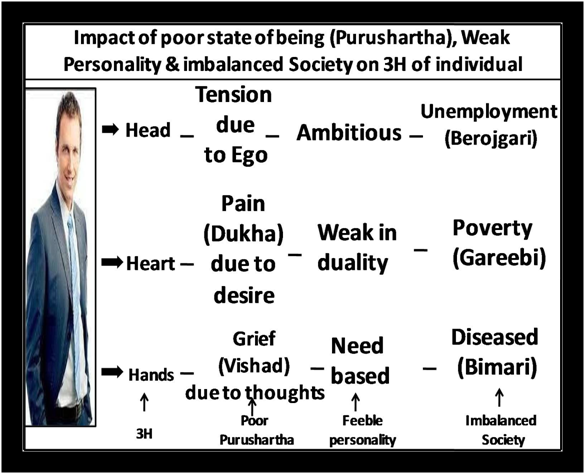
The image explains in brief how an individual gets affected at the Head (Mansa), Heart (Vacha), and Hands (Karmna) because of being poor in Purushartha, having a weak Personality, and an imbalanced Society. The vice–versa is also true.
That is why it is necessary to have Integral Humanism so that the Human Personality becomes stronger to hold firmly the interdependency of other segments. The image also explains inseparable aspects of individuality, society, and nation as a whole.
14.3.1 Economic Development with Special Reference to Integral Humanism
The 20th Century was the era of Scientific and Industrial Development. The developments have provided many fields for human beings to have an easy way of leading a life with comfort. For example, modern gadgets (the Internet, iPod, TV, and Computer) have made it easier to access information and communicate easily. However, they have many drawbacks (Banes) which have made an individual’s life self-centered and a nuclear family. This has resulted in a submissive nature, and people have become more materialistic, yielding unhappiness in life. The peace of mind is lost because of an unnatural lifestyle under the influence of industrial and scientific development.
As a result, internal conflict is visible in an Individual (the state of being a man), Human Personality, Social Structure (xyz among Environment, Economy, Education, and Culture), and also a mismatch in the political world as a whole. – 3 slides obtained. The idea expressed by Pandit Deen Dayal Upadhyay is quite natural and endorses the concepts available in AIW (Scriptures). AIW states that an Individual has four states of being: a man (Purushartha); four states of Personality (Vyaktitwa); four stable structures of Society in terms of Environment, Economy, Education, and Culture; related to Body, Mind (Emotion), Intellect, and Soul (Self). The Physical body and the quality are mysteriously related concerning Purushartha, Personality, and the healthy Structure of Society. Because of interdependency, the world has become like a nest (a small one), and a mismatch in Human Personality and Social Structure affects the overall scenario of Economic Development.
Pandit Deen Dayal Upadhyay has rightly pointed out that Integral Humanism consists of i) a state of being a Man (Purushartha) ii) the personality of a Human Being (Vyaktitwa), iii) basic Social Structure, and iv) Universal Law-related to the cause of Creation v) physical Human Body (Body, Mind, Intellect, and Soul) are integrally related and interdependent. The model given by Pandit Deen Dayal Ji is free from any conflict.
Integral Humanism related to the i) Individual (SWAN) ii) Inner Personality (Related to Purushartha) iii) Family & Society (3 EC), &iv) Creation (cause of Creation), all are parallel with Body, Mind, Intellect, and Soul. Reasons for unhappiness i) not fulfilling the Purushartha ii) not uplifting the Personality mainly from Need-based and Ambitious iii) a large disparity among the basic Structure of Society iv) mismatch in the cause of Creation; all happens because of unharmonious evolution of Body, Mind, Intellect, and Soul. This results in material possessiveness without discriminating against the harmful effect on individuals, society, and the world as a whole.
Three goals of achieving Economic Development – i) Political strength, ii) obstruction-free Democracy, and iii) conservation of Cultural values (cause, result, and symbol of National life); if only material resources are developed and values are neglected then it will be fruitless and disastrous; formulation of Economic Policy should be based on values given above. Dissatisfaction with present Economic structure – i) Socialism fails to establish the importance of Human Beings, ii) Socialist pattern (transferring of Capital to the hands of the State), no Personality Development because of diverse tests and ability, iii) Consumerism – boasts highest importance to the Individual but ironically destroyed all Individuality (Purushartha) iv) the Centralization and Monopolization of Production undermines the influence of consumer v) Capitalism and Consumerism have failed to take in to account the Integral Man (true Personality and Aspiration) vi) Integral Humanism could be explored as an alternate method.
14.4 Yoga Balances Proficiency and Efficiency
To obtain success in the overall growth of the country, the development of Proficiency & Efficiency (both) is required. For example, Japan has achieved adequate success in the World Economy because it has effectively channelized these two dimensions. India has also maximized its Proficiency but lags in achieving the highest Efficiency. Japan has a sound background in Zen (based on Indian Buddhism). Fortunately, India has the backup of the Veda, Upanishad, and other scriptures, together with Yoga, which can be taken as an effective tool.
The Upanishads explore the theme of Veda in understandable language; hence, the same (Upanishads) should be taken as a backbone for improving our Proficiency and Efficiency together. India is fortunate to have one hundred and eight Upanishads alive, which other countries are not so fortunate to possess. If practical aspects dealt with in the Upanishads are explored and utilized along with Modern Education, there will be exponential growth in Proficiency and Efficiency in Society.
There are a good number of Yogic Upanishads, which provide the direct application to improve individuals’ Proficiency and Efficiency, and the same can be explored. It is worthwhile to note that Patanjali Yog Sutra, along with “Narayan Upanishad”, “Hans Upanishad”, “Mandal Brahman Upanishad”, and certain Yogic Upanishads can be introduced in the regular curriculum of Modern Education. This is because these Upanishads open up the door for Modern Science and Spiritual ways of utilizing one’s Energy in any sphere of work.
Along with the modern techniques, if the Yogic approach is added, certainly this (Efficiency) dimension can be maximized in India too. That is why, Swami Vivekananda gave very effective and practical solutions (describing four types of Yoga) to tackle world problems of any kind including Salvation.
14.4.1 How Yogic approach strengthen the base of Holistic Economic Development?
Modern thinkers are trying to find solutions to the Banes of Scientific & Industrial Development to overcome the hindrances related to the quality of Human Life. The 21st Century is the era of Yogic culture. Though Yoga is a very ancient Science (revealed during the inception of the Universe), the same was not unearthed in between. In this century, Yoga is a solution for almost all Banes associated with the Boons of Scientific & Industrial Development.
Viewing the benefits of the Boons; they cannot be ignored. By adopting Ashtanga Yoga, the effect of the Bane could be minimized. In brief, modern Scientific and Technological Development could be more useful by adopting Yogic means for overcoming the Banes.
This is because Ashtanga Yoga, given by Maharishi Patanjali, provides a good linking mechanism between the creation of the World (Sansar), the thinking capability of the Individual (Jivatma), and the functioning aspects of Ishwara (Jagadish). Based on this concept of Patanjali, Modern Science has also evolved the “Particle Physics Model”; where Fermion (having four particles) is akin to the Creation of the World; Bosons could be connected with the functioning of Jivatma, and Higgs Bosons resemble the concept of Jagadish.
Spirituality, along with Maharishi Patanjali’s concept, can provide a better foundation for evolving a Holistic Model for 21st Century Ramrajya. This indicates that the Holistic Model needs an implementation process. The model has to pass through proper planning, organizing, leading & communicating the facts elaborated in different Upanishads and the Bhagavad Gita.
This is because, at each stage, there could be a chance for the model to get derailed. To curb it, Yoga is very effective. It changes the controlling center of Satvik (Transparent) nature from Sushumna Nadi to Ida path (right hemisphere of a Human Being), and Pingala path (left hemisphere of a Human Being). Normal people without Yogic practice will have a Tamsik (Turbid) nature in the right hemisphere. If Sushumna Nadi gets opened up by Yogic means, then Ida Nadi and Pingala Nadi will get balanced, and the same will retain the flow of Satvik (Transparent) nature through Sushumna Nadi.
In this way, Yoga helps to interchange our nature effectively by streamlining the human quality during the implementation process.
14.5 Search for a New Holistic Model
To have the welfare & development of all, the Economic model should be an ideal & holistic one. This could be arrived at by taking stock of the models against the background of dynamic Spirituality. Chinese and Japanese models have been dealt with while comparing the effectiveness of the models. India is fortunate to have witnessed the golden period of Ramrajya, where the civilization of Lanka and the cultural wisdom of Kishkindha were integrated. Ramrajya’s model got lost for many reasons. The same can’t be implemented in the Modern Age as there is deterioration in every segment of Society. The problems associated with its Rehabilitation have been visualized along with the Yogic concept & found effective. Ramrajya’s model, reinforced with the Yogic concept, can be the ideal Holistic Model as Yoga takes care of the problems associated with them (each segment of Personality and Society).
It is to be noted that the Yogic Science given by Maharishi Patanjali in four dimensions, namely Samadhi Padha, Sadhana Padha, Vibhuti Padha, and Kaivalya Padha, makes the spiritual concepts connected with “Energy, Space and Consciousness” in a complete form (Purnatha or in Totality). That is why the Holistic Model should be based on Ashtanga Yoga given by Maharishi Patanjali; especially, added factors like the “Power of Yogi” defined in Vibhuti Padha as Antarang Yoga.
14.5.1 The model resembles Treta Yuga Ramrajya
This provides a balanced society by maintaining good health along with awareness of proper lifestyle & also by developing all “pathies” (Allopathic, Homeopathy….), including Yogic concepts. It manages an even distribution of wealth to reduce the gap between the rich and the poor. It helps to frame policy related to job orientation to reduce the unemployment burden. It will be ideal to preserve the cultural heritage to minimize the educational drawbacks, which otherwise lead to the rat race for hoarding materials. The Holistic Model will be of great help to eliminate the disturbance from people’s minds.
The Civilized and Cultured Society should have the benchmark where i) the Environment is kept pure by protecting Ecology and minimizing the pollution discharge ii) Adequate Economic resources are generated to have the least gap in wealth distribution iii) Modern education along with Vedic and Yogic education could be strengthened and iv) Cultural and Traditional heritage is grown by scientific means.
Society deterioration happens because i) the spread of more diseases due to poor environment ii) family disturbance as a selfish nature has grown among the elders and young people iii) anti-social elements are springing up because of unemployment iv) poor mingling between youth and senior citizens, which has yielded more rooms for the generation gap.
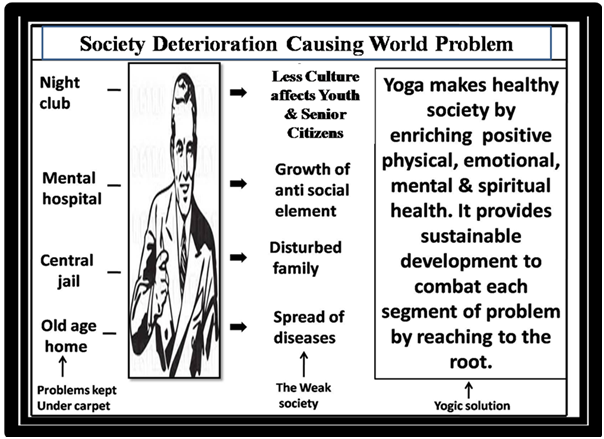
Many developed countries have organized in a clever way to hide the facts caused by the instability of the Social Structure. The sufferings of rich and poor countries seem to be persisting type. The Yogic way of lifestyle helps to combat each segment of problems, enabling individuals to manifest the true nature of the self. To achieve this, the new Holistic Model should be searched.
14.6 Why integrate the Ramrajya model with the Yogic approach?
Many models could be analyzed, but the best holistic approach would be adopted by integrating the Ramrajya model and the Yogic model together. The role of Yoga in Economic Development has been analyzed separately. Thespecial features of Yoga could be utilized to maintain the sustainability of the Holistic Model during its implementation.
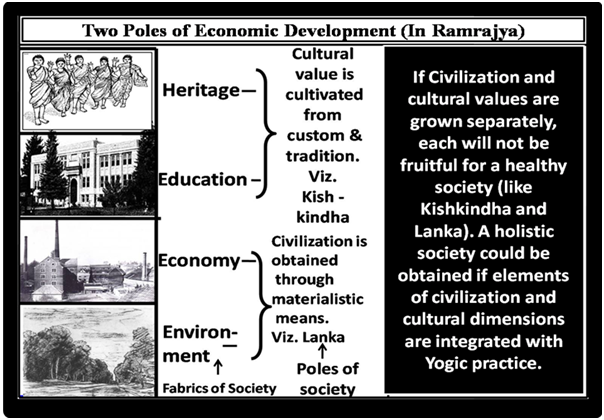
The fusion of two poles is essential for proper Economic Development. They are i) Civilization consisting of Environment and Economy and ii) Cultural Wisdom consisting of Education, Tradition & Cultural heritage. In addition, it should have a backup of scriptures like Philosophy, Upanishad, and Bhagavad-Gita. It should also have a Yogic concept, which could be explored so as to achieve the best possible resultwith quality, and sustainability.
The image describes how the Fabrics of Society become two polar forces of Nature, Civilization, and Cultural Wisdom. When they develop separately, no one will be useful to Society as they are interlinked and inseparable. For instance, Lanka was growing in the direction of Civilization without taking care of Cultural values. It has all the comforts & wealth, but they were poor in Tradition and Cultural heritage. Similarly was the case of Kishkindha. It was having the growth of Cultural Wisdom without nurturing the limbs of Civilization. In the Ramrajya period, the Civilization part of Lanka & the Cultural heritage part of Kishkindha were clubbed together to achieve the effectiveness of Economic Development in Ayodhya.
The above discussions indicate that the Upanishad and Veda will provide the correction or mismatch caused by Human error, because of which, the Global Warming and other forces of nature have been affected. Human Errors are due to the addition of High Carbon Discharge, a Larger amount of Nitrogen envelope (coverage), and an unbalanced amount of oxygen present in the universe. They can be minimized or eliminated with the help of the advancement of Technology obtained by Scientific means. But, the subtle domain and spiritual domain could be only managed with the help of the law of Nature or Primordial matter. The impact on the Stellar system and Interplanetary system could be reestablished if the physical mismatch is fully taken care of, so that a millennial universe could work in a valid, and balanced way.
15. 21ST CENTURY RAMRAJYA IS NEEDED FOR WORLD PEACE
This book titled 21st Century Ramrajya for World Peace, consisting of 15 Chapters, extends this very idea of a possible Ramrajya on the World Stage, where countries across the globe could put aside their differences of caste, color, creed, race, etc., viewing the world as one big family – “Vasu Dev Kutumbakam”, by giving up unreasonable conflict for one-upmanship and supremacy and bring parity and economic betterment all around.
15.0 What is the Call of the World?
The world needs “Sustainable Peace” in all areas, especially in the scenario of “Networking” & “Trafficking”. These (Networking & Trafficking) consist of Energy & Space. This means that the Energy & Space of individuals, society, country & the world are to be well-balanced to meet the smooth functioning of the entire Universe, including worldwide human transactions. How to achieve or inculcate the balancing mechanism between “Networking” & “Trafficking” in the Macrocosm (in Brahmand or Universe) & also in the Microcosm (in the Human Body)? The answer is to fuse Love & Justice (Action-oriented) with “Strong Determination (Dhairya Sankalpa)”. The same kind of approach was undertaken by Lord Rama’s Dharma principles, where he used “Unconditional Love & Justice” to achieve the same. This means that Unconditional Love and Justice are the two means to establish Dharma (Righteousness) among bad & good, cruel & peace-lovers, and anti-social & social elements. This principle will patch the discrepancy within Environment, Economy, Education & Heritage prevailing in different parts of the world.
The world needs to have a balance among the Environment, Economy, Education & Cultural (Heritage) aspects to have Sustainable Networking & Trafficking among People, Objects, Places & Situations. The World can achieve harmoniously balanced factors among them, provided each segment follows the Natural law of “Unconditional Love and Justice”. How to ensure that the call of the hour is implemented? The result could be perceived, analyzed, measured & sensed. The two limbs for setting right the Dharma could be inculcated among Individuals of the Society (at least 5-10 % of the population) using Introspection, Yoga, & Meditation.
These kinds of approaches have already been taken in the past. In Treta Yuga (Era), especially during Lord Rama’s rule, the Dharma and Justice concept was used completely to establish a unique kingdom which was known as “Ramrajya”. To achieve prosperity all around (all four segments of Society of the World) & also to achieve World Peace, the call of the hour is to have a model like “21st Century Ramrajya” as far as possible; which is being implemented in India.
15.1 What is the scenario existing in the present period?
The 20th Century was the era of Science, which invented Technology and provided the concept of Modernization. Unfortunately, Modernization and Western models of progress have categorized these knowledge systems into artificial categories of intelligence, leading to exploring the Boons of Science but certainly not the Banes of Science. This does not mean that the progress or achievement led by the Boons of Science should not be enjoyed by the common people. Only alertness should be inculcated to know the Banes of Science that erupted during the advancement of science. At the same time, the solution of “How to overcome the Banes” should also be thought over. Science does not provide how to come out of the Banes; but fortunately, Yoga is the means to conquer the effect of Banes without interrupting the enjoyment connected with the Boons of Science. Unfortunately, Yoga and Meditation have been ignored for a long time, and only introspection was carried out while analyzing the people, objects, places, and situations.
In earlier eras, introspection on retaining Dharma used to be practiced along with Meditation. However, the concept given by Lord Rama about the Sustainability of Dharma & Justice to establish Ramrajya was slowly forgotten. This clarifies that unless the basic principles on which Ramrajya was functioning are made alive, there won’t be a system like Ramrajya & there will not be World Peace at all. A similar kind of concept was given by Lord Buddha in his doctrine “Four Noble Paths” to achieve a complete solution to any situation, including World Peace. This reveals that all great personalities like Parashurama, Rama, Krishna, Shiva, and Lord Buddha have elaborated the fundamental aspects of the establishment of Pure Dharma & Justice to achieve World Prosperity and Peace.
In this connection, Lord Rama’s (The originator of Dharma & Justice establishment) action could be remembered, and his efforts to make the world in equilibrium with Dharma should be implemented by balancing Justice (Nyaya) and Forgiveness (Kshma). This (Lord Rama’s concept) can be taken as India’s asset for establishing and maintaining World Peace. Viewing the above analysis, it could be presumed that the present-day scenario is normally favorable to reviewing the status and implementation of Ramrajya in India, as well as in the world. This is because adequate favorable features of Ramrajya could be possible if certain attempts to improve the lagging scenario in Society are improved.
The Global Vision of working on ‘Sustainable Development Goals – SDGs (2015 – 2030) is supporting India as well as the World to work for ‘People and societies with better access, inclusion, quality, equity, peace, growth, development, and sustainability’
15.2 Present-day Status in India
There is no stress on exploring the possibility of Ramrajya by the leaders of India presently. This is because presently the country has become one of the most developed countries in the world, but has many discrepancies in Health, Economy, Education, and Culture. Unless adequate progress is achieved in these fields, there won’t be success in exploring the establishment of Ramrajya. However, the leaders of the country are trying to resolve the missing links prevailing in every walk of life. Few thinkers in India are trying to explore the possibility of Ramrajya on the eve of the 100th anniversary of Independent India. If this happens, this will be a great tribute to Mahatma Gandhi, who had this kind of vision for this Nation.
15.3 Pandit Deen Dayal Upadhyay’s views
The idea expressed by Pandit Deen Dayal Upadhyay is quite natural, and the same endorses the concepts available in AIW (Scriptures). He has visualized the lagging scenario in Personality, reduction in the state of Self (Purushartha), and disparity in different Zones of Social Structure. He thought it over and visualized a model called “Integral Humanism” to compensate for the lacuna created by the Banes of Science & Technology. The model also needs a fresh look at the background of Spirituality prevailing in the world. The new model would be able to fulfill the major requirements needed for the growth of Individuality, Personality, and sound Social Structure to obtain prosperity and peace in the country.
Pandit Deen Dayal Upadhyay has visualized the scenario and thought it over along with the views of Ancient Indian Wisdom & endorsed the four aspects of Human Personality; namely Body, Mind, Intellect, and Soul, and the esoteric relationship between an Individual, a Society, and the Universe. He described the importance of Integral Humanism for the welfare of Human Life.
15.3.1 Concept of Integral Humanism for World Peace
To come out from the drawback of the present day of Economic Development,Pandit Deen Dayal Upadhyay has rightly pointed out that Integral Humanism consisting i) a sound state of Being (Purushartha) ii) a strong Personality of a Human Being (Vyaktitwa) iii) basic Social Structure and iv) Universal Law related to the cause of Creation. They are related to different dimensions of Human Personality (Body, Mind, Intellect, and Soul). They are interdependent and inseparable. The model envisaged by him is free from any conflict. His proposed model is endorsed by the Yogic concept expressed in AIW.
15.3.2 Comparison of Views on Integral Humanism for World Peace
His model for Integral Humanism is truly applicable to the Holistic Model & the same will be useful for strengthening the Fabric of Society. The “Yin” and “Yang” diagram is originally a cut-view of Chitta (Brain) of a Yogi; who has cleaned the Mind-Stuff (Chitta Vritti Nirodha). Normal people will have hardly 2 to 3 % development of the brain and they will be ignorant.
The intellectuals, especially scientists (discoverers of scientific laws), will have around 10% of Brain Development. This means that eight petals of the normal Brain, where a large number of Vritti (Mind-Stuff) will exist originally. However, the researcher will be in a position to clean the imprints (Vritti) to the maximum extent possible to reach the zone of natural intuition. In the case of Yogi, the Brain (Chitta of the Yogi) will be very clean, where the maximum energy of the Yogi will flow into the Ida, Sushumna, and Pingla parts. In that condition, the cut view of the Brain will look like a “Yin” and “Yang” diagram. In the diagram, Ida has feminine characteristics and Pingla has male characteristics; whereas Sushumna has neutral characteristics.
Yoga states that the two polar forces, namely male & female in nature (“Yin” and “Yang” symbols of the Chinese Tao concept) can be taken to explain the cohesiveness of Physical (vital) force and Mental force represented by the “Pingla & Ida” path, respectively. The dynamic interplay of these two polar forces could be arrived at as a stable manifestation. The symbol originated from the Indian Yogic concept & later adopted by the Tao concept. The spirit behind the interplay of the Ida & Pingla paths of two forces (Masculine & Feminine) is simplified. The image clarifies & endorses the view of Pandit Deen Dayal along with the Yogic & AIW approach.
An effort has been made to compare the Vedic concept (Cause of Creation); Pandit Deen Dayal’s formulation and Raj Yoga’s concept, taking the interplay of the two. The model helps Ida & Pingla path to find the effectiveness of Cultural Wisdom & Civilization (the interplay of two polar forces). His model is also compared with the concepts available in Indian mythology. AIW concepts like the Ramrajya and Yogic approach have been analyzed along with Chinese and Japanese models to arrive at a holistic approach.
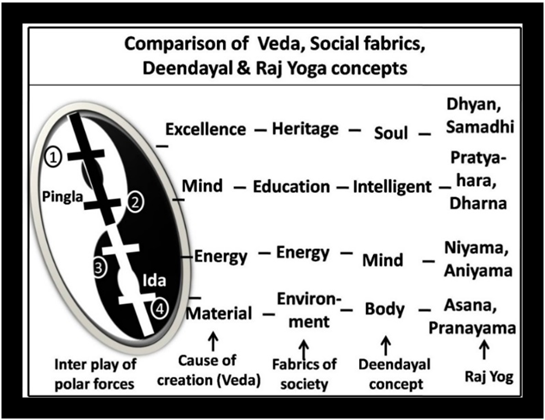
The four limbs connected with the Cause of Creation are compared with the four Fabrics of Society and found them interdependent. Likewise, Pandit Deen Dayal’s concept of Integral Humanism can also be compared with the Raja Yoga team for interdependency and inseparable aspects.
15.4 Basic Foundation of Ramrajya by Lord Rama
Lord Rama installed “Dharma (Righteousness) & Justice (Law of the Land)”, and it was practiced (fused) by individuals, society, and people in the country at large. The concept given by Lord Rama reinforced Nature (Prakriti) against getting imbalanced at three stages namely i) Nature need not get blocked at the Creation level ii) Have the freedom to nourish the growth of Creation as Mother and iii) To protect the Culture or Heritage earned by Humanity or by Nature (Prakriti) itself. These kinds of approaches were earlier followed by Lord Shiva to maintain harmony in Nature’s creation and also for the protection of women.
Lord Rama’s establishment of Dharma (Righteousness) & Justice (Law of the Land), made the people of that era follow pious action by being disciplined (Anushasanam), specializing in action (KarmshuKoushalam), and maintaining inner purity (Chitta Vritti Nirodha). In this way, there was a good ground for Ramrajya, which was installed by Lord Rama after his return from Lanka. The basic features of Ramrajya have been defined in many manuscripts.
Let us analyze how far the Dharma (Righteousness) & Justice (Law of the Land) principles of Dharma have been endorsed by Bhagwan Rama & Sri Hanuman. In this connection, it may be noted that Lord Rama established Dharma (Righteousness) & Justice (Law of the Land) to correct the missing links between Energy (Networking) & Space (Trafficking) that prevailed at that time. The missing link forced the Incarnation of Parmatma (was the need of the hour) to balance Networking (Energy) & Trafficking (Space) to achieve World Peace & Harmony. The same Dharma (Righteousness) & Justice (Law of the Land) principle was further led by Sri Hanumanji even after Treta Yuga.The Ramrajya was protected by Sri Hanumanji by using Love & Action (Energy). Sri Hanumanji has endorsed the principle of Dharma (Righteousness) & Justice (Law of the Land) principle of Lord Rama by following “Dhwaja” (Victory with Love & Forgiveness) &“Gada” (using forceful action wherever required) as two means. Till starting of the 21st Century, many Incarnations took place. In all the incarnations, the basic principle of correction (because of the mismatch between Energy & Space) was the same as laid by Lord Rama.
In brief, Lord Rama gave the strong foundation for Dharma for the World; which in turn was the basic feature for setting up Ramrajya. They are i) Action of Justice containing the persistence for the Law of Society with determination & forcefulness; minimizing disparity in Education, Economy and strengthening the Assets, and ii)Action of Love consisting of Tolerance, Acceptance, Appreciation, and Love. In addition, the sense of Forgiveness, Kindness, Pity, and Mercy should be part of the policymaker’s nature. Lord Rama fused the Action of Justice and the Action of Love to establish the Cosmic Dharma during his Incarnation which also paved the foundation for Ramrajya. Lord Rama (7th Incarnation) has established Ramrajya to attain the world peace in “Akhand Bharat”.
Ramrajya has been defined in every Ramayana, and the most prominent are Valmiki Ramayan, & Tulsi Krit Ramayan. According to the definition given in the Ramayana, Rama’s reign is known as the Ramarajya, which lasted for about 11,000 years or more. During this period, people were healthy, holy, satisfied, and lived with complete Peace and Harmony. There was no evil, no wars, no natural calamity, and no diseases. Shri Rama ruled the whole earth (the then-discovered land of the world) without using military force, as all kings submitted themselves to him. Shri Rama acquired a rare gem from Rishi Agasthya, which entombed the powers of the gods Indra, Varuna, Yama, and Kubera, which helped the king rule efficiently.
15.4.1 Modern Concept of Ramrajya
What is the need and object of establishing a Nation, Government, Rulers, Executives, and Armed Forces? In brief, the answer could be i) To govern the country, one needs to establish a strong Government, and ii) To safeguard the Government, the Government needs Armed Forces, and the Armed Forces need money. This means that everyone needs the money to perform the business, whether it be managerial, rulers, executives, or armed forces types of duties.
The image briefly describes the various needs of Ramrajya.
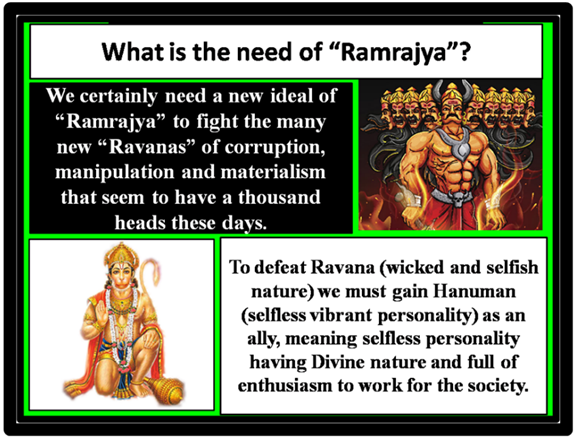
To achieve the concept of Ramrajya, we certainly need a holistic model of Ramrajya to fight against the many new factors (Ravana) of corruption, manipulation, and materialism that seem to have a thousand heads these days. To defeat Ravana (wicked and selfish nature) we must have a Hanuman (selfless vibrant personality) as an ally, meaning a selfless Personality having a Divine nature and full of enthusiasm to work for the Society.
15.4.2 Least disparity in Society encourages achieving the Ramrajya model
There should be complete development of all elements of Social Fabrics. The healthiness of all can be achieved in a balanced way by any other means, but the application of Raj Yoga seems to be the most effective and easy one. A balanced society in the Ramrajya model will have the least disparity in social components. The image indicates the functional aspects of the Fabrics of Society to have the least disparity in the social structure in brief.
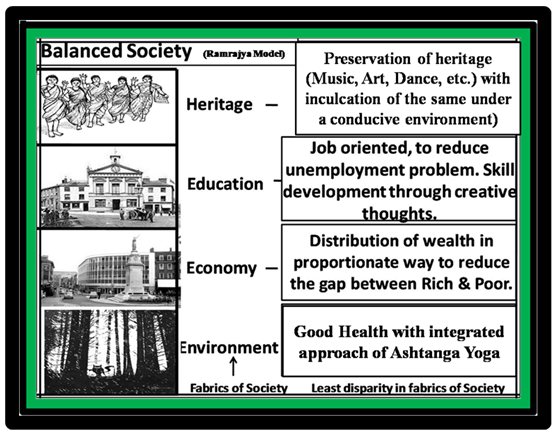
For example, to keep good health, the growth of awareness of Yogic practice has to be developed. Also, it should have a proper investigation approach in medical research to keep or maintain physical fitness. Likewise, there should be effective management to distribute the wealth proportionately to reduce the gap between the Rich & Poor with equity. This will eliminate the feeling among the members. For proper employment, Modern Education should be devised with Job-oriented skills. This will help to evolve inner skills and creative approaches to reduce the unemployment problem. Similarly, the Preservation of Cultural Heritage (Music, Arts, Dance, etc.) will be retained in the Society to achieve a creative entertainment atmosphere. In this way, the model or concept of Ramrajya could be achieved.
There are many approaches to achieving the concept of Ramrajya. Among them, the Yogic concepts along with the theme of Upanishads seem to be the most effective and ideal approach for achieving the principle and process of Ramrajya. This is because; the Yogic concept provides the overall development of an individual for providing selfless service (Nishkam Karma) in Society. The Yogic concept also develops the Physical, Mental, Intellectual, and Spiritual levels of an Individual.
15.4.3 The basic elements of Ramrajya
In the 21st century, the basic elements that can provide the sustainable form of Ramrajya are i) a Vibrant Individual and ii) a Vibrant Society. To eliminate Corruption, Materialism, and Manipulation (the root cause of Non-development or weakening the Society and Country); Honesty, Integrity, Transparency, and Accountability are to be followed by the people to achieve the best possible development in the Society. The analysis indicates how the Vibrant Individual and Vibrant Society can make a strong foundation of Ramrajya.
15.5 A healthy society fulfills the vision of the Vedic Mantra
The image explains how the Ramrajya model can achieve its goals by taking care of each element related to the Fabrics of Society. Further, the same could be tinkered with the help of Ashtanga Yoga to fulfill the highest vision of Veda. By achieving the Ramrajya model, the aim of Vedic mantras like “Serve Bhavantu Sukhinah….Maa Kaschid Dukh Bhav Bhavet” is fulfilled along with Prosperity & Peace with quality and sustainability. Ashtanga Yoga helps to achieve the aim of the Vedic Mantra. For example, Asanas and Pranayama help to maintain Good Health, fulfilling the Vedic mantra “Sarve Santu Niramaya”. Yama and Niyama (Do’s and Don’ts) uplift the Moral Values of an Individual by reducing the sense of Possessiveness. They, in turn, endorse the theme of “Sarve Bhavantu Sukhinah”. Likewise, Pratyahara and Dharana (Withdrawal and Concentration) of Mind help to have a Modern and Productive Education to satisfy the gist of the “Sarve Bhadrani Pashyantu” part of Veda.
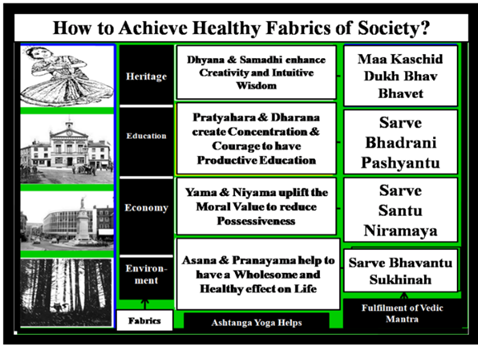
Similarly, Dhyana and Samadhi (Meditation and Bliss) of Ashtanga Yoga develop the Creativity and Intuitive aspects of the Mind by gratifying “Maa Kaschid Dukh Bhava Bhavet”.
15.6 Utility of Subconscious Mind by Yogic Approach
Ramrajya’s model depends on the healthiness of Social Fabrics like i) Environment, ii) Economy, iii) Education, and iv) Culture (Heritage) prevailing with sound & adequate means in Society. To sustain this, the Yogic concept will be quite appropriate to balance the Energy (Force or Prana) & Space (Subconscious Mind) of the people to perform the best possible action while framing & maintaining the Laws of Society in every segment. The role of Yoga in Environmental, Economic, Educational, and Cultural Development has been analyzed separately. The features of Yogic practice reveal that a Vibrant Personality & Balanced Society are the by-products of Yoga. This is because Yoga works on reprogramming of the Mind (Inner Space) & raising Force or Strength or Prana (Energy) at a higher level. These two (Energy & Space) are very essential & the same to be purified & raised to the extent possible by an Individual are needed to contribute to making a Vibrant Personality & Healthy Society. In this connection, the special features of Yoga could be utilized for balancing the Intelligence Quotient (IQ) & Emotional Quotient (EQ) to maintain the Sustainability of the Holistic Model during its implementation.We have understood that factors like Vibrant Individuals and a Vibrant Society are very important for Ramrajya. Among the two, the first one (Vibrant Individual) is the most important; who will be responsible for implementing the Rules and Regulations of Ramrajya. The Vibrant Individual will be in an administrative position to Reform, Perform, and transform the Laws of the Land for the benefit of the common people; if the Vibrant Individual is lagging in EQ and SQ, then the Vibrant Individual will not be able to perform the duty with fully developed Inner skills.
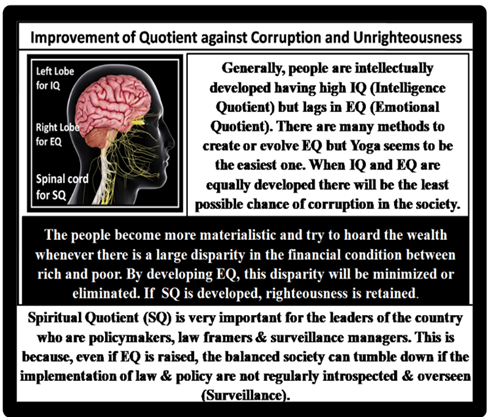
Generally, people are intellectually developed, having a high IQ (Intelligence Quotient), but lagging in EQ (Emotional Quotient). There are many methods to develop or evolve EQ, but Yoga seems to be the easiest one. When IQ and EQ are equally developed, there will be the least possible chance of corruption in society. This is because corruption exists wherever IQ is higher, but EQ is lower. Similarly, another factor that is dragging society is Materialism. People become more materialistic and try to hoard wealth whenever there is a large disparity in financial conditions between the rich and the poor. By developing EQ, this disparity will be minimized or eliminated.
Likewise, the problem of manipulation in the Environment, Economy, Education & Cultural levels (another factor of a poor Society) depends on factors like Caste, Language, Area, and Religion. These (Caste, Language, Area, and Religion) factors are the food for raising the Ego of an Individual. When EQ is developed, the factor like manipulation is minimized or eliminated. The analysis indicates that whenever these factors (Corruption, Materialism, and Manipulation) are minimized or eliminated, the favorable atmosphere for Ramrajya will prevail. By this means, we can conclude that the development of EQ of individuals is very important for the establishment of Ramrajya, and the same can be built up with the help of Yogic practices.
The special feature of Yogic practice is to develop a Spiritual Quotient (SQ), which is very important for the leaders of the country who are Policymakers, Law framers & Surveillance managers. This is because, even if EQ is raised, the balanced Society can tumble down if the implementation of Laws & Policies is not regularly introspected & watched carefully (surveillance). That is why the Yogic practice should be implemented as a guiding factor in the everyday life of elite & common people.
15.7 Lord Rama’s Contributions to the World
Lord Rama mainly contributed to establishing the Dharma (Righteous Action) and Justice (Law of the Land) among individuals, society in general, and the country or nation’s domain in particular. He has given a clear picture of Violence (Himsa) and nonviolence (Ahimsa). He has shown the balance between Desire (Kama) and Means or Power (Artha) while maintaining Dharma in Purushartha (asset) of the Individual. He has perceived and analyzed the concepts of “Forgiveness (Kshma)” and “Judgment (Nyaya)” to keep Society in equilibrium.
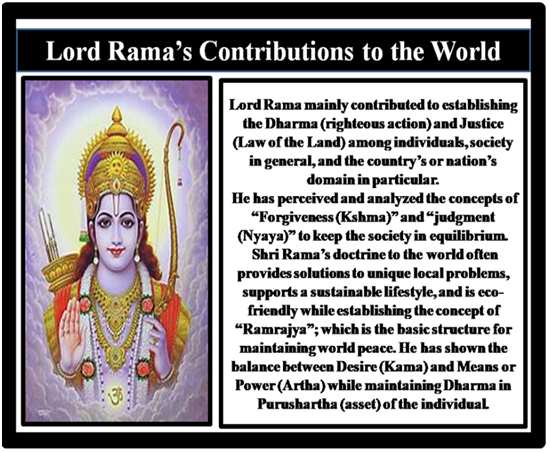
Shri Rama’s doctrine to the world often provides solutions to unique local problems, supports a sustainable lifestyle, and is eco-friendly while establishing the concept of “Ramrajya,” which is the basic structure for maintaining World Peace. Shri Rama, the seventh incarnation of Vishnu, laid the foundation of Ramrajya (when he became the king of Ayodhya).
15.8 Development of Science & Technology (both) endorses “the world is a nest”
Ancient thinkers had visions like i) the world is a “nest” (Vishvam Bhavatu Ek Nidam) and ii) the Earth is a “Family” (Vasu Dev Kutumbakam). Scientific and Industrial Development could make one of the visions true, and the World has become a Village in terms of Information and Communication. The lifestyle of the people has changed because of the comforts and availability of materials. Since Creation started, research has yielded two dimensions of the investigation. They are Boon and Bane. For instance, Ancient Indian Wisdom (AIW) reveals that when there was research on the sea (Samudra Manthan) by then researchers (Deva & Ashura), the Amrit (Boon) and Poison (Bane) came out. At that time, the researchers found the solution of Bane (Poison) as the same was consumed by Lord Siva. In the 20th Century, the associated Bane of each Boon was not thought over & hence, the effective solution was not obtained. This has shown many problems in the world.The 20th century was the era of the development of Science and Technology. Many Scientific theories and Technological developments have been witnessed during this Century. While inventing the Scientific Concept, scientists viewed certain aspects of the disadvantages associated with each development. However, they could not analyze how the problems can have an impact on Society and also on Individuals. The associated advantage of each discovery is taken as a Boon for Society; no doubt, as it provides more comfort and an easy way of leading life.
Development of Science & Technology endorses the AIW concept and fulfills the vision of “the world is a nest”. However, the Banes associated with the Boons of Science & Technology have affected the state of Self (Purushartha), the Personality of the people, and the Fabric of Society. In turn, Human Beings function as self–centered and they develop a possessive attitude, which reflects dishonesty, poor integration, minimum transparency, and least accountability in day-to-day transactions.
15.8.1 A vision like Earth is a family that could not be achieved
Another vision like “the Earth is a Family” could not be achieved even after the development of Science and Technology. This is because the Banes associated with the development are not taken care and the same has resulted in a self-centered attitude toward the behavioral pattern. The quality of life could not be augmented. As a result, failure, frustration, boredom, misery, and conflict are visible due to i) no sound state of Self (Purushartha), ii) poor Personality, iii) weak Fabrics of Society, and iv) losing Cultural Wisdom. As human beings started enjoying the Boons of Scientific and Technological Development, disadvantages associated with the benefits surfaced in day-to-day life. Some of the disadvantages (Banes) have been visualized.
To share the Banes connected with all Boons of Scientific Development, the intellectuals connected with different Societies concerned with Countries have to work together to make use of the Bane by reengineering the Bane product. This is possible when we have to have the Earth as one Family to share Peace and Sorrow combinedly. This kind of vision of Pandit Deen Dayal ji, is based on “Vasu Dev Kutumbakam”.
15.8.2 Present Indian Government’s Approach to Share “Earth as One Family”
It is important to remember that India has followed Vedic concepts like “Vasu Dev Kutumbakam” and “Sarve Bhavantu Sukinah…” since the Vedic era. This kind of Vedic concept yields the scenario, which fulfills the concept of “Earth is a Family. However, this concept was weakened due to many factors, including Invasion. Because of this, the backbone connected with Earth is one that got lost; whereas yogic science was a strengthening factor connected with Earth, is one family. After Freedom, Spirituality evolved in India due to a conducive atmosphere. In this connection, the Science of Yoga, which was completely forgotten earlier, was realized by Indian Intellectuals. Fortunately, the importance of Yoga evolved and the same was brought to people’s minds by “Manniya Shri Narendra Modi Ji”, the Prime Minister of India, through the United Nations Organization (UNO).
The science of Yoga brings the earlier concept of the Indian Vision of “Earth is One” to the limelight. For this, Manniya Shri Narendra Modi Ji has given a slogan like “Earth is One, Sun is One, and Power Grid of the World should be One” on the world platform, fulfilling the Vedic concept of India, which is the World is a Nest and also the Earth is one Family. In this context, Operation Dost (Operation Friend) was the search and rescue operation initiated by the Government of India (under the leadership of Manniya Shri Narendra Modi Ji) to aid Syria and Turkey, after the 2023 Turkey–Syrian earthquake devastation. This is an Eye-opener in concern with Vedic concepts that are followed in India. Another example is the distribution of the COVID-19 vaccine (developed in India) to Developing countries; that fulfills the kindness of India connected with the “World is a Nest, and Earth is One”. The present-day approach to streamline the Vedic concepts (like “Vasu Dev Kutumbakam and Sarve Bhavantu Sukinah”) fulfills the need to have sustainable 21st Century Ramrajya. This, in turn, will provide World Peace among the countries.
16. WHAT UPANISHADS SAY ABOUT WORLD PEACE?
Since World War I, there has always new kind of War, between two countries or a cold war type, because of no solid reasons. The leaders all over the world are doubting the idea that any kind, any time, some conflict might come to the surface, which could lead to a National War. This kind of uncertainty is because of unrighteous thinking in certain parts of the brain, which is understood by the Indian Rishis, and the same can be nullified if universality is dwelt upon, ignoring individuality. Many Upanishads provide the solutions on the same, and the attempts have been made to make use of the “Yog Tattva Upanishads” to eliminate the War.
16.0 Upanishad armors world peace and its importance
There are many Upanishads, which tell about the importance of World peace to be obtained by the lawmakers of individual countries. One among them is “Yog Tattva” Upanishad.This Upanishad reveals i) what way Jiva takes birth in different form ii) what is the process of leaving Jiva or Creation at the time of exit from one form to another iii) how a person while evolving can separate the mind from consciousness (Chetana) of senses (Indriyas) iv) Importance of Omkar meditation and its accessories v) How the Universe (Brahmand) or Jagat protects the Yogi while living and growing in the Jagat positively.
Among the 5 important revelations of the Upanishad, the fifth one is properly suitable for world peace. The lawmakers and implementers (Laws) of the same are also a kind of Yogi. This is because Yogi is trying to positively increase the functional aspects of Brain, so that the associates get quality fruits as a result of the Law maker and implementer of the same.
In a general way, Yogi can be defined who does the creative job in the field of environment, education, economy, cultural and social activity, and preservation work of heritage, including the concept of Vedas and Upanishads. For example, lawmakers, bureaucrats, modern scientists, educationalists, and economists, though they may not be fully grown, are on the path of enlightenment, and can be grouped as general Yogi. The knowledge obtained by these people contributes a lot to obtain new dimensions of the unknown from the Universe.
In this connection, let us recall the Yajur Veda verses, where the verses number 12, 13, and 14 of the 40th Chapter of the same define the knower of complete knowledge (Gyana). The Yajur Veda verses explore that those who have complete knowledge of spirituality are halfway through; unless he or she get scientific knowledge or biological knowledge along with the spiritual knowledge. The reverse is also true.
16.1 YogTattva Upanishad
The theme of the Yog Tattva Upanishad elaborates the importance of the world (Jagath or Brahmand), how the same protects the yogi or creator from the unknown to have a conducive atmosphere for research and development in the field of spirituality as well as in modern science. This Upanishad is a part of Atharva Veda and has only 15 slokas. This Upanishad (Yog Tattva Upanishad) is serial number 41 in the list of 108 available Upanishads. The Yog Tattva Upanishad brings out the theme for the welfare of modern yogis, which include scientists and spiritual masters, who are engaged in original research and contribution to the welfare of Human Beings. The theme of the Upanishad consists of the committed, dedicated, and enthusiastic time for every kind of Yogi who wishes to have only the aim to utilize the time for prosperity and healthiness of well-being without having any quarrel among themselves. The basis for the theme of Yog Tattva Upanishad includes three parts of the brain (Left Hemisphere, Right Hemisphere, and middle brain) & three parts of the main Nadis (Ida, Pingla, and Sushmna) in association with the inner instrument (Antahkarna) like mind, intellect, and ego or ahamkara.
16.2 Important Upanishads other than the Yog Tattva Upanishad
Sweta Saptar Upanishad, Amrit Bindu Upanishad, Hans Upanishad, Mandal Brahman Upanishad.Many Upanishads educate the sadhaka to make use of the three nadis, Ida, Pingla Sushumna. Along with the karma (action) theory connected with each lobe (brain). This is because the karma theory reveals the availability of energy and its function through these Nadis smoothly. Upanishads also reveal that the connectivity of loka, time, Devas, Veda, Omkara, Guna, and Agni Tattva is well interconnected and interdependent, along with the functioning of the three parts of the individual brain. Many yogic Upanishads like Amrit Bindu Upanishad, Dhyan Bindu Upanishad along with Hans Upanishad, Mandal Brahman Upanishad, and Sweta Saptar Upanishad explore the important connectivity of Chitta (combination of three lobes) along with nadis and unique dimensions (Loka, time, Devas, Veda, Omkara, Guna and Agni Tattva) explained in the Yog Tattva Upanishad.
Yog Tattva Upanishad reveals the linking mechanism of different dimensions of the universe exploring the importance of three dimensions to have the best possible scenario of the human system and also for the universe; where people will enjoy outer surrounding (Jagat) as the protective environment without feeling any boredom, anxiety, misery and fear of unseen happening. Other Upanishads, along with Yog Tattva Upanishad, provide the protective environment for the worldly Yogi to move ahead in their respective contribution without any complexity. However, the knowledge of Yog Tatv Upanishad needs comparison with other Upanishads.
16.3 What is the importance of Jagat (Brahmand or Universe) in “Yog Tattva” Upanishad?
In spirituality, the true meaning of Jagat is termed as “Mithya” (changeable after a certain period); whereas, consciousness (Brahman) is called “Sathya” (Eternal and everlasting). Though the world or Jagat is changeable, the same needs to be pleasant and full of enthusiasm; otherwise, life will be boring from one generation to another. This means that the life of the person for each country should be positive and dynamic, which in turn will sustain world peace with a fully committed and dedicated approach to following the principle of “Live and let live”. This kind of analysis clarifies that human beings want to live peacefully and pleasantly to fulfil the long-awaited bliss (Ananda), which is generally claimed in spirituality at the time of enlightenment or obtaining the “Brahmanhood”.The above analysis indicates that the importance of the Jagat is needed by growing Yogi (Scientist, bureaucrat …) to protect the long-awaited bliss while evolving positively.
This does not mean that other revelation of this Upanishad will not have any contribution for the world peace. This Upanishad reveals the theme (Secret) of the three terms connected with the specific and relevant Tatv.The three Tattvas of different subjects are connected with physically visible or seen, partially seen & partially unseen, and fully unseen or remain only in energy form.For instance, the materialistic world including sun, moon and stars are fully seen. But, Air and Planets are partially seen when they are measured with the help of instrument; however, remaining Tatv or subtlest items kept in the universe in energy form.
16.4 What worldly Yogi is aware of to sustain world peace?
The worldly Yogi includes the materialistic people, scientist and spiritual master; who are on the path of evolution and they need the world peace to contribute a lot to the general mass. Though, in the midst of war and peace different intellectuals and spiritual masters are contributing a lot but there is a fear in the minds of common mass and the mental peace is lost most of the time.
The Yog Tattva Upanishad stresses three important terms connected with three important parts of the Brain; which will provide the foundation to sustain world peace for long time.The connectivity of the three parts of the Brain reveals the continuum connection with the root and works as an anchor to keep the worldly Yogi in a righteous way to work. In this way, the true law of nature connected with creation is followed, and the unnatural way of creation is minimised or eliminated.
While answering the different queries in Yog Tattva Upanishad, directly provide the process given by Patanjali to obtain the “Chitta Vrithi Nirodha”. The Upanishad states that the three parts of the Brain are so deeply interconnected that a mismatch of one will create an undisciplined way of working by the other two parts.
In addition, three parts of the brain are very well connected with the three parts of the yogic terms, and they are i) Ida, ii) Pingla, and iii) Sushumna, or the Spinal cord of the body. This indicates that the worldly Yogi should be aware of the functional aspects of the other three parts of the brain or the three parts of the nadis functioning in the body to keep the brain on the right track.
16.4.1 Rebirth concept associated with ingredients in Chitta (three compartments of the brain)
The Yoga Sutra explains that the three compartments of Chitta also serve as storage for the “Karma Phala” or fruits
of actions at the end of the life cycle. According to the Yoga Sutra, Chitta, as a storage house, consists of three compartments in the brain, each of which has specific imprints of karma, associated Vasanas, and Karma Phala at the end of the life cycle. The storage in each compartment will yield the final result due to Karma Phala, which will provide the data as input for the next birth.
For example, the input data from the Adharma karma compartment will be the deciding factor for obtaining a particular species (jaati). Similarly, the input from the Dharma karma compartment will be the deciding factor for obtaining a particular family to enjoy the resources (associated with the bhoga domain). Likewise, the data from the Punya karma compartment will be the deciding factor for obtaining age (Prarabdha karma) in the upcoming species.
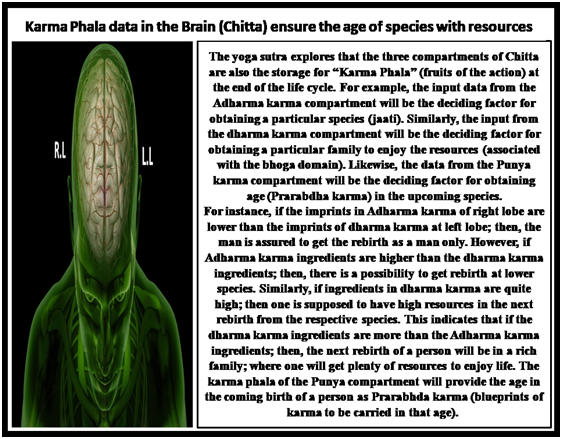
The yoga sutra indicates that the final imprints on three compartments can partially be used for future life as Prarabhda Karma (Action to be consumed in life span). However, leftover karma in three compartments will be kept as Sanchit karma (finally accumulated or added kinds of karma) for the next birth. In brief, Phala karma in three compartments will be taken as ingredients like age (Prarabdha karma) from the Punya compartment, jaati (species) from the Adharma karma compartment, and bhoga (enjoyment of resources) from the Dharma compartment connected with the family of the respective species for the next birth.
In the context of karma, if a person’s Adharma karma imprints are lower than their dharma karma imprints, they will be reborn as a human again. However, if the Adharma karma imprints are higher than the dharma karma imprints, there is a possibility of being reborn in a lower species. If a person’s dharma karma imprints are high, they will have more resources in their next rebirth than they did in their previous one. This means that if a person’s dharma karma imprints are more than their Adharma karma imprints, they will be reborn into a wealthy family where they will have plenty of resources to enjoy life. The Punya compartment of karma phala will determine the age and blueprints of karma to be carried in the next life.
The karma phala of each compartment will be the resource data for upcoming birth in terms of species (jaati) concerned with the right lobe; age in the species (Prarabdha karma) concerned with the mind or manas or Punya karma compartment and enjoyable resources (bhoga) concerned with left lobe compartment, which will be available in rebirth cycle.The rebirth concept, if understood by the politician, bureacrats, thinkers and original researcher of different fields; then, honesty, integrity, transparency and accountability will be established in the dimensions of public dealing and there will not be any social conflict; which exist for longer time to become the cause for quarrel or war.
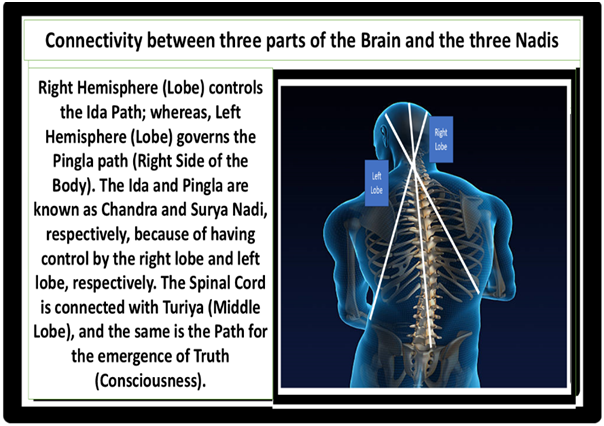
Maharshi Patanjali has given the process to clean the Chitta with a formulation of “Chitta Vrithi Nirodha”. The question arises, what is the methodology to completely clean the Chitta or human brain (3 lobes of the human brain)? In Ashtanga Yoga, there are three main nadis out of 72000nadis, which are to be understood for their function and utility. These nadis are connected with three parts of the brain (three lobes).For example, right lobe is connected with the Ida path and functions on the left side of the body. Similarly, the left lobe is connected with the Pingla path and functions on the right side of the body. Likewise, the middle lobe is connected with the spinal cord and functions as the energy flow in the central part of the body. This means that three lobes (parts of the Brain) are well connected with the Ida, Pingla, and sushumananadi of the yogic system. This indicates that three parts of the brain, or lobes, are managing the functioning aspects of the three Nadis to keep the whole body, including the brain, in a harmonious way of day-to-day living.Harmonious functions of Ida, Pingla, and Sushumna that depend on the purity of the lobes.
16.4.2 Connectivity between Ida, Pingla, and Sushumna, and the three parts of the brain
There are three parts of the brain, namely i) Left Lobe, ii) Right Lobe, iii) Middle Lobe (between left lobe and right lobe).These lobes form Chitta for the individual. The left lobe is responsible for Dharma karma (righteous work), the Right Lobe contains Adharma karma (Unrighteous work), and the middle lobe is responsible for Punya karma (a special action responsible for a span of life).
These Lobes are the result of making process called for the life after death (Jeevan–Maran).For example, the Adharma karma (Unrighteous action) will be a yardstick for the upcoming Species. This means that unrighteous action is more accumulated in the present birth; then, on righteous action will decide the species, either of men or animals, or even lower species. Similarly, the accumulation of righteous work in the left lobe will be decision-making for Boga (material to be enjoyed in the upcoming birth). Likewise, punya karma accumulated in the central lobe or middle lobe will decide the span of life to be enjoyed in the upcoming birth.
These kinds of action results are automatically stabilised or accumulated in the present-day Chitta (consciousness accumulating frame). To understand the concept of rebirth (life after death), let us recall the rebirth concept associated with the ingredients in Chitta (three compartments of the brain). In this connection, let us recall the Pure Chitta definition of Maharshi Patanjali, which is known as “Chitta Vritti Nirodha”. This means that all segments of the brain (Chitta) are kept free from any Vritti (imprints); then the brain will exhibit the condition free from the rebirth concept.
16.4.3 How do three parts of the brain reveal eight dimensions of the universe?
The three parts of the brain, consisting Right lobe, the left lobe, middle lobe, control the three main Nadis of the human body. Similar is an arrangement in the universe. This can be further explored with the help of investigating the connectivity of the Sun with the Earth, the connectivity of the Moon up to the controlling center of the Moon with the Earth and a straight connectivity of effulgent light (Param Prakash) to the Jiva (animates and in animates creation in the universe). This kind of connectivity between Earth, the sun, the moon, and the star of Hiranyagarbha (zone of nebula and supernova) represents Pingla, Ida, and Sushumna, part of the human system. When they are interconnected, naturally, eight dimensions of nature (Ashtadha prakriti), where Jada (full of inertia) and Chetana (dynamic) are also interlinked. That is why the special features indicated in Yog Tattva Upanishad will fulfil the slogan of “Chitta Vrithi Nirodha” given by Maharshi Patanjali to the extent possible. This kind of arrangement in three lobes of the brain will naturally provide the environment of electromagnetic force (Udana Prana) & respiratory force (Samana Prana) along with gravitational force (Apana Prana), which are very conducive for human civilisation to enjoy life without any mental disturbance and agony.
The above analysis indicates that if the spinal cord is cleaned and energized, then the major part of these forces will have a smooth flow in the spine part of the human being and also in the universe. This kind of environment keeps the living in a very pleasant and enjoyable type of environment without much. This indicates that to have a war-free environment in the complete world (Jagat), let us adopt the spinal cord functioning environment of the human body as well as the universe. Yog Tattva Upanishad provides the methodology and clarification in this regard.
16.5 How can the creative people maintain world peace using the Yog Tattva Upanishad?
Yog Tattva Upanishad emphasises that how the connectivity of Loka (three major layers of the universe), Time (Past, Present, Future), Devas (three main Devas like Brahma, Vishnu, Mahesh having corresponding terms as electron, neutron, proton of science ), Veda (systematic knowledge of three Vedas) to develop knowability from the unknown, Omkara (the six labels of the Om for understanding the base of the universe), Guna (three quality like Sattva, Rajas and Thamas), and Agni Tattva (like Adi Agni, Anadi agni and Vaishvanar agni) are linked with three parts of the brain and also three parts of the nadis.How these dimensions become creative while getting linked with three parts of the brain and nadis; this does not mean having full knowledge of Yoga, but to have understanding the theme behind their connectivity.
Creative people in the field of economy, politics (law makers and law implementation of the same), science (biological, psychological, and physiological science), judiciary, trading and management people are prone to get “psycho somatic” disease. This disease is interlinked with the physical and mental aspects of the human system. This disease is a creative of “Adhi” (the root of chronic disease) and “Vyadhi” (the presence of physiological disease). The reference of Adhi and Vyadhi is given in “Yog Vashista Upanishad”. In-depth, “Yog Vashisht Upanishad interlinks Psychosomatic disease with three nadis along with three parts of the brain (lobes)“.The complexity in living pattern happen whenever there is a mismatch in any nine dimensions of microcosm (human body and brain) and macrocosm (universe or Jagat).
In Psychosomatic disease, our inner instruments (Antah Karana), namely, mind, intellect, and Ahankar, are functioning. This (Antah Karana) works as interference in three parts of the brain and three nadis. In this way, three inner instruments along with three nadis and three parts of the brain become nine dimensions, which are to be taken care of for the rhythmic function of the microcosm and macrocosm.
In a nutshell, these nine dimensions function as controllers, also known as particles in science and Devas in the Veda and Upanishad.That is why the nine Devas of Veda and Upanishad are responsible for the stable function of the microcosm and macrocosm.For example, nature’s work on symmetry, based on the same, the particles physics model provides four number of Fermion and five numbers of boson, altogether nine numbers, resembling with nine Devas of Veda and Upanishad.
If the original researchers and contributors of society, including politicians and bureaucrats understand the principle functions of the nine Devas (particles) of the Universe, then they will not have any conflict among themselves and there will not be any quarrel over any petty problems.This does not mean that there will not be any war at any time, but it provides the clarity that the war will be eliminated till the nine Tattva (Devas) of the universe are well maintained.
In the end, the reestablishment of Ramrajya in word and spirit is the better option to work for the Growth and Development of All (Society, Nation and World) with systems, values, quality, equity, access, inclusion, peace, and sustainability and collective efforts of all will make it into reality so that the present-day crises in the areas of Health, Water, Sanitation, Education, Economy, and Environment can be minimized or eliminated as an opportunity cum solution with quality and sustainability.
Bibliography
Referred From Books
I) Four Boons of Hanuman Chalisa Enhance Skills Of Professionals by Prof. A. N. Pandey, published by Manojvm Publishing House, India -2023
II) Innovative Venture Between Science & Spirituality to Get Ionized Plasma as Alternative Source to Combat COVID-19 by Prof. A. N. Pandey, published by Manojvm Publishing House, India – May 2024
III) Yoga Chudamani Upanishad (Crown Jewel of Yoga) by Swami Satyadharma, published by Bihar School of Soga, Munger, Bihar, India – 2003
IV) Pranayam Kala and Science, by Dr. H. R. Nagendra, Swami Vivekananda Yoga Prakashan, Bengaluru, India – 2006
V) SrimadBhagwad Gita (Tattvavivecani) by Jai Dayal Goyendka, Gita Press, Gorakhpur, India
VI) Science or Veda by Guru Dutt, Hindi Sahitya Sadan, New Delhi.
VII) ENERGY and SPACE (Within/ Outside and Beyond) by Swami Maheshananda and Dr Stuart Rose, Mimansa Press Kaivalya Dhama, Lonavala, India – 2010
Referred From Net
I) From simple Wikipedia- https://simple.wikipedia.org/wiki/501.V2_variant
II) Dukha-Vigyan-1 (Yogdarshan Vyakhyanmala-3) by Acharya (Dr.) MaheshanandaVidyalankar – https://www.youtube.com/watch?v=cptAqSfwX24, dated Oct 29, 2023
III) A Talk on “Proposal of use of Ionised Plasma as Vaccine for COVID-19”- https://www.youtube.com/watch?v=Z3JIxAQLRO4&t=1679s dated November 11, 2021
IV) Youtube Channel Name: Swayam Sharma (https://www.youtube.com/@svayamsharma) – for quoted Upanishads in the book